Another election season is upon us here in the US, and as it is not a presidential election year, statistically, we can expect a lower voter turnout. [1] But, as usual, I will be using my internet soapbox to stress the importance of voting in every election… even when you’re not thrilled with the options, even as someone who is currently struggling to select a candidate I can stomach for the top job in PA. Remember, as I pointed out in May, write-ins are an acceptable alternative to casting a vote that makes you cringe, and it sends a stronger message than abstaining altogether. [2] (I may be doing just that again…)
Federal
The consequences vary at the various levels of government. Most eyes are on the balance of congress and what will happen at the federal level in response to the White House / Senate / House trifecta currently held by the republican party. If history is any indication (to say nothing of polling numbers) there is a good chance that democrats will retake the House of Representatives, with a harder fight to retake the Senate. [3] I’m not sure if I’ve just never noticed before, but I feel like this is the first election where I’m seeing more cohesive messaging about what parties will offer America versus the pros and cons of individual politicians.
And to that end, democrats have laid out a clear policy agenda for what could happen if they do regain control of Congress, with affordability issues front and center. They have already assembled working groups for tackling housing, healthcare, childcare, groceries, gas, and utilities; have members of the House Oversight and Judiciary committees “preparing to root out corruption;” and putting specific legislative efforts on deck, including repealing recent Medicare cuts, restoring the Affordable Care Act, repealing Trump-era tariffs, and ending the Iran war. [4]

Image credit: [5]
Meanwhile, it has been a little more difficult to suss out specifics of republican policy priorities, with a Washington Post article from earlier this year stating that the GOP had “yet to coalesce around specifics of a legislative package,” citing an expectation of losing seats in congress during the midterms, as tends to happen to the president’s party. [6] Though, speculators believe that continued republican control of congress would mean extending or expanding tax cuts; completing the US-Mexico border wall, increasing deportations, and tightening visa rules; putting tougher demands on US allies through the “America First” approach; and continuing to roll back regulatory constraints on the oil and gas industry (though we’re rapidly running out of regulations to remove.) [7]
State
At the state level, Pennsylvania’s gubernatorial race is barely worth watching, with Josh Shapiro’s chances of victory holding in the 97% range. [8] What is much more consequential for the state is the balance of power in the General Assembly, where democrats hold a three-seat majority in the House, and republicans hold a four-seat majority in the Senate. Predictions indicate a good chance of the democrats keeping the House, with a tougher job of taking back the Senate, but if they’re successful there, Pennsylvania would be looking at its first democratic trifecta in state government since 1993.
Should that happen, legislative priorities for the democrats are clear, including election reform (maintaining no-excuse mail-in voting, requiring county ballot drop boxes, and allowing independents to vote in open primary elections); marijuana (legalization is likely, though it’s unclear what the system of sale and expungements of past convictions will look like); same-sex marriage (enshrining explicit rights either through changing the state’s statutory definition to “two individuals” or by amending the constitution); data centers and AI (requiring warnings on advertisements made using AI and implementing Shapiro’s “GRID” plan); and affordability (property tax and rent rebates, housing protections, increasing income tax credits, increasing food and energy security funding, and raising minimum wage).
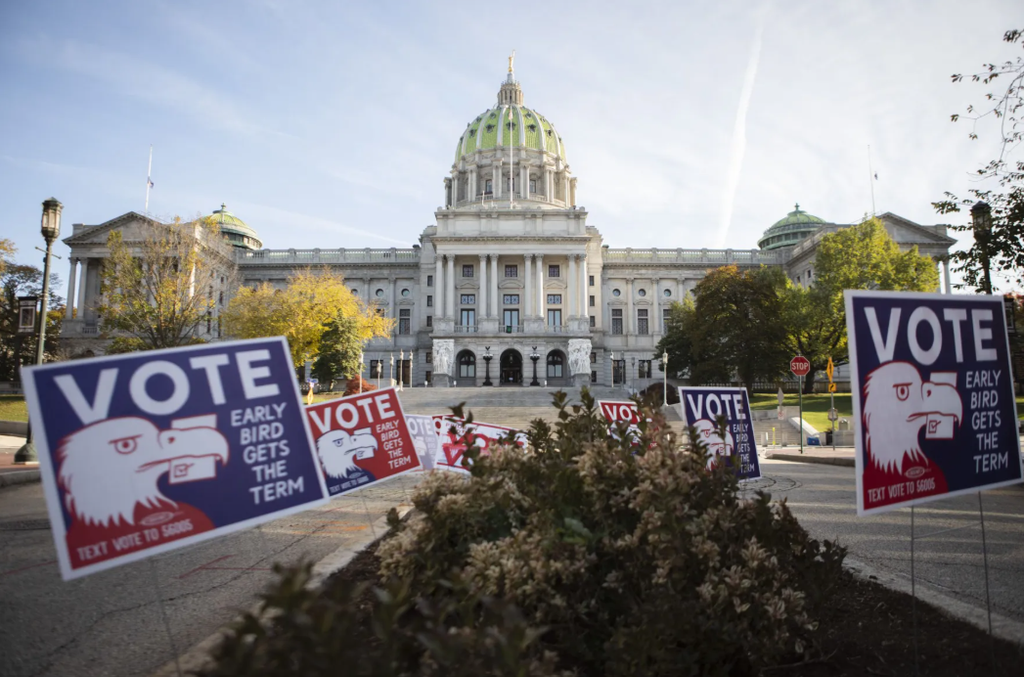
Image credit: [9]
Meanwhile, legislative priorities for republicans cover many of the same topics but with different approaches: election reform (repealing no-excuse absentee balloting, banning drop boxes, securing stronger voter ID requirements); data centers and AI (banning “nudification” apps, bans on nondisclosure agreements with data center developers (which has bipartisan support), fast-tracking data center permits and creating a regulatory framework for collaboration with the industry); energy (supporting an “all of the above” energy strategy, which will effectively expand fossil fuel development); and affordability (lowering taxes, including personal income tax, energy and telecommunications taxes, and state gas tax; changes to zoning and construction rules to enable faster housing construction). [10]
County
Finally, for those of us in Allegheny County, an amendment to our Home Rule Charter is on the ballot. Our Home Rule Charter shifts certain powers from the state to our county and lets us manage our own affairs in those areas. One of the things that our Home Rule Charter currently says is that members of County Council (which is a part-time elected position that comes with a stipend of $11,000 per year, not a salary or benefits). The ballot question asks if the Home Rule Charter should be amended to remove the restriction on benefits, district offices, and staff. A “yes” vote will not allocate funding for these things; it will simply remove the restriction preventing County Council members to have them.
Proponents of this change say that the lack of funding and benefits prove a barrier to entry for those who might like to serve on County Council, and that with better support, the council could more effectively serve in its role to provide checks and balances in County government. Interestingly, County Council is divided on this amendment, nearly half of its members saying that additional funding is unnecessary to support part-time positions and would be a waste of taxpayer money. A Government Review Commission is currently reviewing the provision and plans to make a recommendation in November; Council President Michelle Naccarati-Chapkis feels that it would be prudent to wait for the recommendation before making changes. [11]
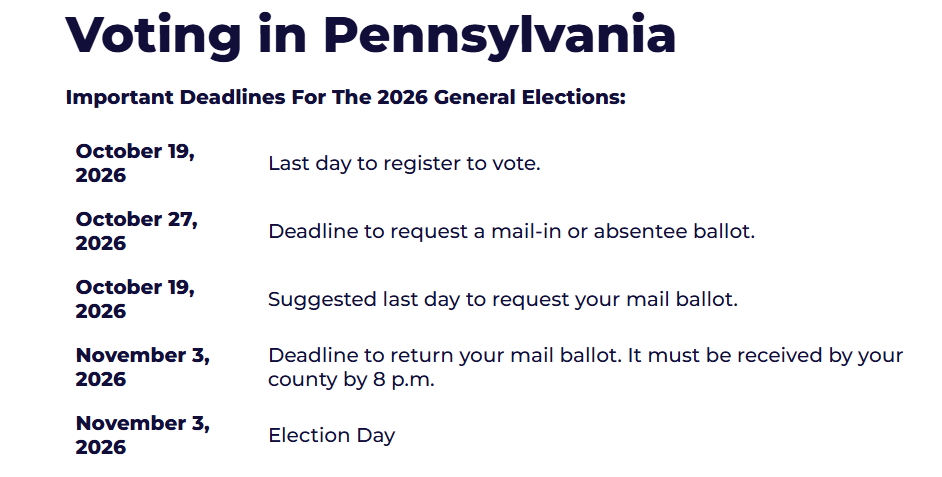
Image credit: [12]
Finally, in case it helps with decisions at any level of this election, I am including my own research spreadsheet, which will be more relevant the closer you live to Allegheny County:
If you can vote in the upcoming election, I hope you do your research, consider your options thoughtfully, and make your voice heard.
Thank you for reading!
[1] https://www.electproject.org/national-1789-present
[2] https://radicalmoderate.online/may-2026-pennsylvania-primary-elections/
[5] https://news.rice.edu/news/2026/what-gets-people-polls-rice-study-offers-new-insight
[8] https://www.politicspa.com/elections/races/pennsylvania-governor
0 Comments