About 600 miles west of Ecuador’s Pacific coast lie the Galápagos Islands. The Province of Galápagos, officially established as such in 1973, is made up of almost 130 islands, islets, and rocks, spread out through more than 50,000 square miles of ocean. Sitting right on the Equator and just an hour from the mainland by plane, Galápagos has become a prime destination for tourists who want to see virtually untouched nature on islands that for centuries were considered too inhospitable and impractical for human settlements. It was (understandably) the one region of Ecuador I hadn’t seen while I was there in college for anthropology, so it was at the top of my list for our trip this past spring.
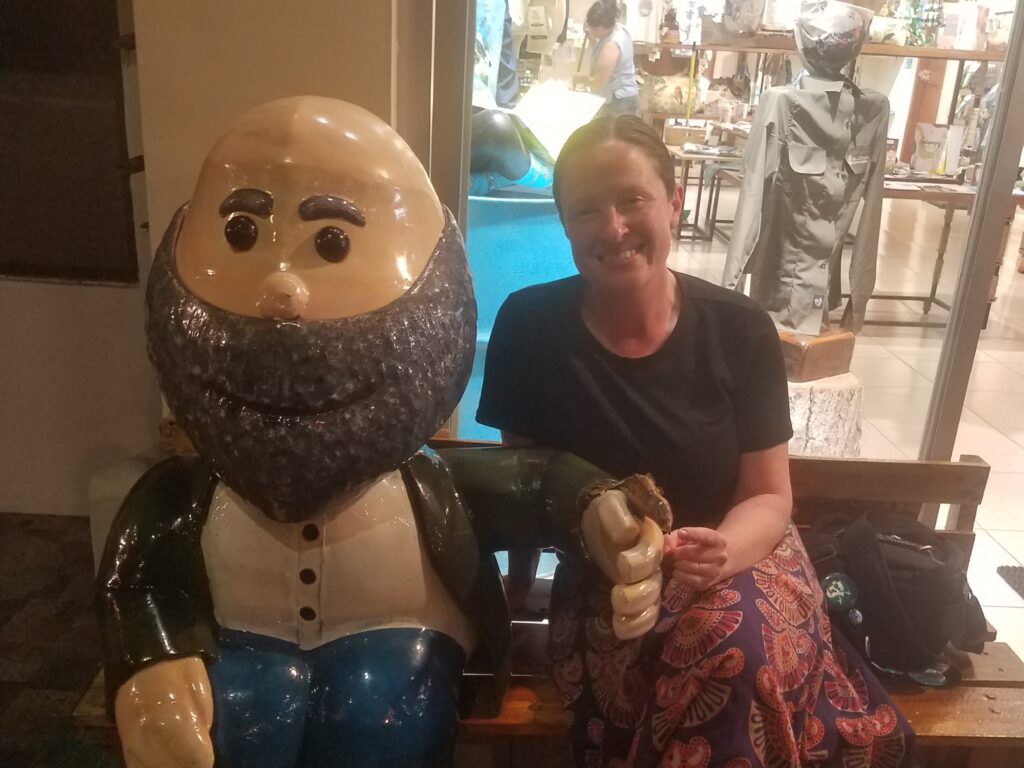
This trip to Galápagos was a fundamentally different type of travel for me in that I organized it through a tour guide. I’ve often talked about my desire for authentic travel experiences, rather than being herded through a curated to-do list in a gaggle of tourists, and I’ve come to recognize that there is no clear dividing line between touristy and non-touristy, between inauthentic and authentic – that it’s all more of a spectrum, [1] and the options on that spectrum absolutely shift based on the context of the location. In the run-up to our trip to Ecuador, I had very little time to research or plan our activities, but I also learned that some of the things we wanted to do weren’t even possible to do on our own.
Protecting Nature
Ninety-seven percent of the land in Galápagos was established as a national park in 1959, [2] commemorating the 100th anniversary of Darwin’s On the Origin of Species. [3] Darwin’s five-week trip on the HMS Beagle in 1835 resulted in some of the most profound contributions to the theory of evolution by natural selection. Because of the different habitat conditions on different islands – and virtual isolation on each of those islands – finches, tortoises, and other species developed different characteristics over time that helped them more effectively survive in each distinct habitat. [4] Because of Galápagos’ setting for Darwin’s discoveries, it has become hallowed ground for biologists, and his likeness is ubiquitous in settled areas.
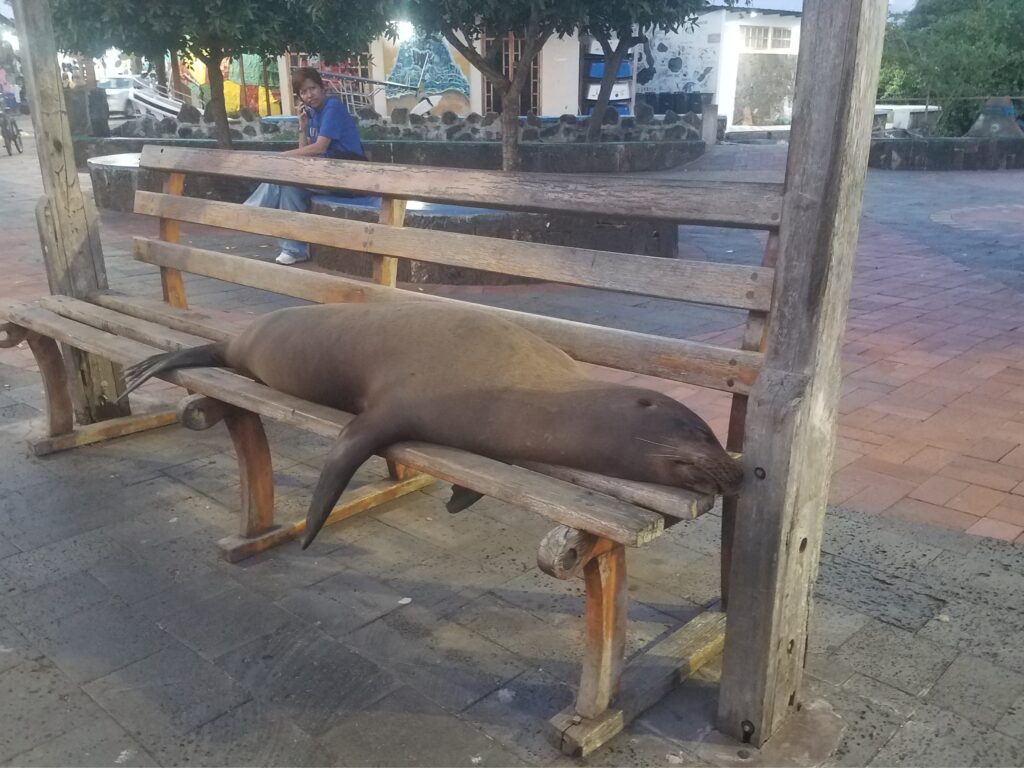
The 3% of the land zoned for human settlements, spread across the four populated islands, is where you will find the airports, ferry ports, hotels, restaurants, microbreweries, souvenir shops, tourism offices, apparel shops, and more. For that reason, anywhere where tourists can congregate will feel exceptionally touristy. Charles Darwin Avenue, the main drag through Puerto Ayora on Santa Cruz Island, just blocks from our hotel, felt like any other touristy beach town I’ve ever been to in my life. That was exactly the type of experience we were hoping to avoid, but we recognized it was also very much a consequence of having so much protected wild beauty elsewhere.
For certain parks in Ecuador, Galápagos among them, visitors must be accompanied by a licensed guide, and from what I could tell, all licensed guides had to be booked through a licensed tour operator. With the exception of going to the Charles Darwin Research Station to see the breeding and rearing of baby tortoises, [5] all of the activities we wanted to do involved observing wildlife in their native habitats, so we simply couldn’t travel as independently as we’re used to. Because we arranged our trip through a tour guide, we were locked into an itinerary from start to finish, with our local guide Ramiro meeting us at the airport as soon as we paid our $200/person national park entrance fee and went through our second biological security check of the day.
(Eco)tourism
The hefty entry fee, mandatory guide, and strict protocols to prevent tourists from introducing new species to the islands all made me very happy. I’ve been to places where unchecked tourism contributes to significant damage – notably Venice, [6] which sees roughly 30-40 tourists for each resident and only recently instituted a nominal tourist fee for day-trippers visiting high-traffic locations during peak travel months. [7] I’ve also been to places where – infuriatingly, embarrassingly – unsupervised adults who should know better actively vandalize natural treasures for fun, such as the destruction that happened in Joshua Tree National Park, while park rangers were furloughed in early 2019. [8] Oblivious and even well-intentioned travelers can cause damage when ignorant of their impacts, which is why I was more than willing to recognize my own ignorance and follow the lead of a licensed professional.
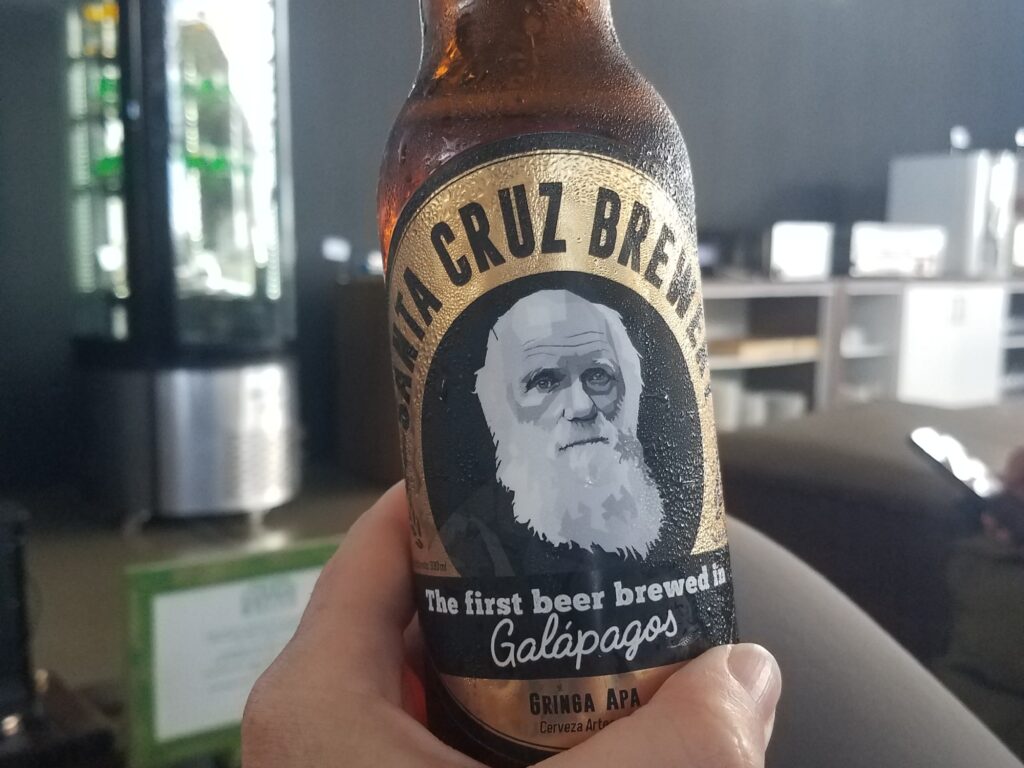
The potential impacts of ignorant tourists in fragile ecosystems is amplified by the volume of them, and Galápagos had about 268,000 visitors in 2022. Their population of 28,500 puts the tourist-to-resident ratio at a fraction of Venice’s, but it’s still significant. The population of the islands is growing three times faster than than the population on the mainland, [9] in part because of the growing opportunities afforded by tourism, which made up about 80% of the province’s economy before the pandemic. Tourism is the largest employer on the islands, either directly (tours and hotels) or indirectly (selling products to tourists), with the country as a whole dependent upon the tourism dollars generated there. [10]
As with last week’s post on the Cloud Forest, [11] there are factors that need to be considered in any growing industry to ensure responsible, equitable development. Evidence has shown that tourism is having a positive economic impact among lower income groups on the islands, which is good news. But, as tourism opportunities grow, they’re also seeing more interest from hotel chains and off-island tourism companies. It is as true in Galápagos as anywhere that the introduction of large, non-local companies will limit how much tourist revenue remains in the local economy. [12] And I’d venture a guess that the impacts of extractive transactions represent more of a risk in more isolated locations. (Nonetheless, I am happy to say that the hotel where we stayed was locally owned and independent.)
Logistics in Remote Places
One of the biggest challenges of tourism in a remote paradise is the support structure required to meet the needs of the people there, which is often made up of components that might not be considered until they’re absent. After a hot plane ride, hot bus ride, hot ferry ride, hot car ride, hike through the humid Santa Cruz highlands, hot car ride, tour of outdoor tortoise rearing pens in the afternoon heat, and subsequent walk to our hotel in Puerto Ayora, Christian was elated to finally sit down in front of an air conditioner… for about five minutes, until the power went out… which is much funnier in retrospect than it was in-situ.
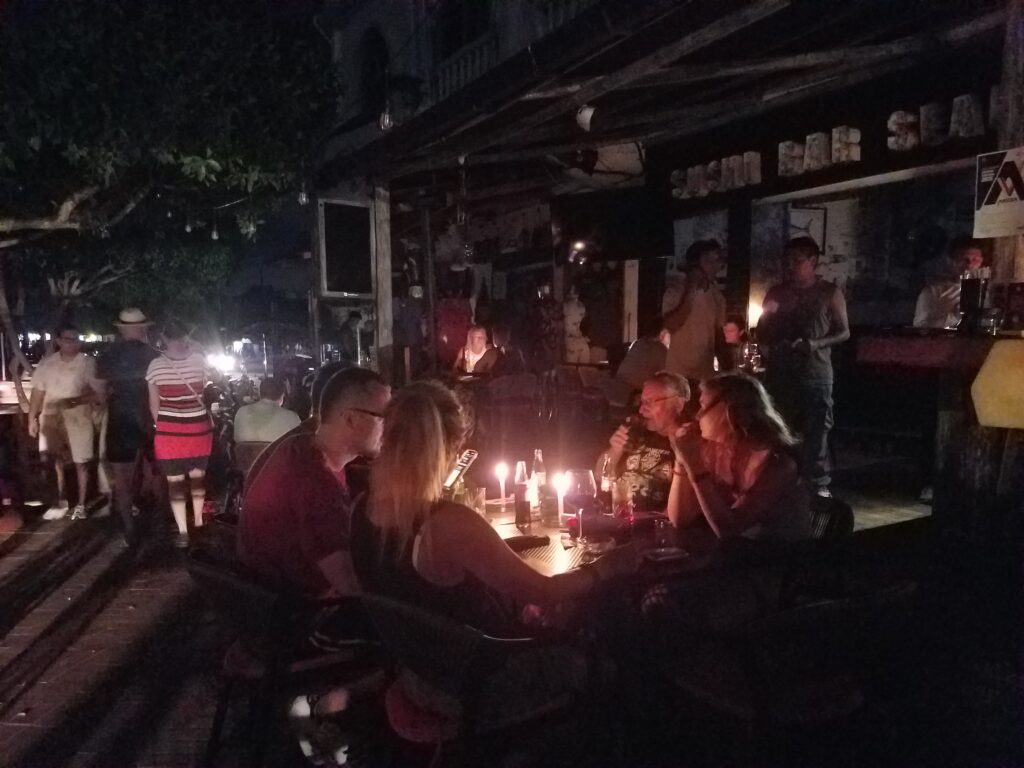
Having lived on an island (albeit, one about 400 times the size of Santa Cruz), I understand the limited availability of products and resources that many Americans may take for granted, as well as the limited availability of space for what remains of those products post-use. Space and resource constraints, as well as distance from the mainland, pose additional challenges for a growing tourism industry. The first restriction we had to consider, as we walked through dark streets to an open restaurant, where diners ate by candlelight (and the cooks worked, presumably, with flashlights and propane tanks), was energy.
The human settlements in Galápagos are powered with microgrids run on a combination of diesel generators and renewables (namely wind and solar). These grids are not particularly unreliable, but the locals did not seem fazed by a several-hour outage. The islands are trying to increase their reliance on renewables (noting the particularly dirty nature of diesel generators), with several proposed paths to achieve 100% renewable energy by 2050. [13] One notable stressor on the local grid is water desalination, which is notoriously energy intensive. The limited sources of fresh water in the islands is one of the reasons that they weren’t heavily populated for centuries after their discovery in 1535.
While the locally desalinated water is sufficient for washing, we were encouraged not to drink it. Our hotel had a water filter in the common area and sold bottled water, as did many local convenience stores. It figuratively killed me to be drinking bottled water, but my first trip to Ecuador taught me that it could literally kill me not to. That bottled water, however, has to come from somewhere – and it comes by cargo ship from the mainland, along with plenty of other packaged consumer products, food, fuel, and supplies. That three-day journey no doubt limits access to supplies in case of emergencies and intense storms – and if you think it’s just an issue for developing countries, it’s not: Hawai’i only has about 10 days of food on hand for residents and tourists at any given time. [14]
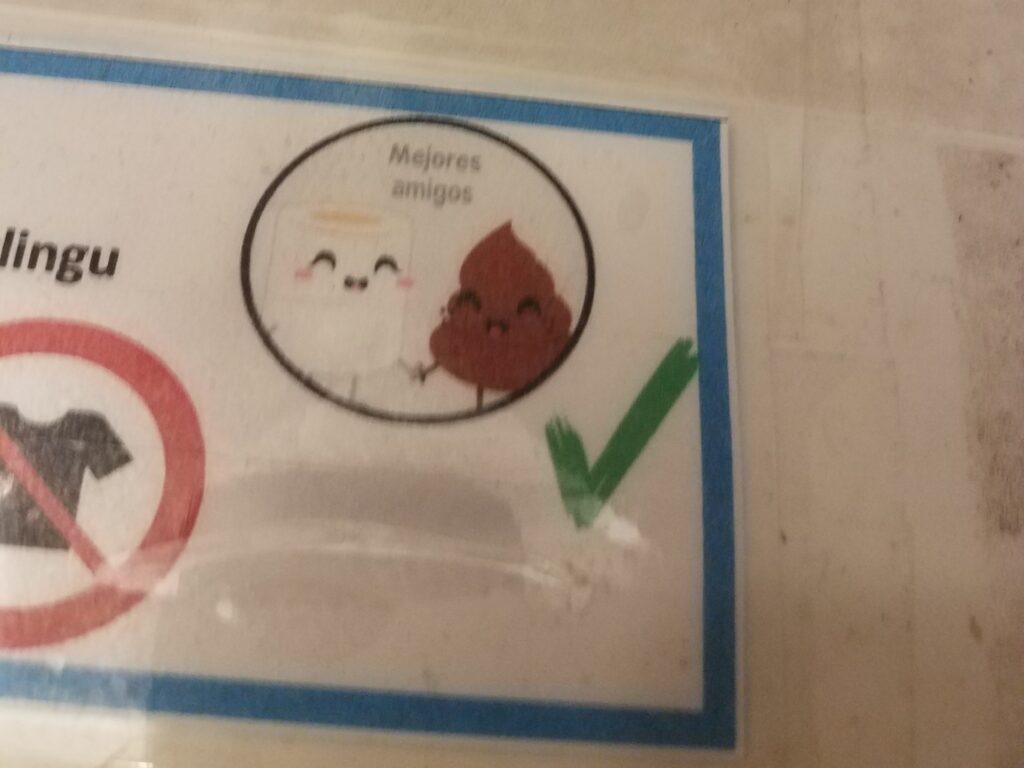
The remnants of those consumer products need to go somewhere, too, after people are done with them. We learned that recyclables are painstakingly collected and shipped back to the mainland because there is no recycling infrastructure on the islands. There are some landfills in Galápagos, but they are at or approaching capacity, which is why residents (if not tourists) have to be especially mindful of what goes into them. [15] It goes without saying that anything that can be composted is – by which I mean anything… including used toilet paper.
There is certainly an adjustment period when it comes to ecotourism as a mode of travel – or, at least, there should be. The intent of the experience is not luxury – and if it is, I firmly believe that tourists should go someplace else that is set up for that particular goal. For fragile, unique places like Galápagos, the more the tourism industry tries to make it a paradise, the less it will be.
~
Next week there will be plenty of detail about what all we saw while we were there. But for now, have you been to Galápagos or other remote ecotourism locations? What were your impressions about the balance of catering to tourists and protecting natural resources? I’d love to hear about it below.
Thanks for reading!
[1] https://radicalmoderate.online/travel-vs-tourism/
[2] https://en.wikipedia.org/wiki/Gal%C3%A1pagos_National_Park
[3] https://www.goodreads.com/book/show/143413088-on-the-origin-of-species-by-charles-darwin
[4] https://www.darwinfoundation.org/en/visit-galapagos/about-galapagos/
[5] https://www.darwinfoundation.org/en/about/our-campus/
[6] https://radicalmoderate.online/from-one-city-of-bridges-to-another/
[8] https://www.nytimes.com/2019/01/11/us/joshua-trees-cut-down.html
[9] https://en.wikipedia.org/wiki/Gal%C3%A1pagos_Islands
[10] https://hir.harvard.edu/the-galapagos-islands-economy-over-ecosystems/
[11] https://radicalmoderate.online/ecotourism-in-the-cloud-forest/
[12] https://hir.harvard.edu/the-galapagos-islands-economy-over-ecosystems/
[13] https://www.sciencedirect.com/science/article/abs/pii/S0960148124012758
[14] https://radicalmoderate.online/climate-lab-hawaii-in-the-classroom/
[15] https://galapagosconservation.org.uk/galapagos-waste-management-report-2021/
2 Comments
Garrod Gray · July 20, 2026 at 12:21 pm
Another intriguing and informative blog 👏👏
Ecotourism in the Cloud Forest – Radical Moderate · October 3, 2026 at 10:58 pm
[…] Natural Paradise vs. Tourist ParadiseJuly 19, 2026 […]