For several years now I have been battling the thistle in my yard. Long-time readers will know that I’ve tried multiple options that have ranged from “work intensive with minimal ecological impacts” (e.g. cutting it off at the ground as often as possible) [1] to “work intensive with moderate ecological impacts” (e.g. cutting it off at the ground and carefully applying an organic or synthetic contact herbicide as often as possible). [2] These options have – sadly, frustratingly – been similarly effective. Based on everything I’ve read and everyone who has given me advice, I know that effectively battling the thistle with environmentally friendly methods takes years, even with perfect diligence, which does not describe my efforts.
And I know this year is only the fourth, so I’m trying not to get too impatient, but once I saw thistle spreading to other parts of my yard and other gardens, I knew I needed to up my game. Even though I am diligent about cutting blooms before they go to seed, Canada thistle still spreads by its roots. We know that it has a significant taproot that can go down six feet and send lateral roots out horizontally, growing 12 feet/year in some cases, making it notably hard to kill without toxic systemic herbicides, such as glyphosate, which I still will not use in my yard.
Eradication or Control
Because there is now a sizable amount of thistle in my neighbor’s yard, too, I know that I will never eradicate it, and that the best I can hope to do is control it. At least her yard service cuts down some of it with their weed whackers, so it doesn’t always have the opportunity to bloom. Unfortunately, there are several other houses in the neigbhorhood–uphill and upwind–that let their thistle go to seed every year, negatively impacting the rest of us. I haven’t yet resorted to guerilla gardening in strangers’ yards, but don’t believe I haven’t thought about it.
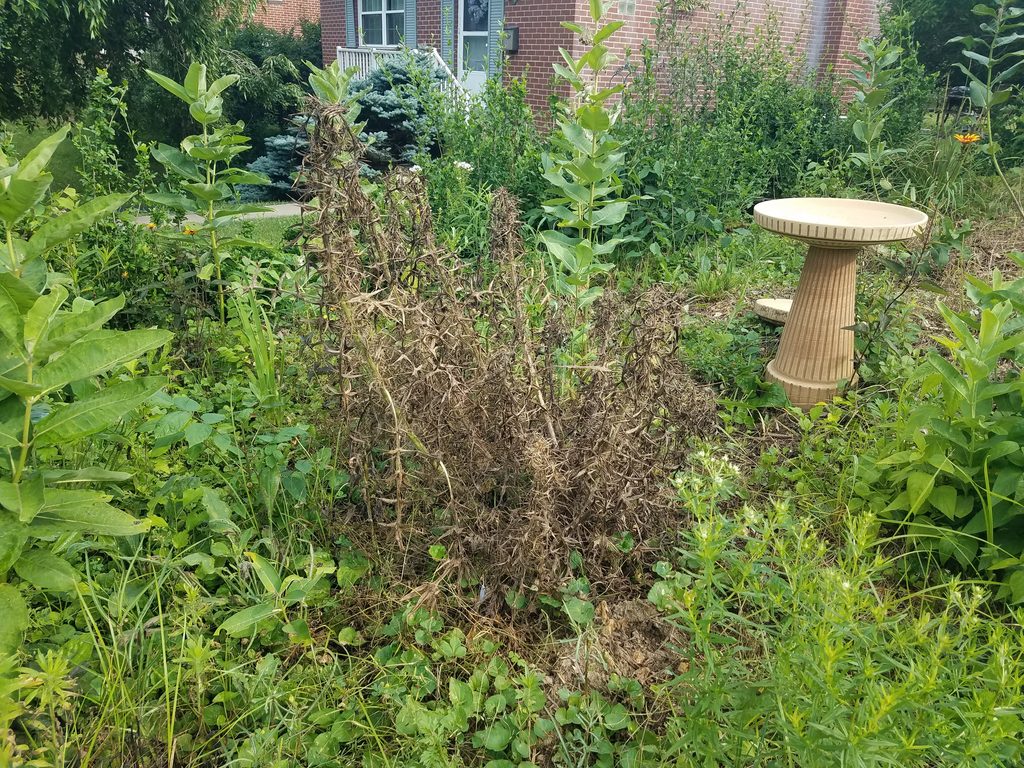
Continuously in search of options I hadn’t yet tried that would manage this constant barrage of seeds and roots from a tough-to-kill invasive species, I scoured the internet. Of course I would prefer to avoid synthetic herbicides if at all possible, but if I found something manmade that might be more effective and less harmful than vinegar, I was willing to consider it. Unfortunately, the one I picked as a “least bad” option last year was less effective than I had hoped, even though it was marketed as a product that could kill tough weeds, “roots and all.” [3]
I did point out in last year’s garden update post that, after at least two rounds of cutting and spraying with the Maleic Hdrazide, I thought my crop of thistle was starting to look a little sparse and spindly compared to before. But I also fully admit that the difference was so slight that I could very well have been experiencing confirmation bias – a point Christian was quick to point out as well. At the very least, by the end of summer the garden beds were only half thistle and half grass, and I was willing to take that as a good sign of movement in the right direction.
Because of my desire for a somewhat environmentally friendly herbicide option, I had previously only used what are known as “contact herbicides,” as in, they only affect the plant matter they touch. Agricultural vinegar (acetic acid) breaks down cell walls and acts as a desiccant, while maleic hydrazide inhibits cell division, but neither one could get to the roots. Theoretically, if you could keep the plant from sending out leaves and taking in nutrients from the sun through photosynthesis, it could starve the roots of their energy, but with roots that substantial, it can take years of regular cutting down to the ground every 2-3 weeks, [4] and that was clearly not happening in my yard. It looked like I was going to need to change my strategy, notably with something systemic.
FeHEDTA
At some point this past spring I was searching to see if I could find an organic systemic herbicide. Systemic herbicides work through the plant’s systems, designed to kill the entire plant, even if the chemical just touches the foliage (e.g. glyphosate, dicamba, sulfentrazone, etc.) I now know that the mechanisms these herbicides use rely on synthetic technologies, so you’re not going to find an organic systemic herbicide; they’re all synthetic. (NB: not all synthetic herbicides are systemic – the maleic hydrazide I was using last year isn’t.) But the internet doesn’t know what is true or false, and thanks to some implications or vague language somewhere, I came across an eco-friendly synthetic herbicide I had never heard of before that was described as systemic: Iron Chelate.
Iron is an essential micronutrient for plant health; it’s also not normally water soluble. While plants typically absorb iron in healthy levels through their roots, chelated iron is modified so that it can remain in suspension and can be absorbed quickly through the leaves of certain plants. [5] Once absorbed, the unhealthy levels of iron cause progressive oxidative stress inside the plant, releasing free radicals and causing cell damage. Notably, broadleaf plants (dicots) can’t regulate how much of this solution they absorb, while grasses (monocots) can. [6] In fact, grasses can absorb quantities that are healthy for them, making them even greener after application. [7] For that reason, Iron Chelate is used as a more environmentally friendly weed killer and fertilizer on golf courses, where dandelions and clover are shunned and green grass is prized.
But back to my yard, where clover and dandelions are left to roam free and improve the soil health… Sources I read have said that Iron Chelate is not a systemic herbicide and will not reliably kill the rhizomes in an established patch of Canada thistle, but what I saw in my yard this year was encouraging, even if what I’m spraying isn’t killing the roots. It’s also encouraging that I’m not risking a lot of harm to myself or the environment with this product, either. There is some risk associated with ingesting too much iron, but as long as you’re not drinking it out of the bottle or using it near a waterway where it can impact fish and mollusks, the biggest concerns I’ve seen listed relate to eye, skin, and lung irritation upon contact. [8]
Smarter, not Harder
There are multiple chelating agents used with iron, though they are most commonly synthetic. The only mention of organic applications I could find online seem to be related to soil amendments for plant health. Meanwhile, I’ve only seen the synthetic varieties (including the one I purchased, Iron Hydroxyethylenediaminetriacetic acid, a.k.a. FeHEDTA) available as herbicides, and rarely at that. There was exactly one option on a wall of herbicides at my local garden center, which one worker kindly helped me find. [9] When I made an offhand comment to the lady at the checkout counter about the other options being worse for the environment, she shot right back with a jab about how that meant they were more effective. (I grimaced and passed on that teachable moment.)
As it happened, there was no claim on the bottle that it would work on Canada thistle, but I had found mention of Canada thistle in a study out of the University of Maryland Extension. There was very little information about how much of an application was necessary for controlling it (note: they still say controlling, not eradicating), but the study suggested a “medium” application, with a high application for “harder to control weeds” (harder than thistle?!). [10] I had purchased a concentrated version of the Iron Chelate and diluted it less than the instructions suggested for the tamer weeds listed on the bottle. Armed with my own spray bottle and a makeshift shield cut from a milk jug to protect nearby plants, I started spraying. In all honesty, it was a little disconcerting to see the red herbicide dripping off the leaves, as though they were bleeding.
I couldn’t believe how quickly the thistles started to wilt. In a couple of hours it was clear that something was wrong, and the foliage was clearly dead within a day. Three weeks later I went out for a repeat performance (timed around the weather so I could guarantee a 24-hour window for drying), and there were far fewer thistle sprouts than I expected. On my third time out a couple weeks after that , I spent more time looking for thistle than I did spraying thistle. Now that I haven’t touched the garden in about three months, I can attest that there are definitely a few thistles popping up, but they are short and spindly compared to what I’d expect by now. We’re still only in the first year, but my thistle-weeding burden was so much lighter than expected in 2026. If I only have to go out and spray for an hour three times a year, I will gladly take it over what I’ve had to do in the past. More to come on that in the future.
Meanwhile, I’d love to hear if you have any products that have worked well in your yard – please share below.
And thanks for reading!
[1] https://radicalmoderate.online/thinning-a-thicket-of-thistle/
[2] https://radicalmoderate.online/organic-vs-synthetic-herbicides/
[4] https://extension.psu.edu/removing-canada-thistle-from-the-home-garden
[5] https://www.epicgardening.com/chelated-iron/
[6] https://www.visiblebody.com/learn/biology/monocot-dicot/overview
[7] https://www.gardeningknowhow.com/lawn-care/kill-lawn-weeds-without-killing-lawn
[10] https://extension.umd.edu/resource/iron-based-herbicides/
0 Comments