Disclaimer: everything on this personal blog represents my own opinions and positions, not those of any organization with which I am affiliated.
There are plenty of times when my work life and personal life smash up against each other, as was the case this summer when the smoke from Canada’s wildfires arrived in Pittsburgh. For several years I’ve worked to improve awareness around the negative health impacts of poor air quality and help others take steps to improve the air quality in their own homes. As they say, however, the cobbler’s kids have no shoes, and I had never actually gotten around to adopting any of those measures myself. But when unhealthy levels of smoke prohibited me from opening the windows during my favorite season of the year, I finally took matters into my own hands.
Define “Worse”
Wildfire smoke events seem to be getting worse in recent years, but there are several factors to consider when we talk about changes to wildfires and smoke exposure over time: quantity, intensity, and weather patterns. Research indicates that the number of wildfires in the US decreased by 10% over the period from 1990 to 2024, but the total area burned each year increased by 60% during the same time period. [1] In short: there are not more wildfires, but there are more extreme wildfires. While that may seem like splitting hairs, it is an important distinction when we consider the contributing factors.
We are seeing these trends of increased intensity, size, and frequency in the coniferous forests of the western US and the boreal forests of central Canada. Hotter weather (including warmer nighttime temperatures), reduced precipitation during fire season combined with earlier snowmelt, as well as years of fire suppression efforts have led to more available fuel for these fires. As a result, when they happen, the consequences can be far worse. [2] In fact, “15 of the 20 most destructive fires in California state history, in terms of structures destroyed, have occurred since 2015,” which is due in part to the severity of the fires but also because we’re constructing more buildings near wildlands. The construction of homes in the so-called “Wildland-Urban Interface” (WUI) has been steadily increasing in the US by about 350k homes per year, representing 32% of our nation’s homes in 2020. [3]
The other consideration from a health perspective is how much wildfire smoke actually gets to the lungs (and other organs) of people near and far. The risk is certainly great for people living near them, but the smoke can travel for hundreds or thousands of miles under the right conditions. This summer saw several heat domes in North America, which represent their own health risks (and a whole ‘nother can of worms), but the presence of one particular heat dome over Northern Minnesota and Southern Ontario meant that the smoke from wildfires happening at the same time moved east and south, through the Midwest and Northeast. [4] Not every heat dome we saw this year coincided with wildfire smoke, and it’s unclear whether heat domes are increasing in frequency, [5] but there is scientific consensus that both events are increasing in intensity, which may also impact the dispersion of wildfire smoke.
Exposure Outcomes
Wildfires don’t just burn forests – they can also burn buildings, cars, and pretty much everything in their way. Wood smoke on its own is bad enough for humans, as it contains hundreds of harmful chemical compounds that can contribute to cancer, asthma, and reduced oxygen delivery throughout the body. We know that components of buildings, vehicles, and electronic equipment can release heavy metals and industrial chemicals when they burn, creating more toxic soot that represents additional health hazards, but the specific components of WUI-smoke have not been studied extensively… yet. [6]
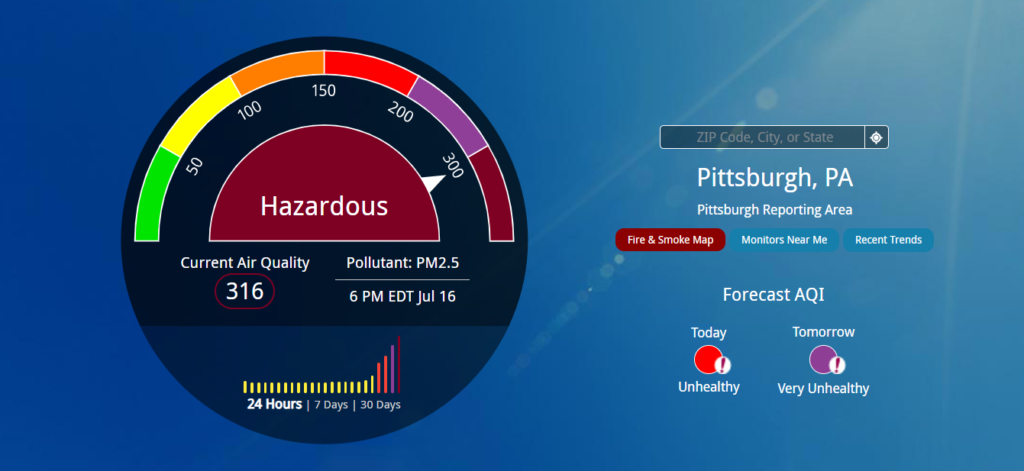
Image credit; [7]
What we do know about wildfire smoke is that it generates fine particulate matter (a.k.a. PM2.5, a.k.a. soot), carbon monoxide, nitrogen oxides, and sulfur oxides, all of which have negative health consequences for humans. But when chemical compounds from wildfire smoke travel through the atmosphere, they interact with other chemicals and sunlight to create secondary pollutants, such as ground-level ozone and secondary organic aerosols (a.k.a. haze) – and that is why wildfire smoke that has traveled hundreds or thousands of miles might not even smell like smoke anymore. Again, while we know that the chemical compounds in wildfire smoke are hazardous to human health, the scientific community is still only scratching the surface of this research because we haven’t been exposed to this much this regularly before. [8]
For now, we can at least keep track of how bad our local air quality is with tools that track wildfire smoke and share data from nearby air quality monitors. The Environmental Protection Agency’s AirNow.gov is a regular resource for me: it lists a numerical value for air quality that I find to be a simple but straightforward indication of relative risk. [9] Their Air Quality Index (AQI) is calculated based on specific pollutant concentrations, such as PM2.5 and ozone, and the resulting index numbers are tied to levels of concern: 0-50 is Good; 51-100, Moderate; 101-150, Unhealthy for Sensitive Groups; and so on. [10]
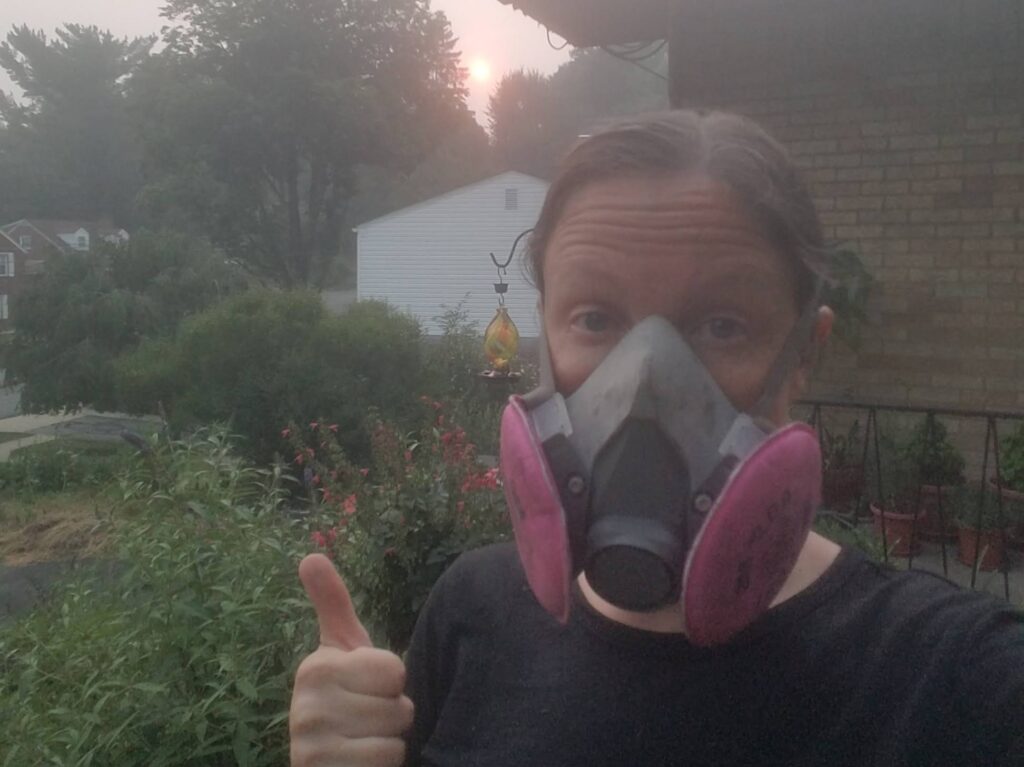
When the smoke arrived in Pittsburgh this July, it took me off guard. I was working at home, with my door closed and window open, in order to enjoy the warm weather and avoid the air conditioning in the rest of the house. Even though the AQI was only around 100, I started to get a headache that only worsened throughout the day until I closed my window. My coworkers and I chatted about the continually rising AQI numbers, and I said I was going to wear an N95 when I went out later to water my garden (fortunately, we have plenty from the pandemic). Someone with a degree in public health suggested I wear a P100 (respirator) instead if the AQI went above 200 (fortunately, we have plenty of those too because Christian is a car guy).
As it happens, the P100 didn’t save me from a headache or burning eyes when I went outside later in 300+ AQI, but I still think I made out better than Christian, who had hives for several days until the smoke dissipated. (Although we didn’t realize it at the time, dermatologists see increased cases of eczema and other skin issues during wildfire smoke exposure. [11]) But it was that day I knew we needed to do something to protect ourselves (and our kitty Pumpkin) from the smoke, so I headed to the local home improvement store to get the components for a Do-It-Yourself air filter.
Home Defense
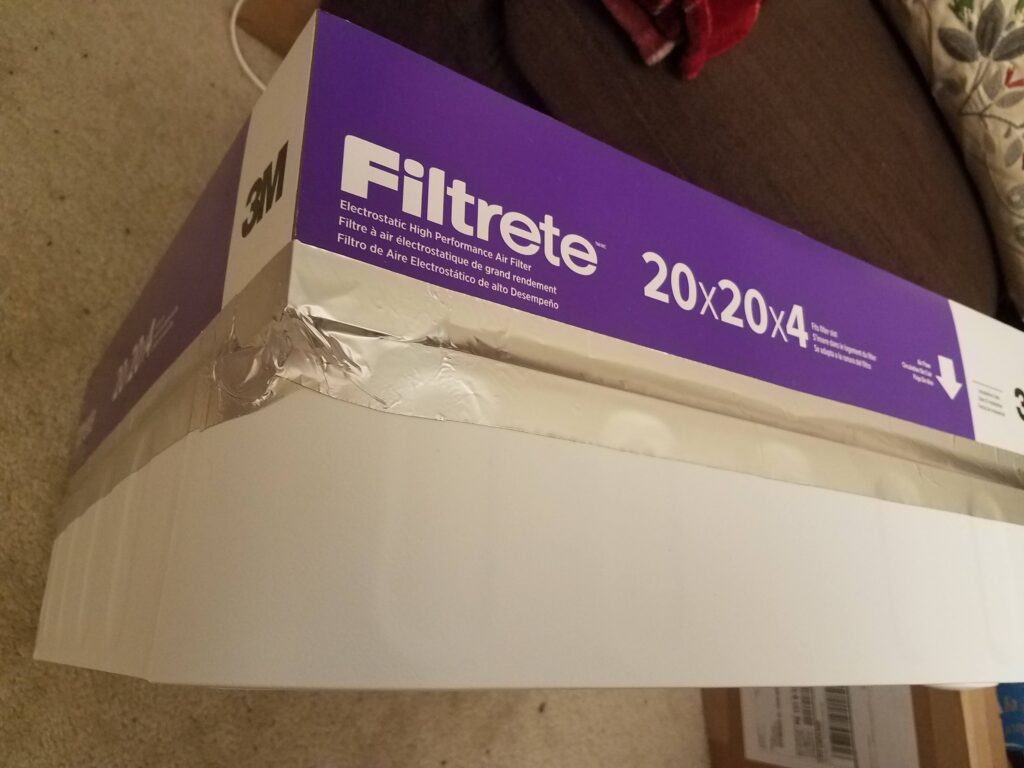
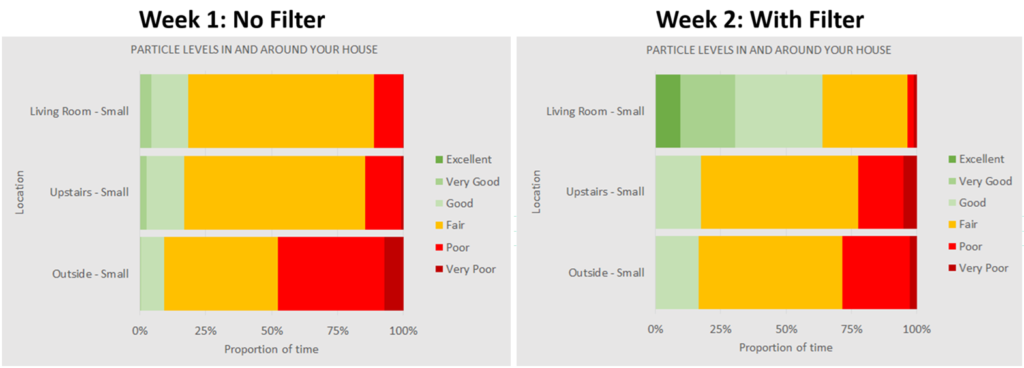
When I ran a home health program at my last job, one of the things we did was put low-cost air filters in people’s homes for short periods of time and examined improvements in air quality. Because Pittsburgh’s housing stock is so old, it can often be leaky, meaning that poor outdoor air quality means poor indoor air quality too. The simple step of taping an air filter to a box fan actually made notable impacts in the room where it was running, whether placed in an open window or somewhere in a room with closed windows. All you need to make one yourself are three basic components: a 20×20” box fan, a 20x20x4” MERV 13 air filter, and aluminum tape for duct work (not duck tape). Check out the organization Reducing Contaminants in Indoor Spaces (ROCIS) for more information on assembly. [12]
When I got to the store, I wondered if other people had the same idea because there was only one 4” filter left, and it was a lower filtration rating (MERV 12). “Minimum Efficiency Reporting Value” ratings measure how effective the filter is at removing particles from the air. MERV 9-12 filters are “effective against smaller particles like lead dust and car emissions” while MERV 13-16 filters remove “bacteria, tobacco smoke, and even virus carriers.” [13] While MERV 12 and 13 are comparably effective against particulate matter 2.5 microns in size (removing 80% and 85% of it, respectively), the difference is notable with smaller particles, such as those 0.3-1.0 microns in size (removing 35% and 50% of it, respectively).
Smaller particles can penetrate deeper into the lungs, cross into the bloodstream, and contribute to a range of cardiovascular and respiratory conditions, such as asthma, COPD, heart attacks, and strokes, which is why I was disappointed that I couldn’t get a MERV 13 filter at the store. (When I go to replace it, it appears that I’ll have to order one online ahead of time.) The only downsides of a better filter are that it will force your fan to work harder (if you’ve assembled it properly – there should be an airtight seal between filter and fan) and that it is more expensive. I was surprised to find that once I had purchased the materials for this “low cost” filter, it came out to about one tenth the price of a good quality air filter – cheaper for sure, but not something I would consider to be cheap. That isn’t a problem for us, but the program I ran at my last job specifically targeted low-income households, many of which wouldn’t be able to swing $80 worth of supplies. With that in mind, it is frustrating to think of clean air as something that is only available to those who can afford it. (But that’s a post for another time.) In the meantime, it’s important to consider 1) how we can protect ourselves from wildfire smoke when it’s around, and 2) how we can limit the effects of climate change (which we know exacerbates events like these.)
~
Have you made an air filter like this one? Have you noticed a difference? I’d love to hear about it in the comments.
Thanks for reading!
[2] https://science.nasa.gov/earth/explore/wildfires-and-climate-change/
[4] https://www.cnn.com/2026/07/14/weather/canada-wildfire-smoke-northeast-midwest-air-quality
[5] https://www.metoffice.gov.uk/blog/2026/what-are-heat-domes-and-are-they-getting-worse
[6] https://phys.org/news/2025-03-wildland-urban-interface-deadlier-remote.html
[10] https://www.airnow.gov/aqi/aqi-basics/
[11] https://www.sciencedaily.com/releases/2021/04/210421124635.htm
[12] https://rocis.org/how-to-assemble-a-fan-filter-2/
[13] https://www.lennox.com/residential/buyers-guide/guide-to-hvac/glossary/merv-rating
0 Comments