I have been maybe a little too excited about mending clothes over the last few weeks. It’s possible that part of that enthusiasm comes from the novelty, as it’s not something I typically do these days, but also because it’s something that I’m actively choosing to do, rather than something I have to do. There is no reason why I would have to darn a threadbare pair of socks from high school – I can obviously afford to buy myself new socks, and there are plenty of other things that need my attention around the house. But, still, it feels like an exciting little rebellious stand against our modern consumption-driven habits, as I thumb my nose at all of the advertisers pushing new clothes on me.
Invisible Mending
My limited skills with mending lie principally in repairing seams and hems, where the thread attaching fabric with fabric has broken. It’s something that can be done quickly with a sewing machine but generally just as quickly by hand by the time I get all of the equipment out and set up. I’ve also done some occasional darning and patching, where a hole appears in a piece of fabric. Because the professional world has standards for appearance, and because I typically don’t care what I look like when I’m at home, almost all of my mending has been done on work clothes. Gardening clothes and loungewear alike are sorely neglected to the point that some are borderline non-functional.
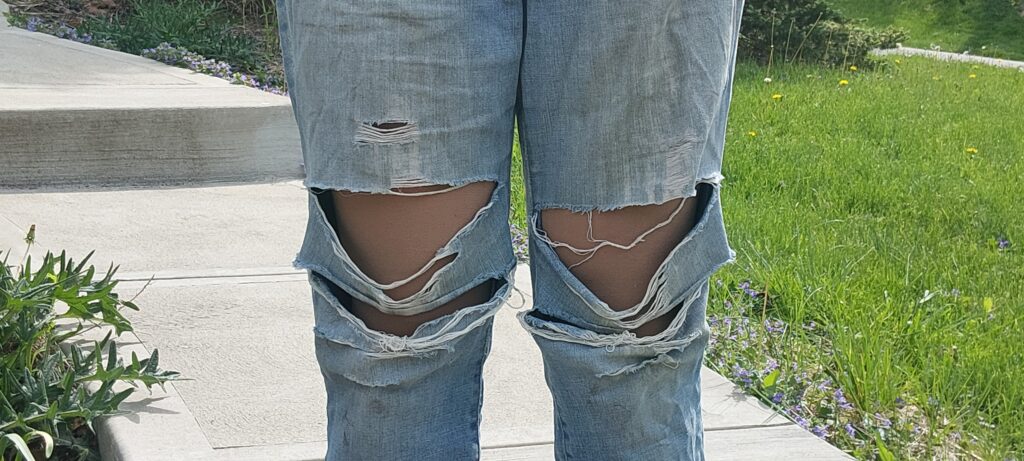
Photo credit: Christian Korey
And for those professional clothes, it is imperative that they appear new or at least well-maintained so you look like you’re taking your job seriously and respecting the situation. Consequently, any mending done on these garments basically needs to be invisible. It’s not always possible to make something look like new, but it can be done in more cases than one might imagine, especially if you can catch it early by regularly inspecting your clothes for signs of wear. This post is not a tutorial in any of these techniques, but I have assembled some useful resources here:
Woven fabrics
For the record, I also use this technique on very small knit fabrics, including delicate socks, because they’ll get less scrutiny, and it’s much faster.
- A good video walkthrough of the darning process (from a 1954 instruction book), though there are other tutorials available demonstrating better execution [1]
- A video that is a little lighter on the process but shows a good example of weaving threads to replicate the design of the fabric [2]
- A collection of darning methods for different types of damage to woven fabrics (including tearing it on sharp objects, such as a hedge… as one is taking a turn about the garden) [3]
Knit fabrics
I have never done anything other than repairing small holes in cashmere, but I am very excited to try Swiss darning… and have plenty of old, bulky socks in need of it.
- A video demonstrating how to close a very small hole in a very small knit, such as cashmere [4]
- A great video on Swiss darning, which is used to duplicate the knit stitch – this type of repair is much more easily managed when the fabric is worn but does not yet have a hole [5]
- A comprehensive video on repairing large holes in large knits, but it may be unclear at times if you aren’t a knitter – I highly recommend watching the previous video first to get the technique [6]
Visible Mending
Of course, it is difficult, even for professionals, to make some repairs completely invisible: it can be difficult to match the exact shade of the original; lightweight fabrics will hang differently with added material, no matter how delicately it is incorporated. In short, depending on the type of fabric, the nature of the damage, and the skill set of the person doing the mending, it can be impossible to make certain clothes look like new again. So in some cases, people are opting instead to showcase their repair work, especially if they have an artistic flair or strongly believe in more sustainable approaches to fashion.
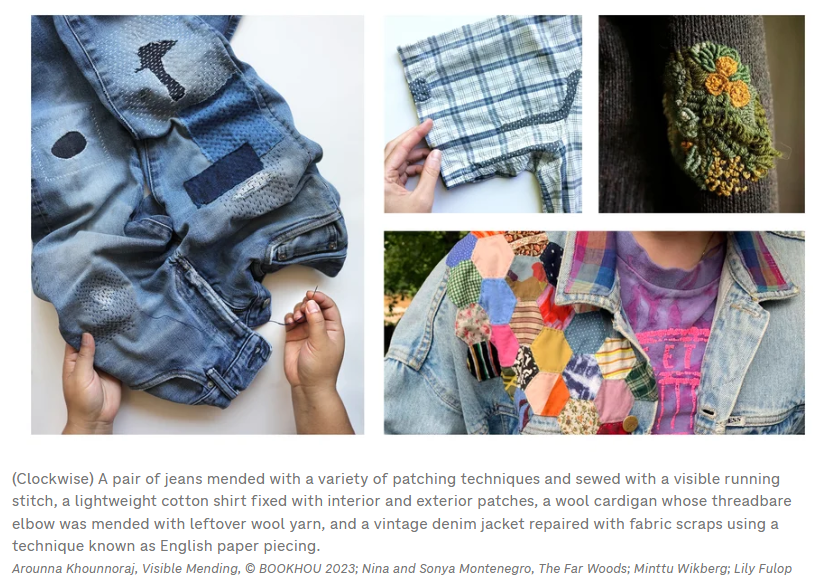
Image credit: [7]
Visible darning can be done using the same techniques as above, but with a contrasting color. There are other techniques that don’t stop at using a different color – some don’t even attempt to match the type of fabric or weave. For example, it is easy to use the woven darning technique with different colored threads in knitwear, provided you effectively secure the hole so it doesn’t continue to spread [8] Note: I have seen some darning tools and techniques that basically create a patch over the hole – my concern is that this approach puts stress on the fabric at the edge of the patch without reinforcing the fabric at the point of wear. [9] The end results from these popular darning looms in particular strike me as far more decorative than functional – which is fine, if that’s what you’re going for. (It’s not what I’m going for.)
Part of the problem with some of my clothes is that, while I do get holes, I often get whole areas that become thin with wear, necessitating patches that can reinforce the fabric itself, not simply close a hole. Patches are some of the most obvious mending one can do, which is why it is nearly impossible to do it invisibly (I said “nearly” [10]). Consequently, many people lean into patchwork by using loud and contrasting colors, especially on jeans, as a creative outlet. For this reason, I (and probably most people, I would guess) have at least subconsciously looked down on patchwork as an indication of poor quality clothing. However, in researching different types of mending for this series, I learned that certain kinds of patching can be quite beautiful, as is the case with the Japanese technique of sashiko.
Overcoming Stigma
Like kintsugi, the art of repairing broken pottery with gold to make it unique and even more beautiful, [11] sashiko is an embroidery technique that employs visible stitching for reinforcement and mending. [12] It can be used in conjunction with boro, a technique of layering and patching that originated in northern Japan. [13] It did not surprise me at all that there was a Japanese method of repairing fabric and making it even more beautiful in the process; I was surprised that I don’t recall having encountered it when I lived in Japan (at least not in the context of contemporary clothing). It is possible that I saw it and didn’t notice it at the time, but most of the Japanese adults I knew were coworkers, and well-kept professional attire is a must in the workplace (even for teachers).

If my uniquely tailored internet search algorithms are to be believed, sashiko does seem to be on the rise as a recommended option for people who want to keep worn clothes in their regular rotation and employ some artistic creativity in the process. One video tutorial has me thinking about repairing the jeans I got married in, which never see the light of day anymore because I want to preserve them. [15] But still, those are jeans, not business clothes. Having seen some beautiful examples of sashiko that range from DIY repairs to high-end garments, [16] it is difficult to believe that such an elegant form of visible mending might be unwelcome in professional settings, but I have certainly thought twice before wearing my own mended clothes to work – and I work in a field related to sustainability!
It remains to be seen whether we will be able to shift norms around mended clothing. I absolutely continue to invisibly mend my professional attire, and I will probably look to thrift stores once individual garments truly reach their end of life. With that said, I am curious about employing some tasteful visible mending when it’s necessary and stress-testing some of the boundaries of our business norms by wearing my values on my sleeve, as it were. After all, who better to be in the vanguard against fast fashion and synthetic fabrics than someone who spends her days looking at the health impacts of the plastic lifecycle? I’ll definitely be curious to see where this path leads… and let you know what I find.
~
How about you? Do you have reservations about wearing mended clothing in certain situations, or do you go ahead and do it? Have you tried any of the techniques mentioned here, and if so, how did it turn out? I’d love to hear about your experiences below.
Thanks for reading!
[1] https://www.youtube.com/watch?v=HXZEV3toMhg
[2] https://www.youtube.com/watch?v=i75UFqmSfhU
[3] https://historicstitcher.blogspot.com/2008/04/darn-it.html
[4] https://www.youtube.com/watch?v=AVVawL1LD6Y
[5] https://www.youtube.com/watch?v=f-SJEwSP4HE
[6] https://www.youtube.com/watch?v=soZoUyV7utw
[7] https://www.npr.org/2023/05/22/1177552573/extend-the-life-of-your-clothes-with-visible-mending
[8] https://youtu.be/pfaag52L6W0?si=wzI4-719WPPALsB9
[9] https://www.youtube.com/watch?v=x8V0GwFcKMM
[10] https://www.youtube.com/watch?v=QIj90yA9WWc
[11] https://japanupclose.web-japan.org/techculture/c20240326_1.html
[12] https://japanobjects.com/features/sashiko
[13] https://japanobjects.com/features/boro
[14] https://www.textilesphere.com/2024/10/charkha-history-mahatma-gandhi.html
[15] https://www.youtube.com/watch?v=bj2eZcMWsNo
[16] https://medium.com/engawa/sashiko-the-ancient-stitch-that-fashion-cant-stop-borrowing-f7b65d2f848e
0 Comments