After last week’s feat of covering three religions in a massive country with a lengthy history, I decided to try it again, this time in China. Boasting the largest population in the world until 2023, when it was surpassed by India, China is home to 1.4 billion people. China’s religious breakdown is a bit nuanced, as the Chinese Communist Party is officially atheist, but five official religions are recognized (Buddhism, Taoism, Islam, Protestantism, and Catholicism) as long as they are practiced within specific guidelines (including government registration, reflection of “socialist core values,” and limits on who can receive religious education). [1]
Depending on the report, China’s religious breakdown varies from one-third to two-thirds atheist. It’s unclear to what extent that title is self-applied for political reasons, as CCP members are forbidden from holding religious beliefs, but many of China’s historic religions have strong roots in cultural traditions and philosophies, decoupling practices from beliefs in some cases. [2] Many of these beliefs and practices are influenced by Buddhism, Taoism, and Confucianism, “the Three Teachings,” [3] as they are sometimes called, described as three peaks on a single mountain – and each has something (or several things) to say about consuming animal products.
Three Peaks
Confucianism
Numbers vary, but it is believed that somewhere between 6 and 28 million people worldwide claim to follow Confucianism, either as a formal religion or guide for ethical behavior. In the religious sense, it is nontheistic and does not worship a creator god. Rather, it is more a code of conduct founded by the Chinese philosopher Confucius sometime during the 6th century BC. Principles of Confucianism focus on the five key virtues of benevolence, righteousness, propriety, wisdom, and sincerity. [4] Similar to some other religions we’ve covered in this series so far, meat is not forbidden, but moderation is encouraged in eating and drinking, though there are some instances of abstaining from meat and grains while mourning. (Of note: alcohol is not forbidden, but drunkenness is discouraged.) [5]
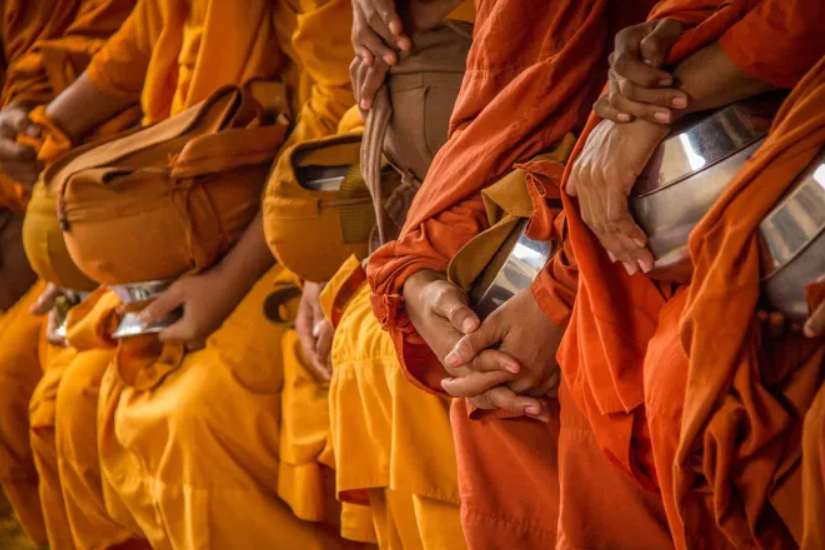
Image credit: [6]
Taoism
Similarly difficult to ascertain, followers of Taoism are somewhere in the range of 9 and 173 million people worldwide, again largely depending on the definition of what “following” means. Still, the majority of adherents to this Chinese religion remain in China, with some spread throughout Southeast Asia. Taoism was formalized as a religion during the Warring States Period, from about 450 to 300 BC. What began as more of a mystical philosophy, inspired by Confucianism, Naturalism, and other contemporary schools of thought, evolved into an organized religion that has been described as both nontheistic and polytheistic, again, depending on definition. [7]
In Philosophical Taoism, the Tao is described as an impersonal, formless force that is the source of existence and the rule of natural order; humans are incapable of comprehending it, but it exists within all of us. In Religious Taoism, we see a pantheon of deities added to the equation, though they are all still subordinate to the Tao. The older school of Zhengyi Taoism (2nd century BC) focuses on ritual-based cultural traditions and seems to be less severe than the more modern Quanzhen Taoism (12th century AD), which emphasizes moral discipline and monasticism, requiring celibacy and strict vegetarianism.
The more popular Zhengyi school has some instances of fasting before religious ceremonies and meditation, but it generally allows meat on non-fast days, with four notable exceptions that are never allowed: beef (representing loyalty), dog (righteousness), goose (fidelity), and black fish (filial piety). [8] Many followers also avoid the “five pungent foods” (garlic, onions, leeks, chives, and coriander), which, like the rajasic foods described in last week’s post, excite the emotions, trigger cravings, and disturb an individual’s life force, or qi. The ideal diet is moderate, balanced, and seasonal. [9]
Buddhism
By far the largest religion of these three, the number of Buddhists around the world ranges from 320 million to 1.6 billion, though the vast majority of followers live in the Asia-Pacific region. Similar to the other two, Buddhism does not rely on worship of a deity; it is instead based on the teachings of Siddhartha Gautama (the Buddha, “the awakened one”), who was born in modern-day Nepal and lived in northern India around the 6th-5th century BC. The Buddha’s teachings focused on the path to spiritual development through wisdom, moral virtues, and meditation; those who reach enlightenment are released from the cycle of death and rebirth. (As Siddhartha was likely raised as a Hindu, this echo with Hinduism makes sense.) [10]

Photo credit: Arthur Parisi
Buddhism likely arrived in China during the first century AD, growing slowly in merchant and immigrant communities before spreading to mainstream adoption. Differences of opinion in religious interpretation and large geographic separations between followers led to different schools of Buddhism. The Mahāyāna school, which is prevalent in China, Japan, and Korea, among other countries nearby seeks enlightenment, not just for the benefit of the individual but for the benefit of all sentient beings. [11]
The concept of ahimsa (non-harm) is present for all Buddhists, but Mahāyāna Buddhists emphasize vegetarianism, recognizing that eating meat is incompatible with ahimsa. Some also avoid the “five pungent spices,” in keeping with Taoist tradition and a full prohibition on alcohol to avoid clouding the mind and hindering meditation. Other schools, which are more prominent in other parts of Asia, are less strict about vegetarianism, in some cases because of more limited availability of plant-based food options. [12]
Recipe: “Spicy, Fried Entrails” of Questionable Authenticity
About 18 years ago I traveled to China to cross several items off my bucket list. While in Chengdu (to see pandas), my friend Arthur and I visited a Buddhist temple, where we ate a lunch that we still talk about. I lived in Japan at the time, where I would sometimes tell people I was Buddhist simply to avoid the endless confusion of what I did or didn’t eat. “Buddhist food” in Japan, while elegant, often felt like deprivation to me: I couldn’t get eggs, dairy, or even alcohol once the “B-word” crossed my lips. But this temple cafeteria blew my mind wide open because not only was everything on the menu vegan, but there was no shortage of standard Sichuan meat dishes, including mock “chicken,” “lamb,” and “pork.”
Now, I started this blog series determined to highlight vegan dishes that didn’t involve an attempt at replacing an animal protein (i.e. veggie burgers) but rather relied on delicious plant-based ingredients presented as themselves. However, the Chinese have been perfecting the art of mock meat over many centuries, [13] and they are really good at it, so it seemed a shame not to include a nod to this culinary tradition. I personally don’t miss meat (and don’t particularly care for substitutes that taste anything like the genuine article [14]) but I am fascinated by the food science aspect of replicating qualities of meat with plant-based ingredients… so here we are.
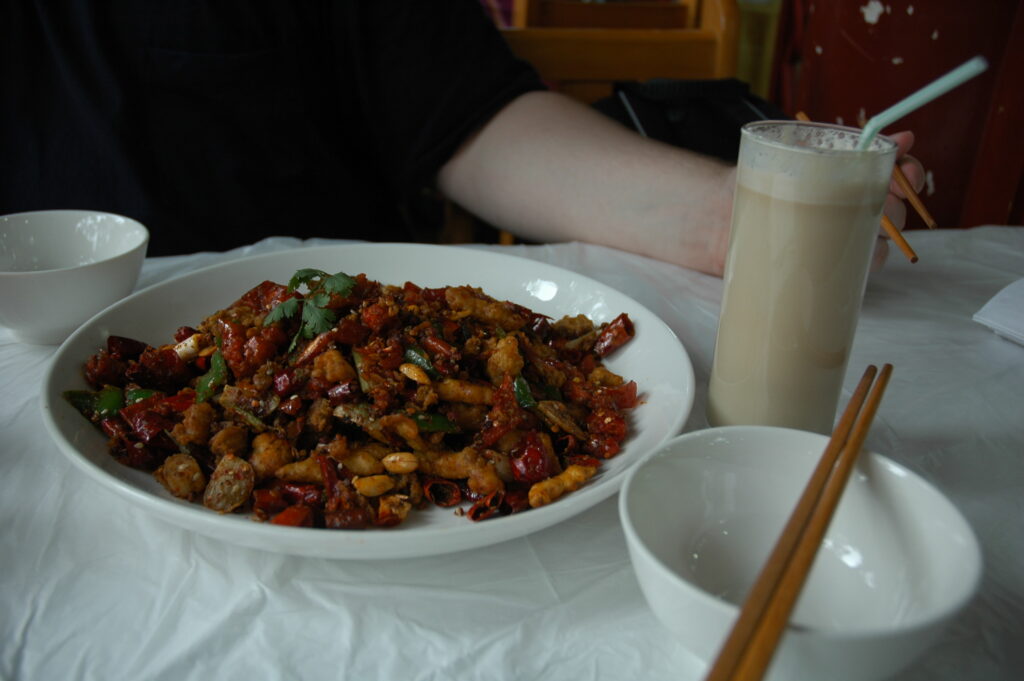
I’ve done enough Italian and Indian cooking in recent years to know that there is rarely a “definitive” recipe for any dish, and I’ve given myself permission to experiment a little with what I have on hand or what I want to taste. My goal with this recipe was to recreate a dish Arthur and I ate that day, called “spicy, fried entrails.” I had that caption on photo of it and a vague recollection that it was something like Chongqing chicken (but not exactly) or a westernized version of kung pao chicken (but if they were doing that for the benefit of tourists, the dish did not carry that name). Consequently, I’ve cobbled together aspects of a few different recipes [15], [16], [17] to create something that is pretty close to what we had and does a decent job of imitating offal with readily-available ingredients.
Marinated mock offal:
- 10 oz extra firm tofu – frozen, thawed, pressed, and then torn into pieces to resemble offal
- 1 ½ tsp salt
- 1 ½ tsp MSG (yes, you should consider using it [18])
- 1 ½ tsp white pepper
- 1 Tbs soy sauce
- 1 Tbs sesame oil
- 1 Tbs rice wine or mirin
- 1 Tbs corn starch
- 3 Tbs cold water
- Approx 1-2 cups frying oil (I use sunflower)
Prepare tofu (note the freezing step to ensure the proper texture – be sure to plan ahead). And remember to get some white rice going before you start cooking this dish.
Whisk salt, MSG, white pepper, soy sauce, sesame oil, rice wine, corn starch, and cold water together in a medium bowl, add tofu pieces and toss to coat. Marinate at least 20 minutes, turning occasionally.
Heat frying oil in a medium-sized, heavy-bottomed pot to about 320 F. Reserve the marinade for the stir fry step; drain the tofu and add to the hot oil. Stir to ensure even cooking for 3-5 minutes, until it starts to brown. Increase temperature to 365F and fry for another minute. (If you have an induction cooktop, [19] don’t bother taking the tofu out – just crank the burner as high as it will go; if you don’t, you should remove the tofu while the oil heats. Note: these two-temperature cooking instructions are for chicken, but I followed them in hopes of getting a chewy interior and crispy exterior. I don’t know if it’s strictly necessary, but I liked the result.) Cut heat; strain tofu and place in a separate bowl.
Stir fry:
- 1-inch piece of ginger, peeled and sliced
- 6 cloves garlic, halved or quartered (about the size of peanuts)
- 15 Sichuan peppercorns (green are more intense than red – you can crush them with a mortar and pestle if you don’t want to risk biting down on a whole one)
- 20 dried red chili peppers, sliced (peanut-sized pieces)
- 6 scallions, sliced (peanut-size)
- ½ green pepper, chopped (peanut-size)
- ¼ c roasted or fried peanuts
- 1 tsp white sesame seeds
- 1 Tbs soy sauce
- 1 Tbs rice wine
- 1 Tbs corn starch
Prepare all stir fry ingredients ahead of time – stir fry moves too quickly to chop between additions. Whisk the soy sauce, rice wine, and corn starch into the reserved marinade to make the stir fry sauce.
Ideally use a wok (or a well-seasoned cast iron skillet [20] if you have an induction cooktop). Heat the pan over medium-low and transfer about 2 Tbs of the frying oil (you may need more oil and sauce if you’re not using a wok, since they’ll spread out more on a flat surface – just keep an eye on it). Add the ginger and garlic, stir for one minute; add the pepper and chilis, stir until fragrant but make sure not to burn them; add the tofu and stir for one minute; add the stir fry sauce, scallions, green pepper/chilies, peanuts, and sesame seeds; stir to coat and continue cooking until moisture is largely evaporated. Veggies should still be crisp, tofu should still be tender, but there should not be a wet sauce that spreads on the serving dish.
Serve with rice.
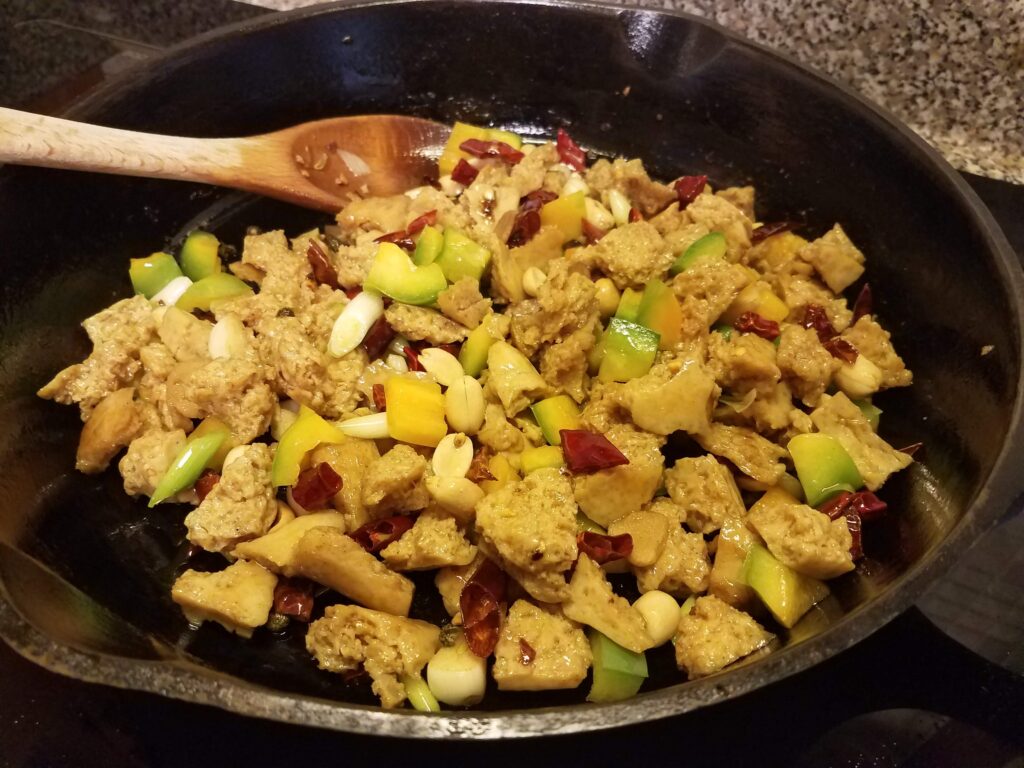
I can absolutely attest to the fact that this “pungent” dish triggered cravings for more, whether or not it was true to the lunch I’ve reminisced about for almost two decades. I can’t wait to make it again, and I’m already thinking about things I’m going to adjust next time.
Now it’s time to say goodbye to China and look to wrapping up this series next week as we welcome Easter, Passover, and Tomb Sweeping Day.
Until then, happy eating and thanks for reading!
[1] https://www.state.gov/reports/2023-report-on-international-religious-freedom/china
[3] https://en.wikipedia.org/wiki/Chinese_folk_religion
[4] https://en.wikipedia.org/wiki/Confucianism
[5] https://www.flavorandfortune.com/ffdataaccess/article.php?ID=1389
[7] https://en.wikipedia.org/wiki/Taoism
[9] https://dao-world.org/2020/12/31/daoist-diet/
[10] https://en.wikipedia.org/wiki/Buddhism
[11] https://www.namchak.org/community/blog/three-different-paths-theravada-mahayana-and-vajrayana/
[13] https://edition.cnn.com/travel/article/china-fake-meat-vegetarian-intl-hnk/index.html
[14] https://radicalmoderate.online/beyond-impossible-meatless-meat-part-1/
[15] https://redhousespice.com/mala-chicken-laziji/
[16] https://www.thefoodranger.com/kung-pao-chicken/
[17] https://redhousespice.com/kung-pao-chicken/
[18] https://radicalmoderate.online/essence-of-flavor/
[19] https://radicalmoderate.online/now-youre-cooking-with-magnets/
[20] https://radicalmoderate.online/cast-iron-cooking/
1 Comment
Fast Food, Part 6 – Hinduism and India – Radical Moderate · October 3, 2026 at 9:53 pm
[…] Fast Food, Part 7 – Buddhism and ChinaMarch 29, 2026 […]