Happy birthday to my aunt, the most skilled seamstress I know, and to my mom, whose clothes are featured in this post as the catalyst for said rebellion.
Structured procrastination is the name of the game in my life. I constantly have an unrealistically long to-do list, full of things that must get done plus regular additions of things I genuinely want to do. [1] For much of my life, I would regularly put off the “wants” until after I finished the “musts” – as a reward – and hope that that would encourage me to get more efficient with completing the “musts.” As an adult, I have come to realize the sad truth that my “musts” never actually get done, and that my “play only after work is done” approach leads to cycles in which I try vigorously to do everything, fail, and then do nothing in a mild state of burnout, feeling guilty for being unproductive and feeling angry about feeling guilty.
Someday
I abhor the unending household tasks of washing and folding laundry, washing dishes, cleaning and tidying, dusting and vacuuming, etc. I don’t like them to begin with, but the real kicker is that they are never, ever truly done. It is emotionally draining for me to fold and put away my laundry only to see that my bottomless laundry basket has somehow produced another load that needs to be washed. Consequently, even if I cross that item off my to-do list, I have to add it back onto the list again, which robs me of the satisfaction and dopamine hit of one more thing completed. (Even writing that description exhausted me.)
With that said, I will take to these tasks like a hobby if there’s something else I “should” be doing instead – and there is so much I “should” be doing right now. Between work and family, house and garden, and making a legitimate effort to take care of myself both physically and mentally, [2] I go from day to day, week to week, making long lists and crossing off one item at a time, whatever that item is, just as long as it’s something I can get done, even if it’s not a big one that needs my attention.
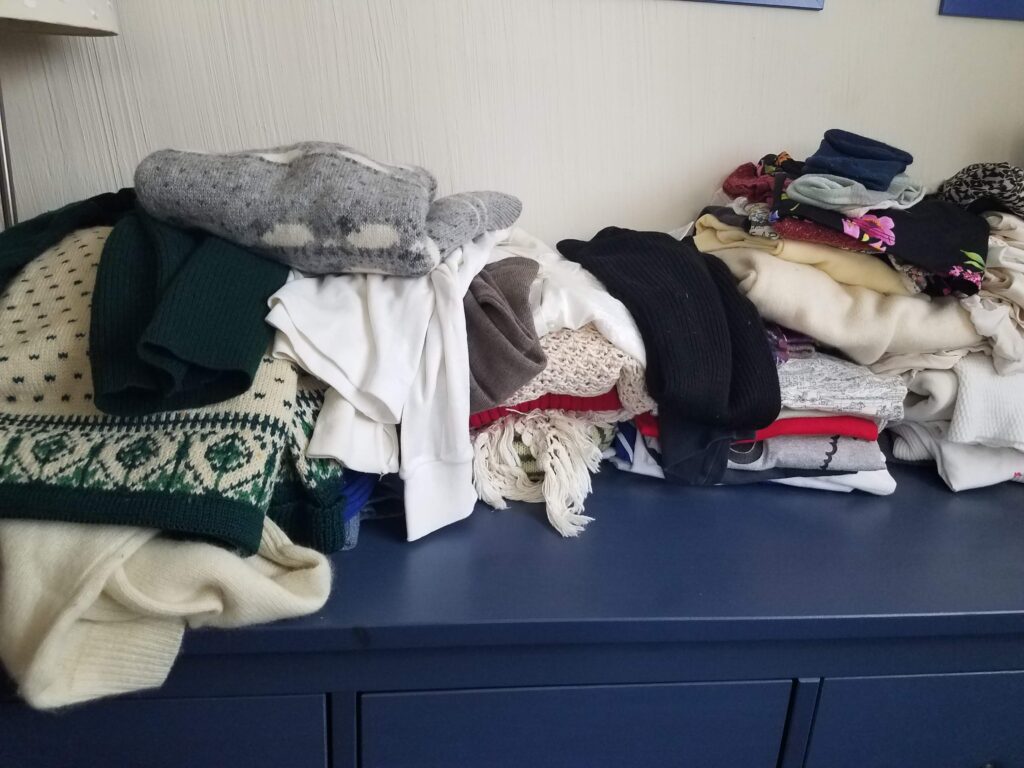
One of the big, daunting tasks I’ve been dealing with for over two years now is sorting through my mom’s things, many of which are stacked in boxes and reducing the functionality of at least three rooms in our house. It has been difficult enough to part with things of my own as I try to revive the Marie Kondo tidying process I started during the pandemic, [3] but parting with my mom’s things has been even harder, particularly if there’s a possibility they may just wind up in a landfill. My best friend came over and helped me sort through bags and bags of her clothes last year, [4] and there were many I wound up keeping because they needed mending – and would therefore not wind up on the rack at a thrift store.
Investment Garments
I have used this blog before as a platform to rail against fast fashion, including the plastic content and the planned obsolescence of our clothes. [5] With the exception of a vanishingly small percentage of plant-based sources, synthetic fibres are produced from fossil fuels – the stuff we (i.e. humanity) continue to drill out of the ground, pollute the air with, and wage war over. The cheap plastic fibers in our clothes break down as we wash and wear them, creating microplastics and nanoplastics small enough to enter our cells and damage our DNA. [6] Although I now make a point of buying natural fiber clothing when I buy new, I still own plenty of older clothes with synthetic fiber content – it’s almost impossible to avoid unless you have the time, money, and know-how to shop consciously or make/mend your own clothing.
I am fortunate to be able to afford periodic and thoughtful investments in 100% wool, linen, cotton, and leather clothing items, but many of these options remain in the realm of luxury products these days (like my $90 wool t-shirt). [7] I am also fortunate to have a particular set of skills when it comes to fabric (thanks to my grandma, mom, aunt, and a college internship in the costume shop of a theatre company), but I don’t have the time to make or mend my own clothes… or do I?
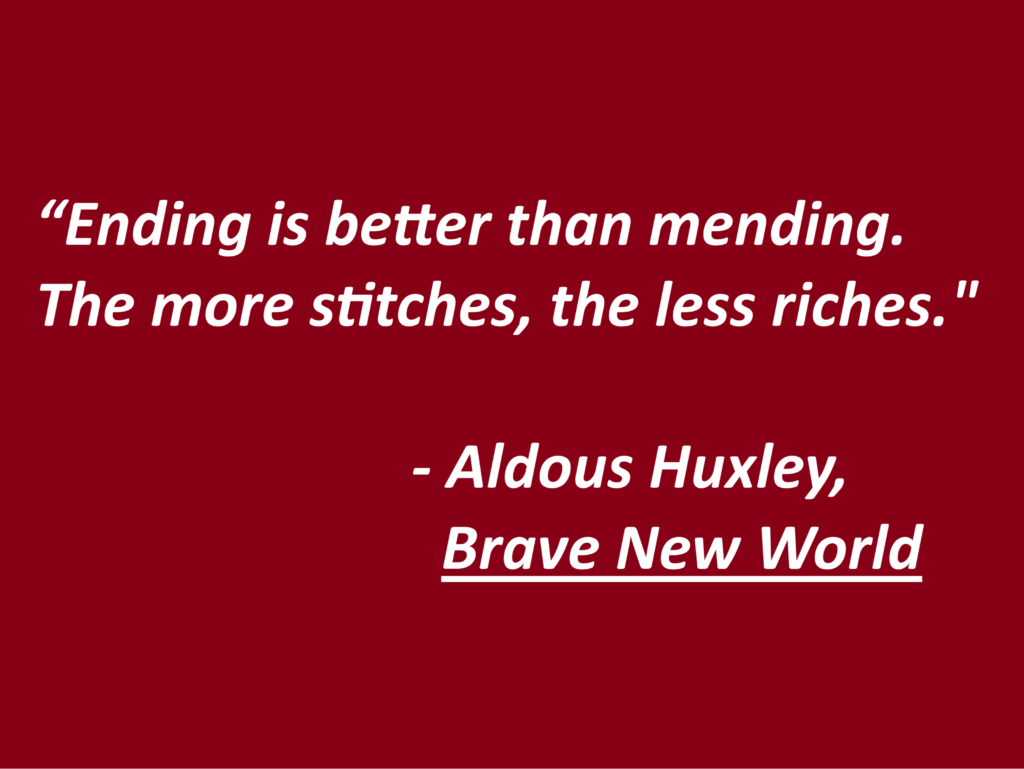
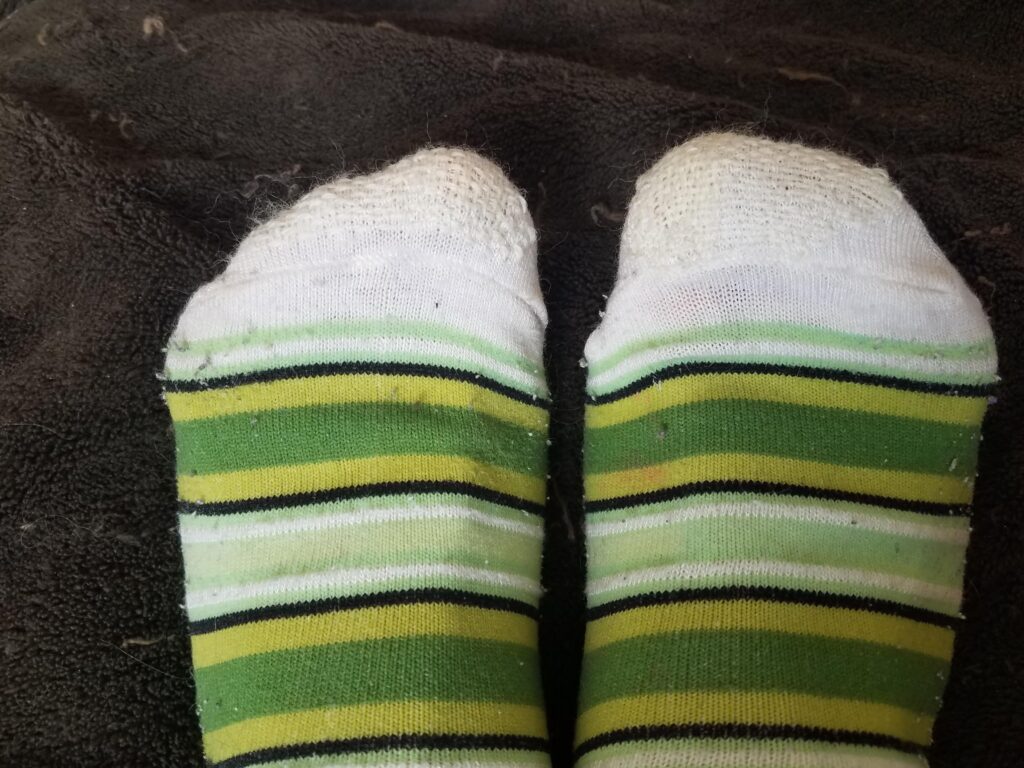
I have a mending pile (socks, leggings, sweaters, etc.) that has changed addresses with me several times over the years while remaining largely untouched – it’s for “when I have time.” But the pile of my mom’s clothes – high quality, natural fiber, “investment” garments that were too worn for the thrift store – is what tipped me over the edge into sitting on the couch in the evenings with a needle and thread. And I have to say that darning socks is the most effective way to feel both indulgently lazy and responsibly productive at the same time (or is that just me?)
Reduce, Reuse, Repair
Before technological advances contributing to fast fashion (e.g. textile mills in the Industrial Revolution, synthetic materials in the 20th century), garments were investments that needed to be maintained – darned, patched, taken in / let out, or have buttons reattached. But things are different today: most fast fashion clothes are of poor quality because they aren’t expected to be worn more than a few times. Making our clothes out of plastic makes them incredibly cheap to produce – to the point that it can be far easier (and sometimes cheaper) simply to throw something away and buy a new garment instead of trying to repair it.
Again, there are plenty of environmental and ethical reasons to slow down our clothing consumption and maintain a smaller, higher quality wardrobe. And again, I recognize that it can be difficult to do that if you’re not in the position to buy “investment” items that will last longer (and save money in the long run) and/or if you don’t know how to maintain them (about one in three Americans don’t [9]). I’d venture a guess that there are some other obstacles at work as well, and several of them may have something to do with social stigmas. Mending has historically been viewed as women’s work – and the gender differential is still apparent [10] – but it is also, I think, looked down upon as something that is a financial necessity for people who can’t afford to buy new clothes, rather than something someone chooses to do that aligns with their personal ethics.
I remember when I was starting my MBA program, one of the first concepts I learned was optimizing the value of my time, and one of the examples given was that of mending your own clothes vs. paying someone else to mend them. If my earning potential is $100/hour, but I could pay someone else $50/hour to mend a pair of jeans for me, it doesn’t make financial sense for me to do it myself. It also means that, by engaging in commerce that way, I’m supporting someone else’s business venture in a skilled trade… but I remember the disappointment I felt at the time because sewing, something I genuinely enjoy, suddenly felt wrong since it didn’t represent the best use of my time.
The beginning of grad school was a different time in my life – clearly, a time when I thought problems could be solved through optimization in order to get more done, and if I wasn’t having an impact, it’s because I wasn’t working hard enough or smart enough. Perhaps I could be spending longer hours at work these days, solving bigger problems than holes in my socks, but physically fixing something (especially something small and imminently solvable) has been giving me immense satisfaction, if not downright glee, lately. And to me, it feels like an appropriate, if small, jab against fast fashion and our consumption-driven habits to extend the life of clothes that would otherwise have been written off long ago.
~
If you’re interested in learning more about my small-scale rebellion, I’ll have more details in next week’s post. But for now, I’m curious to hear if you mend your own clothes (or have someone else do it)? I’d love to hear what you think about repairing vs. replacing.
Thanks for reading!
[1] https://radicalmoderate.online/the-greatest-productivity-hack-part-2/
[2] https://radicalmoderate.online/surviving-2026/
[3] https://radicalmoderate.online/tidying-up-week-1/
[4] https://radicalmoderate.online/clothes-of-dead-white-people-part-1/
[5] https://radicalmoderate.online/plastic-free-july-corona-edition-part-4/
[6] https://pubs.acs.org/doi/10.1021/cen-10237-cover3
[7] https://radicalmoderate.online/a-new-age-for-wool/
[8] https://www.goodreads.com/book/show/5129.Brave_New_World
[9] https://www.thecommons.earth/blog/mending-clothes-as-climate-action
[10] https://www.tommyjohn.com/blogs/news/can-americans-do-basic-tasks-study
1 Comment
Fast Food, Part 8 – Capitalism and Our Global Society – Radical Moderate · October 3, 2026 at 10:00 pm
[…] Darn It! – Small-Scale RebellionApril 12, 2026 […]