I try my best to keep my “work” (day job) and my “Work” (purpose on this planet) separate on the internet as much as I can, but they are so closely aligned that it can sometimes be difficult to achieve. If something is on my mind, it’s usually because it’s related to one or the other, and if it’s on my mind, it’s likely going to show up on this blog at some point. Suffice it to say, I will be talking about my work (lower case) in the coming posts, but – as always – the opinions shared in this venue are my own.
Earth Day came and went this year, unmarked by me – I was very busy at a conference, and my brain and emotions were working overtime: hope and enthusiasm were being cranked to 11 on one hand, with despair and frustration at 11 on the other. These few days, I was surrounded by brilliant people from around the country, all working to address the existing energy problems we have today and to identify the new ones we can expect tomorrow. To reference a quote often attributed to Albert Einstein, we recognized that the approaches that got us into our continued and growing reliance on fossil fuels would not help us solve that problem, so a lot of creativity would be required.
Defining the Problem
I will admit that the moment we’re in right now is overwhelming. We, as a global society, understand the negative consequences of our continued use of fossil fuels, and yet we are still extracting more, not less, over time. It has been 10 years since the adoption of the Paris Climate Accords, [1] and of the 196 original negotiating parties, 194 remain in the agreement and meet on an annual basis to discuss goals and emissions reductions plans. However, despite these ongoing efforts, experts now believe that we will miss the stretch goal of limiting global temperature rise to 1.5°C, [2] and that keeping it below a 2°C increase will be “extremely challenging.” [3]
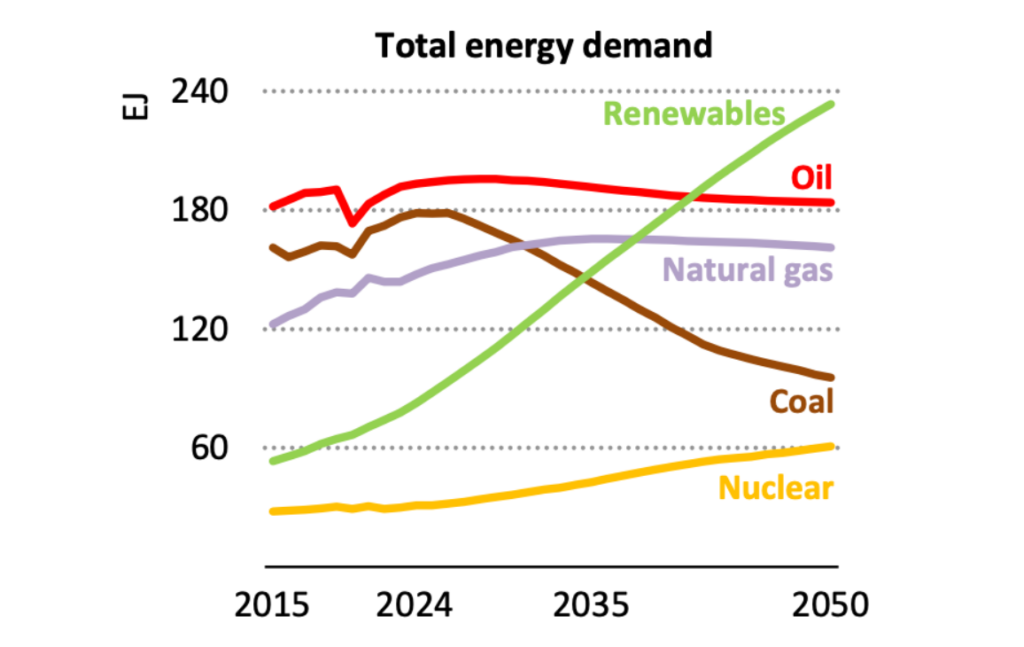
Image credit: [4]
Meeting this moment effectively requires understanding how the questions we’re asking limit our understanding of the situation. I recall a conversation I had at a conference about four years ago with Canada’s “Queen of Green,” Tzeporah Berman. [5] We sat down next to each other at a meal, and I was chatting away casually, not knowing who she was until someone else joined us at the table and asked her about her TED Talk. [6] Berman’s revelation was that, when it comes to climate change mitigation, we tend to focus on how many greenhouse gases we’re emitting, rather than how much fossil fuel we’re extracting. As she said at the time, whether the avenue was governmental policy or commerce (via carbon markets), those efforts to measure and reduce GHG emissions have not been effective because fossil fuel extraction has continued to increase, and no one was working to reduce that metric. And that was what inspired her to found the Fossil Fuel Non-Proliferation Treaty, which includes a global registry to track fossil fuel extraction and reserves. [7]
I was disappointed to hear from her that carbon markets were not as effective as many had hoped, though she explained that government subsidies for fossil fuel development were skewing the potential impact of carbon pricing. For many years, I have held out hope that if smart policy can’t save us, smart business decisions will. Indeed, renewable energy sources continue to grow in availability, affordability, reliability, and deployment speed, [8],[9] making them a wise choice for increasing capacity in an aging grid. However, at least in this neck of the woods, we are still seeing a preference for fossil-fired capacity, despite the increasingly favorable business case for renewables.
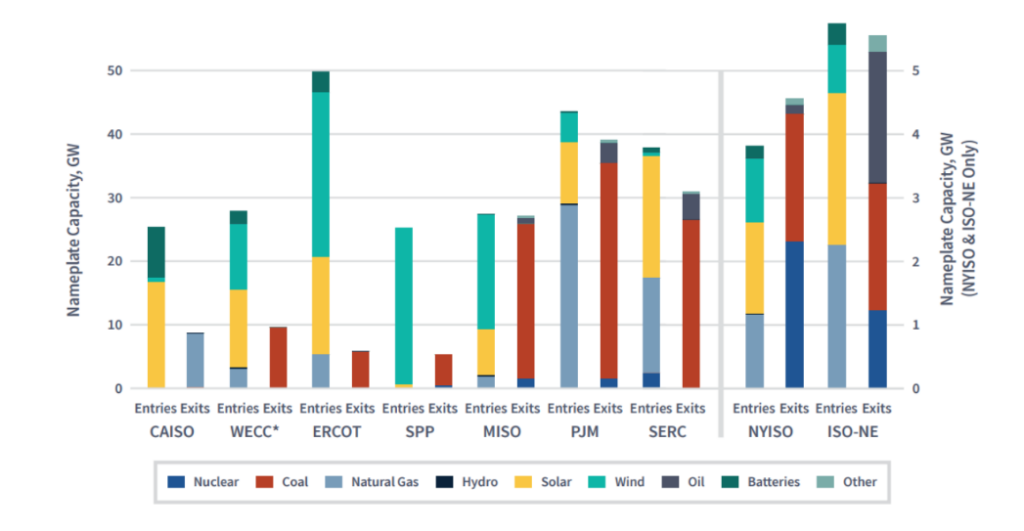
Image credit: [10]
Part of the reason for this slow change is that perceptions lag, and many in power may still believe that fossil fuels will always be the more abundant, affordable, and reliable choice for energy supply. But there are some other factors explaining so much inertia, such as the state of our infrastructure and the fragmented policy frameworks that oversee it. Our aging electricity grid was designed for large, centralized loads, rather than small, distributed ones. [11] The current transformer shortage [12] is part of the reason why it is taking so long to get new projects connected to the grid, and probably part of why my local electrical grid (PJM) seems to be prioritizing connection for large fossil-powered producers over the hundreds of gigawatts’ worth of smaller renewable sources that have been waiting in the queue for years. [13]
Understanding the Layers
That slow-moving queue was already posing a problem, but now we’re also expecting an explosion of demand with the rise of hyperscale data centers in Pennsylvania. Most of the data centers around the country are small to medium sized, consuming around 1-20 megawatts each; PA and some of our neighbors are newer to hosting data centers, but we’re apparently trying to make up for lost time with proposed facilities ranging from 100 MW to over 4 GW. [14] In an effort to alleviate grid constraints, some of these facilities will be building their own generation to offset the added demand and will probably be required to pay for related interconnection and infrastructure upgrades in order to protect other utility ratepayers from cost increases. [15] While that may sound like a good idea on the surface, most of that new generation is expected to be gas-fired, which will mean more fracking across the region and contribute to the climate impacts we’re already failing to reverse.
For over a century, Pennsylvania has been a pioneer in energy production: the first commercial oil well was drilled in Titusville in 1859, [16] the first commercial nuclear power station was opened in Shippingport in 1957, [17] and the first Marcellus Shale fracking well in 2004 opened the door for the fracking boom that reshaped not only Pennsylvania’s economy, but the United States’ as well. [18] For many communities in this region, energy generation is tied into their identity – and their budgets. For as upset as many of us were about our governor’s Earth Day announcement that he would be extending the lives of two coal-fired power plants, [19] I know someone who lives in Indiana County who told me there is a lot of concern about how the county would balance its budget without the tax revenue from the Conemaugh Generating Station.
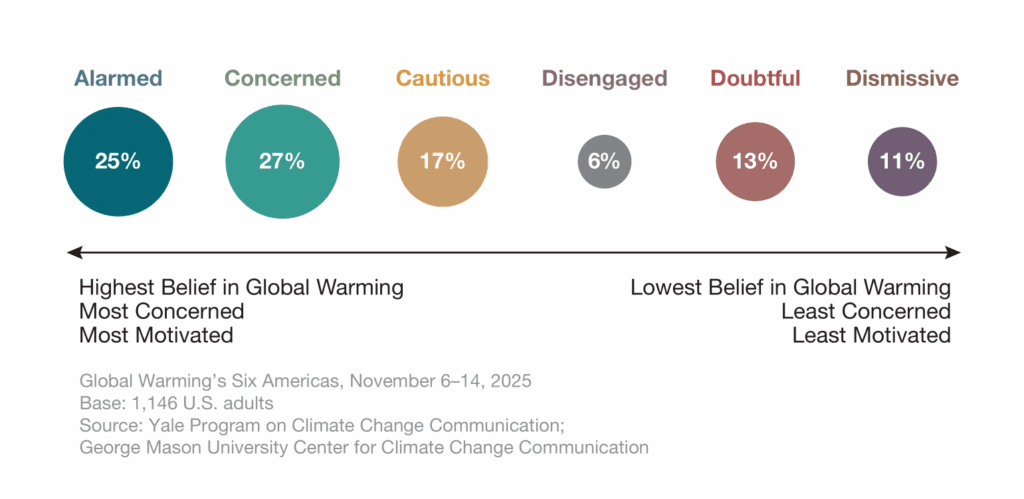
Image credit: [20]
If I chose to do so, I could very easily sit comfortably inside my safe little bubble of personal experiences, insulated by my relative financial security, dictating a one-size-fits-all policy based on the facts that continued dependence on fossil fuels will wreak havoc on our environment, our climate, the health and safety of people near and far, and our long-term economic wellbeing. Those are facts. Even in the United States, only about one in 10 people actively rejects climate science anymore. [21] It’s not the climate denial that’s the problem now; it’s the uncertainty about what a transition will mean for systems that are currently built on on fossil fuels in one way or another. For municipalities, counties, states, and even countries that rely on fossil fuel revenue, the prospect of transitioning to renewables can be a scary thing. Change is scary, and that keeps individuals, governments, and companies clinging to the technologies that got us into this problem, either accepting them as a necessary evil or grasping for a “get out of jail free” innovation that can allow us to continue extracting fossil fuels without experiencing the consequences. (For the record, that’s not how physics works.)
It is worth pointing out that Pennsylvania’s identity as an energy producer doesn’t have to mean fossil fuels: we could support technological innovations that meet the needs of the moment we’re in and provide clean jobs to Pennsylvanians in the process. Just because it’s easier said than done doesn’t mean it’s not necessary. To use Berman’s words, I believe there are a lot of “good people stuck in bad systems.” As I learned in my Climate Lab, it’s hard to have systemic change that is also just and that effectively addresses the unique concerns of different people in different situations. We know that there is no silver bullet approach to climate change, which is why I was so excited to see different countries coming together for some outside-the-box thinking in Colombia last week. And that’s where we’ll pick up in Part 2: with the first international conference specifically focused on transitioning away from fossil fuels.
In the meantime, I’m curious to hear about your perspective. What are you most concerned about and what questions do you have? Let me know in the comments.
And thanks for reading!
[1] https://en.wikipedia.org/wiki/Paris_Agreement
[3] https://www.rff.org/publications/reports/global-energy-outlook-2026/
[5] https://en.wikipedia.org/wiki/Tzeporah_Berman
[6] https://www.ted.com/talks/tzeporah_berman_the_bad_math_of_the_fossil_fuel_industry
[7] https://en.wikipedia.org/wiki/Fossil_Fuel_Non-Proliferation_Treaty_Initiative
[11] https://a16z.com/decentralizing-the-electric-grid/
[12] https://radicalmoderate.online/more-than-meets-the-eye/
[14] https://e360.yale.edu/features/pennsylvania-data-centers-natural-gas
[16] https://www.ebsco.com/research-starters/power-and-energy/pennsylvanias-energy-consumption
[17] https://eartharchives.psu.edu/2020/04/13/pennsylvanias-energy-heritage/
[18] https://www.pennlive.com/news/2016/03/the_rise_and_fall_and_rise_of.html
[20] https://climatecommunication.gmu.edu/all/global-warmings-six-americas-fall-2025/
[21] https://climatecommunication.gmu.edu/all/global-warmings-six-americas-fall-2025/
0 Comments