Every year by now I’m already behind when it comes to battling weeds in my yard. I always imagine I’ll have time to get out and pull weeds before they flower, but when I was out last weekend, it was already too late to prevent the hairy bittercress from shooting its seeds in every direction as I delicately removed handfuls along the driveway. [1] I couldn’t believe I was already so far behind on what was basically my first chance to get out in the garden this year. Then the immortal words of Pink Floyd came to me: “every year is getting shorter / never seem to find the time.” [2]
Pick Your Battles
Between traveling (wedding/vacation, seeing family, and a work trip) and unfavorable weather conditions over the last two months, I have had very few opportunities to actually do any yardwork. I only applied my nematodes in the middle of April (too late, unfortunately, so we’ve been dealing with termite swarms the last few weeks) [3] and just removed most of last year’s dead plant growth from garden beds to a brush pile in the back, [4] but that’s about it. I’ve been waiting for weeks for 24 hours without rain so I can apply maleic hydrazide to the thistle that is already starting to bolt, [5] but that has yet to coincide with times I’ve actually been at home.
It’s usually mid-April when all the dandelions pop in my yard at once. I am more than happy to leave them in the lawn as an early food source for pollinators (and as a way to normalize weeds, in spite of all of our neighbors who get regular chemical lawn treatments), but I have always tried to pull them from my garden beds as much as I can, again, before they go to seed. Sometimes I will vainly run around and deadhead the little yellow blooms (or, heaven forbid, the white puffs) before they spread, making a mental note to return with my dandelion tool later. (That usually doesn’t happen, at least not in a timely manner.)
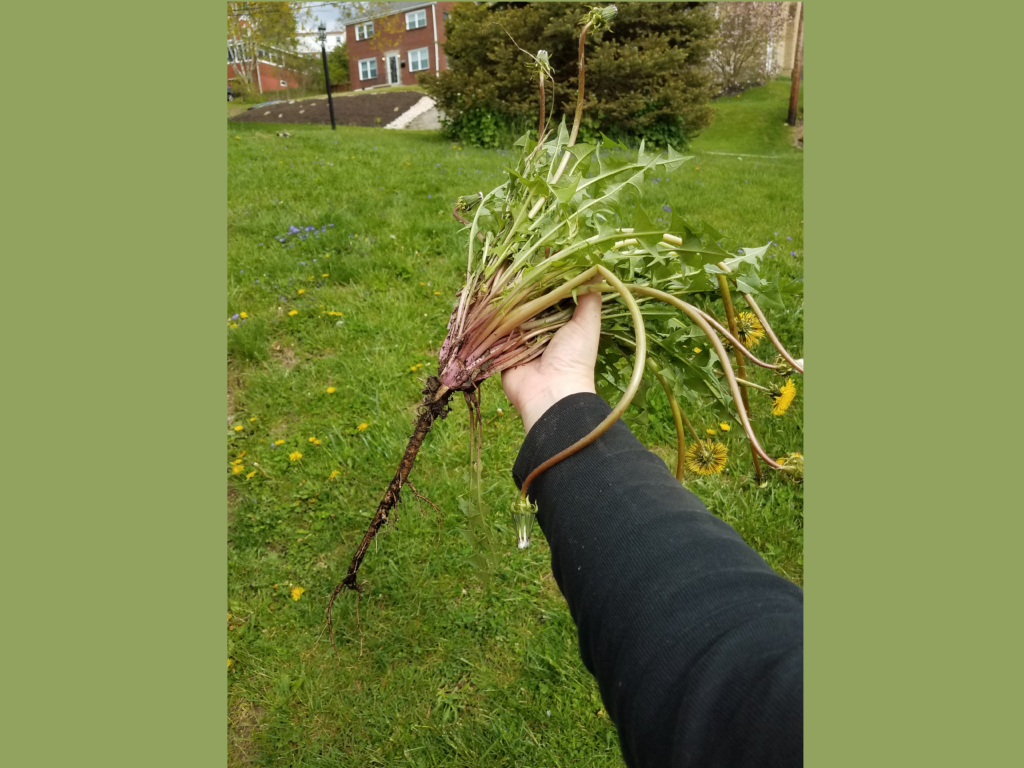
Last week, when I saw the white seed heads all over my yard and lamented not getting to them sooner, I remembered something I had read years ago about how dandelions actually benefit the soil: aerating it, loosening clay, providing nutrients… and then I wondered when and why I started fighting them in the first place. With limited time and growing thistle still to wrangle, it occurred to me that I was going to have to pick my battles in the garden, and the dandelion battle may be one that is not worth my time. (So, obviously, I’m going to take some time to justify this course of inaction!)
Taraxacum officinale
It is possible that I originally fought these plants because I didn’t want them taking over my gardens and overcrowding the plants I wanted to put there. Their pollen has low nutritional value, [6] and the whole purpose of a native pollinator garden is to stock it with highly nutritious food that native pollinators evolved to consume. However, converting ever-expanding patches of lawn into garden beds is a lengthy, years-long process, [7] and there are still some very inhospitable, clay-heavy sections of my yard that are now “garden” in name only. No matter how diligently I dig larger-than-necessary holes that I back-fill with a mix of soil, compost, and mycorrhizae to create a welcoming environment for new garden residents, most of them have still struggled in places that weren’t already a garden at one point.
Could I, instead of fighting to dig dandelions out of clay (and destroying my dandelion tool in the process), let the dandelions make my “garden” beds more welcoming to the plants I eventually want to put there? Yes, I think so. Recognizing that a healthy dandelion can produce 2000 seeds a season, [8] could calling a truce with them reduce some of the frustrating futility of certain gardening activities and allow me to optimize my limited gardening time? Yes, definitely. So, as a result, I am calling a truce with this non-native but arguably-beneficial weed.
Dandelions are great at making their homes in compacted soils with poor growing conditions. Their long taproots make their way through compacted soil, which serves several functions: improving aeration and drainage in the area and bringing up moisture and minerals from further down in the ground. The dandelion uses those nutrients to grow, but when the foliage dies and decomposes, it adds nutrients to the topsoil, meaning that over time, the dandelion contributes to the soil quality in multiple ways. [9] (It was at this point I had to stop and laugh at my neighbors who pay a company to come kill the dandelions in their lawns and also pay a company to come aerate their lawns.)
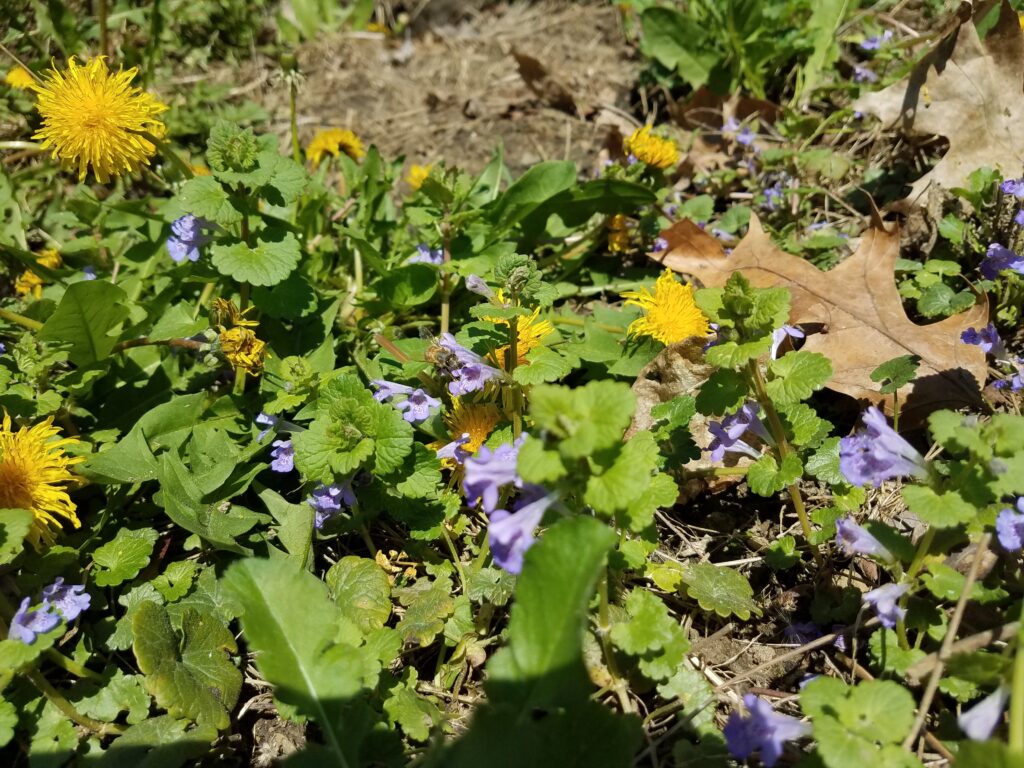
The source I remembered from years ago (and cannot find for this post) indicated that dandelions prefer poor soil and will be less likely to grow in rich soil. Given that, gardeners should not worry about them, as they’ll go away on their own once the soil improves. From the reading I’ve done for this post, that seems not to be the case: dandelions also seem to prefer good quality soil, but when in it they have much more competition from plants that aren’t as resilient in poor conditions. [10] Indeed, I do feel like I see fewer dandelions in my older, more established, fuller garden beds than in the newer ones. And our lawn still has plenty – in fact, whenever I have pulled or dead-headed garden dandelions in previous years, I’ve simply tossed them in the lawn, in hopes that they will just go to seed there.
From Garden to Kitchen
But it’s also not necessarily a bad thing if we have a few dandelions left in the garden because I’m learning they have health benefits for humans. I always knew they were edible (and have even purchased dandelion leaves in my Community Supported Agriculture subscription [11]), but I was not aware that the flowers, leaves, and roots all provide distinct health benefits. Several sources have listed their medicinal use in multiple cultures, including ancient Egypt, Greece, Rome, China, Japan, and among some Native American tribes (which seems suspect, given the widespread belief that they were intentionally brought to North America by Pilgrims on the Mayflower). [12], [13], [14]
Dandelions are rich in antioxidants and vitamins A, C, and K, and they have been used throughout history to treat digestive issues and inflammation. You can even find companies selling various forms of dandelion as a product – something so many of us spend time and money trying to get rid of! (If commodification of weeds isn’t a symptom of late-stage capitalism, I don’t know what is.) Nonetheless, I was impressed that this company included citations to peer-reviewed research with each of the following claims: [15]
- “The Leaves: Dandelion leaves are mineral-rich and mildly bitter. They contain meaningful amounts of vitamins A, C, and K alongside calcium, magnesium, potassium, and iron. The compounds doing most of the medicinal heavy lifting are the sesquiterpene lactones (the source of the bitterness), chicoric acid (a polyphenol studied for blood-sugar and immune-modulating activity), and chlorogenic acid. [16]
- The Flowers: The bright yellow blossoms concentrate flavonoids, most notably luteolin and apigenin, alongside chlorogenic acid and a spectrum of other polyphenols. These are antioxidant molecules, and they are what give the flower its traditional reputation as a topically soothing and internally uplifting medicine. [17]
- The Roots: Dandelion root is famously high in inulin, a soluble prebiotic fiber that can comprise up to 40 percent of the dry root weight in autumn-harvested material. It also carries taraxasterol and related triterpenes, which have been investigated for liver and anti-inflammatory activity in preclinical research. [18]”
I will also note that Masterclass is advertising a course on dandelion foraging, if you needed further proof of the value of (and growing demand for) this plant. [19] Meanwhile, for those of us with no shortage of dandelions that are not covered in herbicides and pesticides, there is a slew of information online about how to cook and use them for tea, wine, salad, salad dressing, syrup, jelly, pickles, and pesto; [20] how to stew and fry different parts of them; how to process the root to use it as a coffee substitute; [21] and how to preserve them, whether through drying, [22] freezing, or canning.
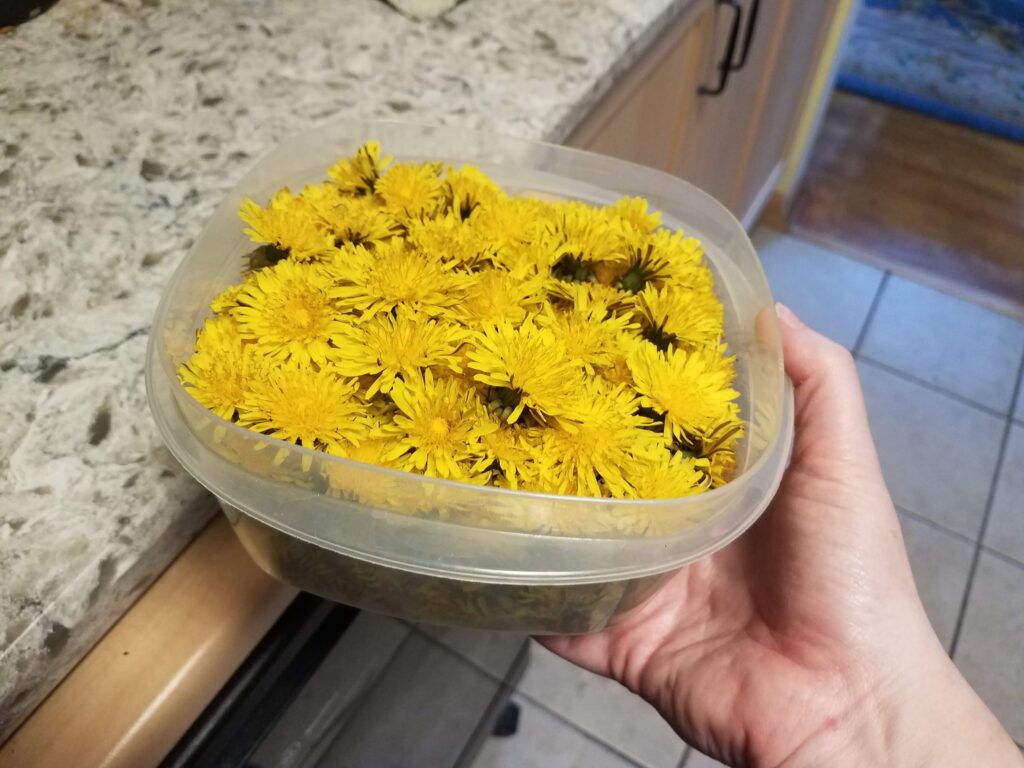
There never seems to be any shortage of dandelions in my yard, but I will probably look into drying some of the blooms for tea. I’ll no doubt have plenty to report back on in the future – including how well these now-uninhibited dandelions are improving my nascent garden beds and how well some of these dandelion recipes have turned out (in case I find time to cook them – in addition to pulling them).
How about you? Have you made use of dandelions in your kitchen? I’d love to hear about your favorite recipes below.
Thanks for reading!
[1] https://www.canr.msu.edu/news/identify-and-manage-hairy-bittercress-in-nurseries-greenhouses-part-1
[2] https://genius.com/Pink-floyd-time-lyrics
[3] https://radicalmoderate.online/terminator-2/
[4] https://radicalmoderate.online/spring-garden-cleanup/
[5] https://radicalmoderate.online/organic-vs-synthetic-herbicides/
[7] https://radicalmoderate.online/pollinator-garden-update-2021/
[8] https://seedsheets.com/the-dandelion-life-cycle-and-why-its-so-resilient
[9] https://seedsheets.com/the-dandelion-life-cycle-and-why-its-so-resilient/
[10] https://www.gardenguides.com/1876407/dandelions-meaning-health-soil-lawn-yard/
[11] https://www.eatharvie.com/about/
[12] https://www.mofga.org/resources/weeds/ten-things-you-might-not-know-about-dandelions/
[14] https://www.backthenhistory.com/articles/the-history-of-dandelions
[16] https://pubmed.ncbi.nlm.nih.gov/16950583/
[17] https://pubmed.ncbi.nlm.nih.gov/22946853/
[18] https://pubmed.ncbi.nlm.nih.gov/15567259/
[19] https://www.masterclass.com/articles/are-dandelions-edible-raw
[20] https://www.almanac.com/dandelion-recipes-wonderful-edible-weed
[21] https://www.coffeeness.de/en/dandelion-coffee/
[22] https://homelyhens.com/medicinal-herbal-remedies/how-to-dry-dandelions/
3 Comments
K. Theresa White · May 3, 2026 at 1:36 am
Friend👍🏽
Garden Update, 2026; or, A Weed by Any Other Name – Radical Moderate · September 27, 2026 at 10:00 am
[…] are one in particular that I’ve decided to let help me as I wait for the soil to improve. [15]) But the grass was bad. Two years of letting the grass proliferate throughout the corner and […]
Darn It! – Shifting Norms – Radical Moderate · October 3, 2026 at 10:07 pm
[…] Dandelions: Friend or Foe?April 26, 2026 […]