Climate scientist Katharine Hayhoe has been making the rounds in news outlets for the past few years talking about the value of having conversations as a way to tackle climate change – and she means conversations, not arguments. I highlighted her book [1] on this blog four years (and what seems like a lifetime) ago [2] as a way to bridge the growing gaps in our society by more effectively navigating conversations with those who disagree with us. As a Canadian who lives in Texas and an evangelical Christian who works in climate science, Hayhoe is no stranger to having conversations with people who have different perspectives.
So much of the conflict I encounter on a regular basis – in my life and in my job – takes the form of an “us vs. them” mentality, which is hard-wired into our brains. We humans readily go into that mode to protect ourselves – indeed, it’s why we’re still here because it helped our ancestors survive at some point (or many points) in our evolution. Our brains tell us to trust those in our “in” group and distrust those outside of it, which is why labels that categorize people into tidy groups are so seductive and persuasive. But if we expand our “in” group labels to be more inclusive (from Pittsburgher, to Pennsylvanian, to American, to human), we are more likely to trust (or at least work together with) other members of that larger group. [3] It’s part of why we sometimes see unlikely allies fighting common enemies.
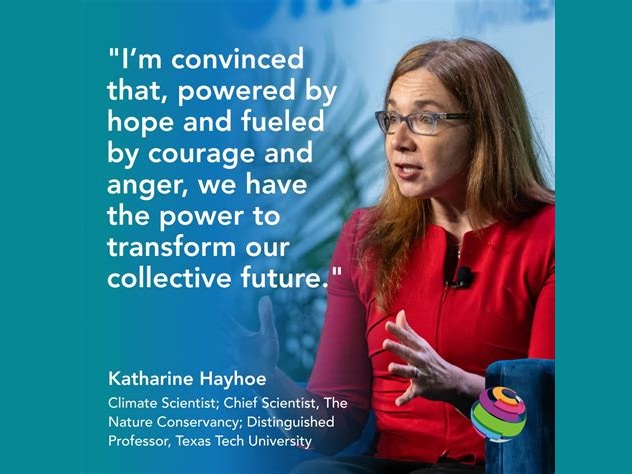
Image credit: [4]
But, as tempting as it may be to believe it, the common enemy here is not humans working in certain industries or humans aligned with certain political parties – it is climate change itself, which will impact us all eventually, no matter our jobs or politics. And Hayhoe’s approach is not to shame anyone who doesn’t realize that yet; it is to listen to them, understand their perspective, meet them where they are, and then help them understand how what and who they love will be impacted. She describes catching an entire room of fossil fuel professionals off guard when she started a presentation by talking about all the ways fossil fuels have benefited our lives up until now. Hayhoe will be among the first to recognize those benefits while also recognizing that fossil fuels will not continue to benefit us in the long run.
“Fossil fuels have brought us many benefits – and I’m grateful for their contribution to my life – but the solution to our current crisis is to stop using them. That change can be scary, especially for those with most to lose financially from this shift. If you feel threatened, the instinctive reaction is to push back.”
– Katharine Hayhoe [5]
Silver Buckshot
For years I’ve been involved with an organization that is focused on promoting market-based solutions for climate change. [6] It is largely made up of conservatives and centrists but welcomes people from across the political spectrum – basically anyone who is concerned about climate change … as well as the current (very slow, policy-based) course of action we’re taking to address it. For me, I believe that we don’t have to choose between economic solutions and policy solutions because we’ll need to try multiple approaches in order to get meaningful results. I also believe that political lines are no longer an indication of net-positive climate action, with democratic President Biden overseeing what was then-record oil and gas drilling in the United States [7] and Pennsylvania’s democratic governor now being extremely friendly to the gas industry [8] and industries that will spur continued gas extraction. [9]
Of course, the United States’ climate contribution is going from bad to worse in the current “drill, baby, drill” environment, with President Trump’s second administration pulling us out of the Paris Climate Agreement (again) [10] and using the Defense Production Act to expand gas extraction and infrastructure even further. [11] Ironically, it is the party that claims to be in favor of small government that is overriding state-level authority, [12] and it is the party that claims to be in favor of free-market solutions that is artificially propping up an industry that represents increasing harm for long-term business interests. [13]
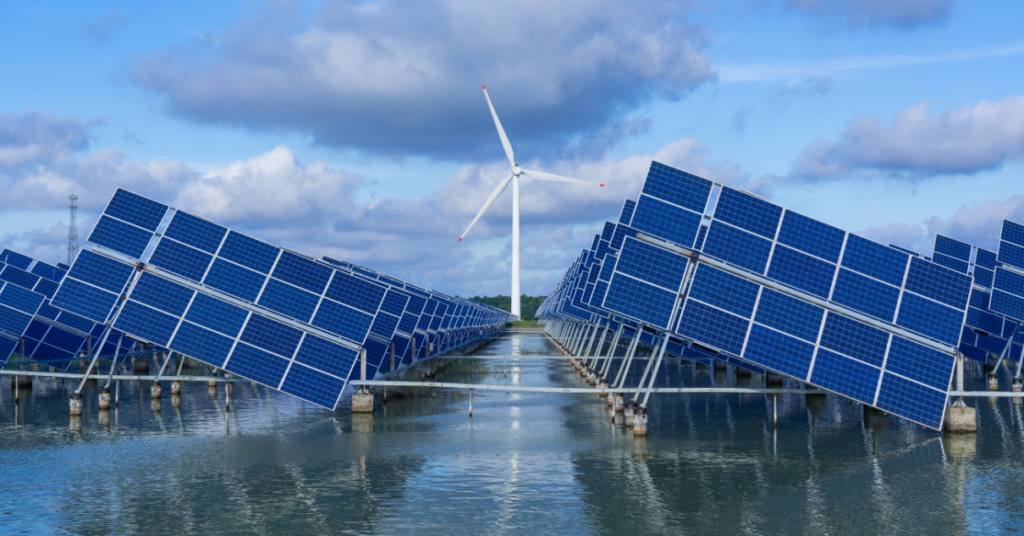
Image credit: [14]
Long-term economic impacts can feel abstract if you’re worried about your household budget for the coming month. And for years, proponents of fossil fuels have relied on the narrative that fossil fuels are cheaper than renewables – a narrative that is quickly becoming false with continued technological advances, and a perception that is rapidly crumbling in light of the current oil crisis. For the record, I am not taking any joy in what could be an “I told you so” moment because the people who are suffering most of the consequences are people who have limited power in the situation. We could have been actively planning for a managed transition away from fossil fuels in order to ensure that people who rely on them are supported effectively as their sources of energy and revenue shift… but we have not been doing that. And as Tzeporah Berman, Canada’s “Queen of Green,” has pointed out, in an unmanaged decline of fossil fuels, people will suffer. [15]
Group Projects Suck
As I mentioned in last week’s post, there are communities here in Pennsylvania that don’t know how they will balance their budgets without revenue from coal-based energy production; people who have spent a career in fossil fuel extraction who don’t know what they’d do if those jobs went away. But the transition is already happening in other states and other countries, no matter how anyone feels about it, and what we’re seeing here in the US is a microcosm of what’s happening globally. There are wealthy countries and multi-national businesses that have power because of fossil fuels and don’t want to let that power go; there are small countries that don’t have many other options at the moment because they are financially dependent on fossil fuel extraction, even if they don’t want to be.
Businesses and governments that are looking ahead and planning for the inevitable shift from fossil fuels to renewables will be better prepared to navigate the transition, if not actively participate in establishing the new power structures that will emerge in the process. Those of us who are not planning ahead for that change will have the terms dictated for us. As the saying goes, “if you’re not at the table, you could be on the menu.” For that reason, I personally was very frustrated that an ostensibly business-savvy leader pulled the United States out of global climate negotiations. Twice.
But other nations have been frustrated with lack of progress achieved at the United Nations’ Conference of Parties over the years. The negotiations in these annual climate talks require consensus, which can pose some difficulties, given the reasons mentioned above. Gaining consensus in a diverse group is incredibly valuable for determining a successful path forward, and it is something I strive for as a leader whenever possible – but the result at COP generally means that global goals related to climate change don’t even mention fossil fuel reductions because of pushback from large petrostates. [16]
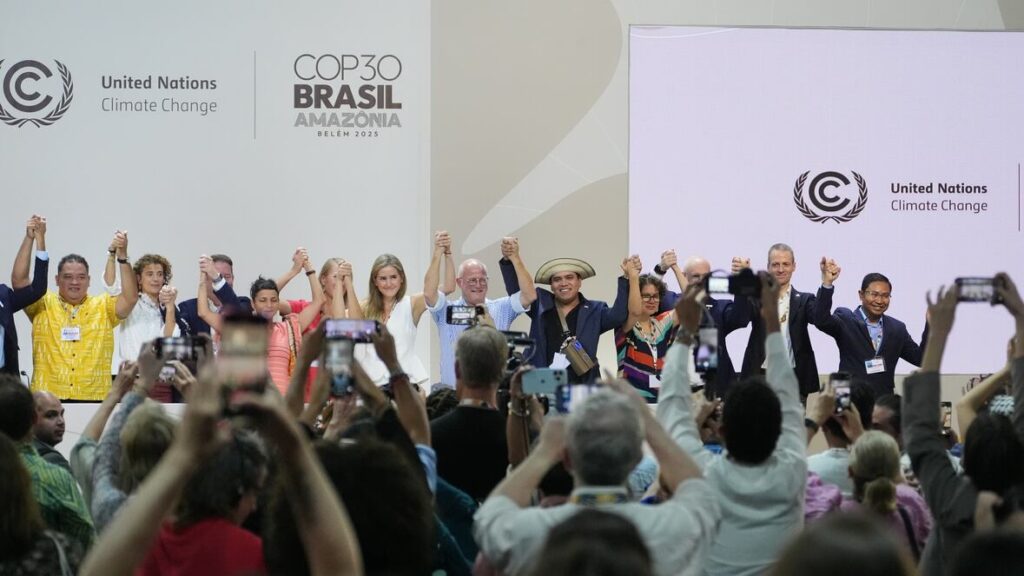
Image credit: [17]
As a result, we often see countries with comparatively small power on the world stage doing more than their fair share to reduce their comparatively small emissions while also begging large, highly emitting countries to take more decisive action, which would result in more significant global impacts to curb climate change. But even for the nearly 200 countries that voluntarily participate in COP, there are no hard requirements to commit to certain actions and no penalties for failing to achieve self-determined goals.
Strength in Numbers
Consequently, partly out of a need for action and recognition that the COP process has been too slow and too ineffective, over 50 countries gathered in Colombia last month for the inaugural Conference on Transitioning Away from Fossil Fuels. [18] While many of the countries represented were smaller with individually less weight behind their names on the world economic stage, together they represented “more than half of global GDP, nearly a third of energy demand, and a fifth of fossil fuel supply.” While they may not have much ability to push an agenda through at COP, where consensus rules, this group could certainly impact global energy markets when working together. [19]
Recognizing that every country is different and has unique challenges, this diverse group focused on the common goal of phasing out fossil fuels and identified some of the biggest obstacles, such as financing, labor transitions, and trade policy. As mentioned before, some of these countries want to transition but are trapped in a cycle of financing debt with fossil fuel projects and need financial support as well as technological and policy guidance in order to build healthier, more robust economic systems that don’t rely on fossil fuel extraction. [20] And some of the more experienced, wealthier countries have agreed to support those needing such assistance – because, ultimately, the entire globe will benefit from a successful transition away from fossil fuels.
I still have hope that economic indicators will continue to shift the scales in favor of renewable energy projects – indeed, the world’s leading energy economist has said that the current energy crisis has changed the energy landscape permanently in some ways. The closure of the Strait of Hormuz will have impacts for years after it reopens, and its closure to date may have already been enough to spur faster action in this transition. [21] I do agree that there will need to be thoughtful, proactive planning efforts to make sure that those who have historically been excluded will have a seat at the table moving forward, but it is heartening to know that such conversations are already happening – this year in Colombia and next year in Tuvalu. This space will certainly be one to watch, as countries will be working on solutions like their lives depend on it – because they do.
~
I’d love to hear what you think about necessary components of a just energy transition. Have you been involved in any efforts yourself at any level of business or government, and what do those look like?
Thanks for reading!
[1] https://www.goodreads.com/en/book/show/56379758-saving-us
[2] https://radicalmoderate.online/saving-us-getting-through-2022-together-part-1
[3] https://www.amazon.com/Managing-Climate-Change-Business-Consequences/dp/0230115837
[7] https://www.newsweek.com/joe-biden-producting-more-oil-donald-trump-environment-1858714
[10] https://apnews.com/article/trump-paris-agreement-climate-change-788907bb89fe307a964be757313cdfb0
[13] https://online.hbs.edu/blog/post/climate-change-affecting-businesses
[15] https://www.ted.com/talks/tzeporah_berman_the_bad_math_of_the_fossil_fuel_industry?language=en
[17] https://www.cbc.ca/news/science/climate-summit-transition-fossil-fuels-9.7175158
[18] https://www.fossilfueltreaty.org/
[19] https://www.theguardian.com/environment/2026/apr/30/colombia-climate-talks-end-fossil-fuel-phaseout
1 Comment
Fossil Phaseout, Part 1 – Radical Moderate · October 3, 2026 at 10:09 pm
[…] Fossil Phaseout, Part 2May 10, 2026 […]