“Time travel is like visiting Paris. You can’t just read the guidebook. You’ve got to throw yourself in! Eat the food, use the wrong verbs, get charged double, and wind up kissing complete strangers! Or is that just me?”
– The Doctor, “Doctor Who”
For nearly two decades I clung tightly to this enthusiastic description of adventure, as Christopher Eccleston’s iteration of The Doctor doled out sage travel advice in an early episode of the 2005 revival of “Doctor Who.” When I travel, I seek immersive, unpredictable, authentic experiences – but I’ve recently grappled with the fact that some of the more authentic ecotourism experiences still require a guide or host of some kind, which still makes me an outside observer (i.e. a tourist). [1] And tourists we were as we headed out into Galápagos National Park, where our activities were strictly regulated. In the park (i.e. 97% of the land area plus surrounding waters), there are 54 land sites and 62 snorkel/SCUBA sites where tourists are allowed in small groups for 2-4 hours at a time in order to limit environmental impact. [2]
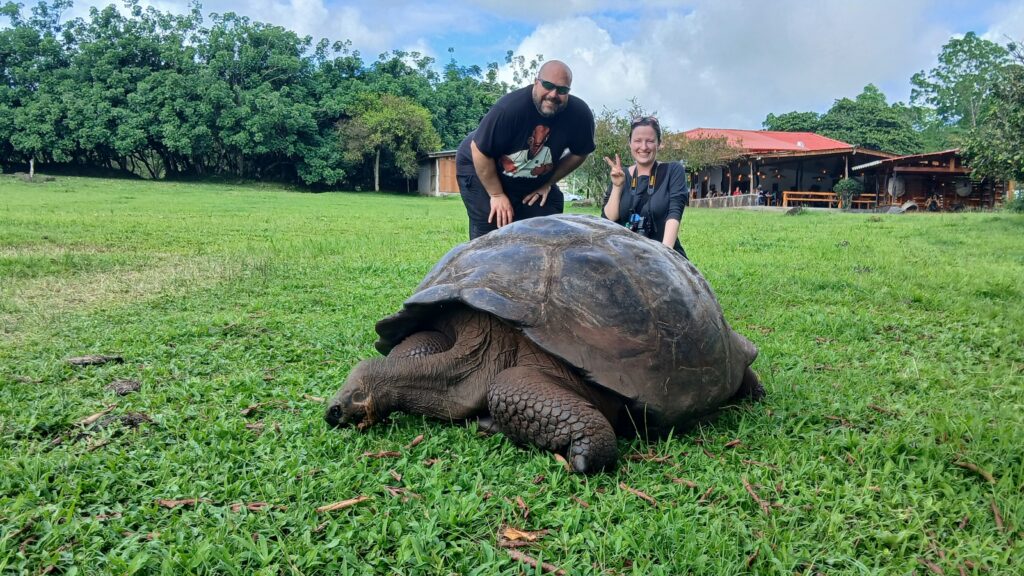
Photo credit: Ramiro, our tour guide on Santa Cruz
In what appears to be a fairly standard maneuver for many tourists who hope to see untouched natural beauty, tour companies offer day trips to uninhabited islands for a hike, a snorkel, and a freshly prepared lunch on the boat. The groups are about 10-15 tourists, which is small enough to be manageable for tour logistics and large enough to be affordable for splitting the overhead of a full-day trip, with a bus to and from the port, boat to and from the island, fuel, food, equipment, and wages for the boat crew and tour guide. I get the impression that most tourists who are in Galápagos for a rushed three-night stay, as we were, do one such uninhabited island trip; we did two (and slept very well both nights).
Land
I was shocked to learn how young these islands are. Coming from the Appalachian mountains, which are approximately 480 million years old, we were touring land about 5 million years old, at most. The archipelago is forming from east to west, and some of the western islands, such as Isabela and Fernandina, are estimated to be a couple hundred thousand years old and are still being formed. [3] Also fascinating is the range in size, vegetation, and features among them. I’ve known for years about Darwin’s revelation about different conditions on different islands leading to different characteristics of their inhabitants, but it didn’t quite hit me how different these islands might be.
The size of islands can make a big difference. Some of the smaller, lower islands (such as Bartolomé, which we visited on the first tour), have limited vegetation and are made of volcanic rock. Our hike up to Bartolomé’s 374-foot peak was extremely hot, with reddish brown rock absorbing and radiating heat. Only little shrubby tequila plants and the occasional lava cactus dotted our path along the wooden walkway, with the occasional tiny lava lizard (just a few inches long) scampering around, jumping between plants if possible. It was a world apart from Santa Cruz Island, where we were staying, which boasts a tropical rainforest climate in its highlands (about 700-1,000 ft).
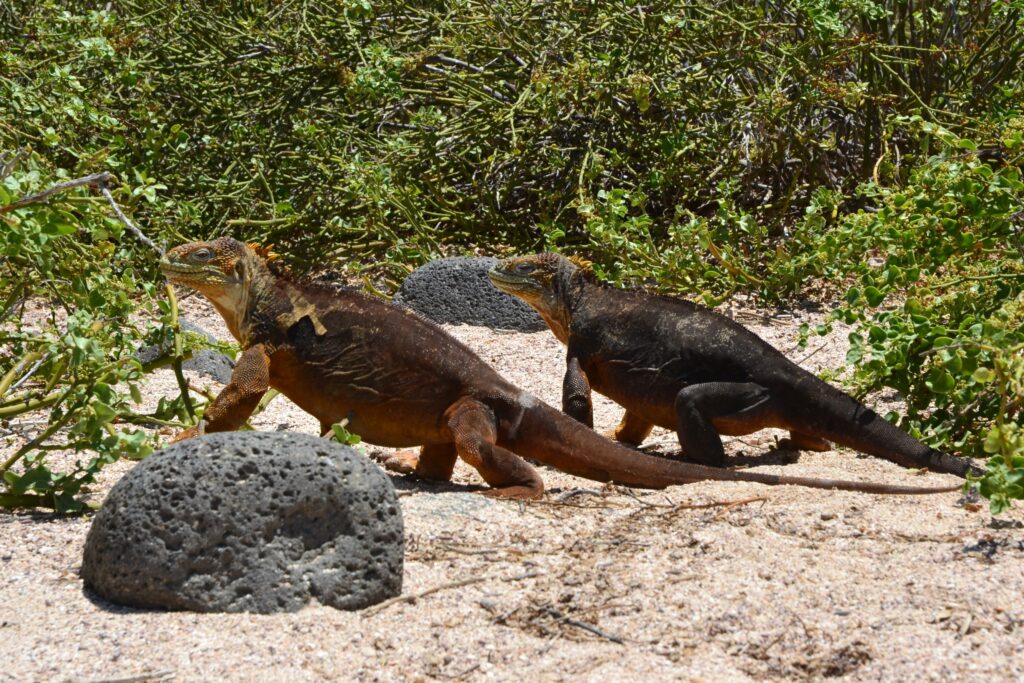
It isn’t just the size and elevation that play a role in the characteristics of an island. While Bartolomé is younger, cone-shaped, and was formed through volcanic eruptions, Seymour Norte (which we visited on our second tour), is older, flatter, and was formed by the seabed being pushed upward through movements of the tectonic plates. Although the two are relatively small in size (less than one square mile) and low in elevation, Seymour Norte is covered in shrubby trees and hosts large birds and lizards. It similarly receives very little rainfall, but our hike there felt markedly different and much more hospitable than the volcanic cone we had explored the day before.
Sky
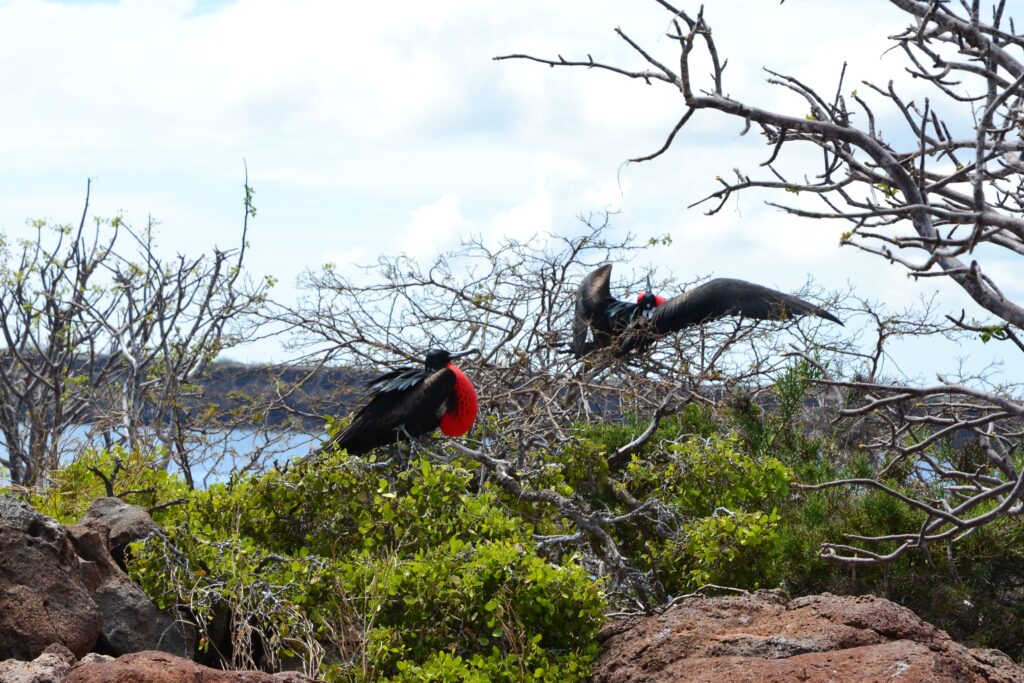
Seymour Norte really felt like a jackpot of bird life. While we didn’t see any finches, we had some amazing encounters with larger (much larger) avian residents. Pelicans coasted overhead as we made our way from the boat to shore in a zodiac; we saw swallow-tailed gulls nestled in rocks above the water as we got close. But the real showstoppers were the frigatebirds. With an impressive wingspan of 7-8 feet, frigatebirds are un-missable as they hang in the sky. During mating season, adult males inflate a bright red pouch at their throats to impress females. None of the females we saw were quite as impressed as the tourists, who kept pressing forward to get the best shots with their cameras.
In Galápagos, humans are required to keep a 2 meter (6 ft) distance from all wildlife – both for the wildlife’s protection and sometimes their own. It was unfortunately something our tour guide had to repeat to a few members of our group, especially when we encountered a juvenile frigatebird in the nest, just feet away from the path. Despite their impressive wingspan (almost that of adults’), juveniles cannot fly, and if they fall out of the nest, they cannot get back into it. Sometimes they fall out of their nests if frightened by tourists, which may have been what happened to a dead one on the ground nearby. After that, a Swiss lady and I began assisting our guide with enforcement of the 2m rule (much to the annoyance of everyone else, I’m sure).
But in general, the animals we encountered were largely unbothered. The land iguanas were probably the most skittish if out in the open, but often resorted to a staring contest if parked under brush. The most surprising moment happened when our group was circled around a juvenile blue-footed booby: it hopped off of its rock and went to investigate someone in our group who was dressed in blue. I was continually struck by what a rare privilege it was to be among animals who really didn’t care that humans were there. Bored animals in zoos behind glass tend not to care, but this experience was different. It seemed like these animals didn’t have enough awareness of humans to know to be scared of us… when they really should.
Sea
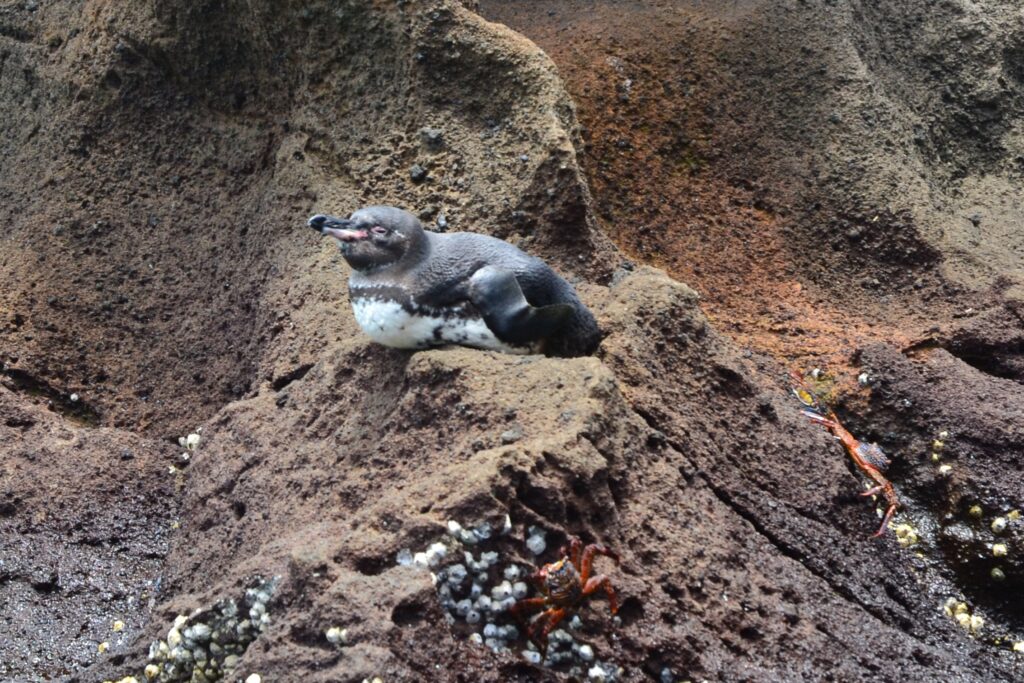
There are fewer than 2,000 adult Galápagos Penguins, and we saw one of them from the zodiac after our hike on Bartolomé. [4] The only penguin that exists north of the equator is endangered, in part because of habitat loss, unsustainable fishing practices, and plastic pollution, as well as non-native predators that have been introduced to the islands, including cats, rats, and dogs. Since they are also impacted by warming ocean temperatures, climate change and El Niño events pose additional threats to them, with increases in ocean temperatures decreasing available food sources. They do not breed in times of famine, but conservation efforts have included constructing safe nesting spaces in breeding years and eliminating invasive species on certain islands. [5]
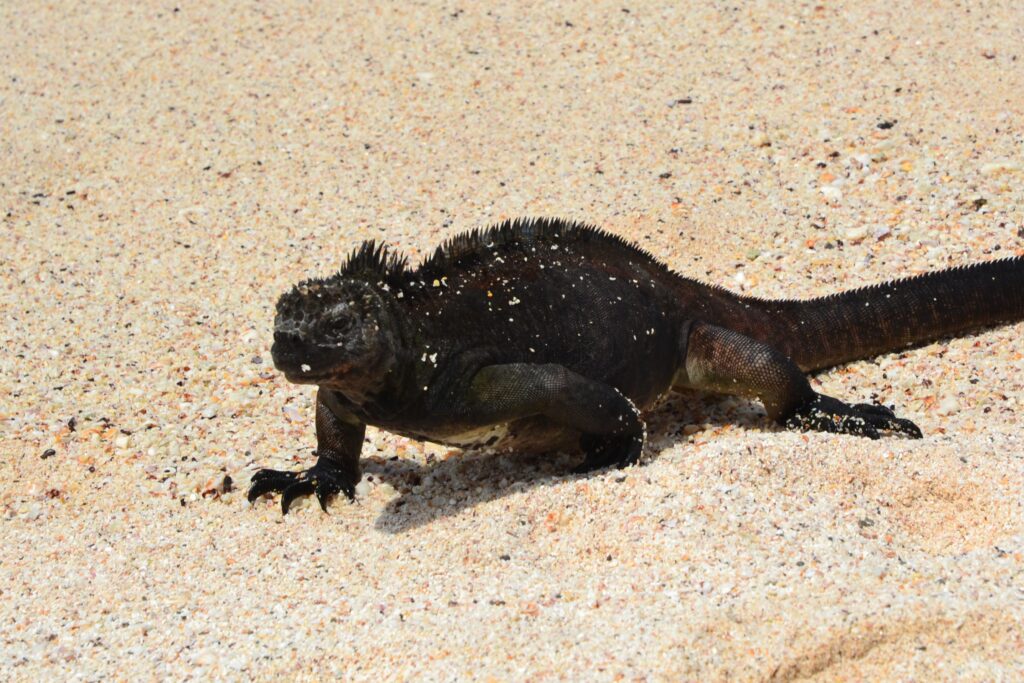
As it happens, this year was an El Niño year, so that solitary penguin was likely pretty hungry. The warmer current and recent storms kicked up a lot of debris in the water, making the visibility poor for snorkeling, but a dip in the water was welcome after both of those blistering hikes, no matter what awaited us below. In truth, the photos I took with my underwater camera were nowhere near as impressive as what we could see with our eyes. Crabs and marine iguanas hugged the rocks, while schools of iridescent fish shot past. Since Christian had been too sick to do much snorkeling in Fiji, I was glad he got two chances to encounter sea life – and encounter he did, as he got touched by a passing sea lion.
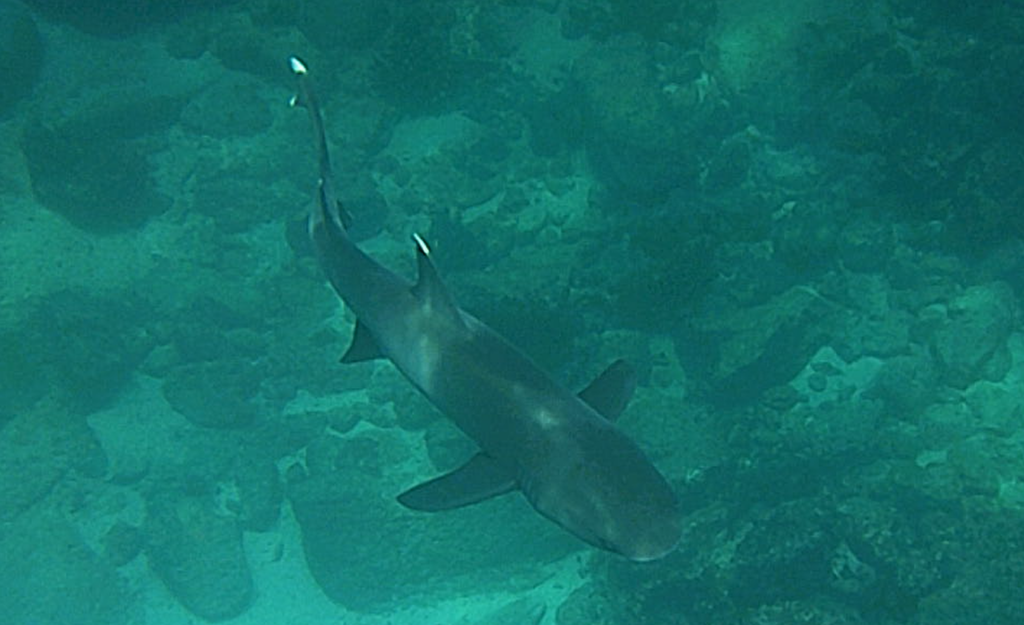
The snorkeling highlight for me was seeing sharks. (Did you know the collective noun is a “shiver” of sharks?) As we rolled out of the zodiac off of Seymour Norte, we saw about a dozen whitetip reef sharks parked on the bottom, about 50 feet down. Between the strong current and a number of people in our group with limited swimming ability, we didn’t get to do much exploring, but the sharks were worth it, especially one that was investigating the rocks just below me. Humans are a much bigger threat to them than they are to us, and despite their prevalence among Indo-Pacific reefs, they are still listed as vulnerable.
Both days, as we headed back to port on Santa Cruz, I dozed in a post-workout, post-lunch, heat-of-the-afternoon exhaustion, and on both of those nights, I collapsed happily into bed, sunburned and satisfied. I do wish we’d had more time there, but I’m beyond thrilled that we got to see what we did. It was a privilege to visit a place so fiercely protected, even if I had to do it as a tourist.
~
Have you been to any of the uninhabited islands in Galápagos? I know more and more people who have gone, and I’d love to hear where you went and what you saw. (Or where you’d like to go and what you’d like to see.)
Thank you for reading!
[1] https://radicalmoderate.online/southern-cross/
[2] https://en.wikipedia.org/wiki/Gal%C3%A1pagos_Islands
[3] https://www.galapagos.org/about_galapagos/history/
[4] https://www.penguinsg.org/copy-of-fiordland-penguin
[5] https://earth.org/?endangered-species=galapagos-penguin-endangered-animals-spotlight
1 Comment
Natural Paradise vs. Tourist Paradise – Radical Moderate · October 3, 2026 at 11:01 pm
[…] Island ExpeditionJuly 26, 2026 […]