When I was in Ecuador for an anthropology class in college, I really wanted to study deforestation, which was notably more in the ecology camp. My professor worked with me to develop a research topic that was actually anthropology related, focusing on the financial decisions landowners were forced to make when trying to make ends meet, often selling land that had been owned by their families for generations, which was then clear-cut for lumber. Unfortunately, I took far more pictures than notes on that trip and can barely remember what insights I cobbled together for my final research paper, if there were even any worth remembering.
At the tender age of 19, I was very attached to my ideas about how I thought the world “should” be (i.e. fair, responsible, focused on conservation of natural resources) and that in a very black-and-white way, it was all achievable if we all did the “right” thing. In all honesty, not much had changed in the 22 years until my second trip to Ecuador, except maybe a little more perspective aided in part by that undergraduate anthropological training of cultural relativism, which encourages you to suspend moral judgment and instead strive to understand why things are the way they are.
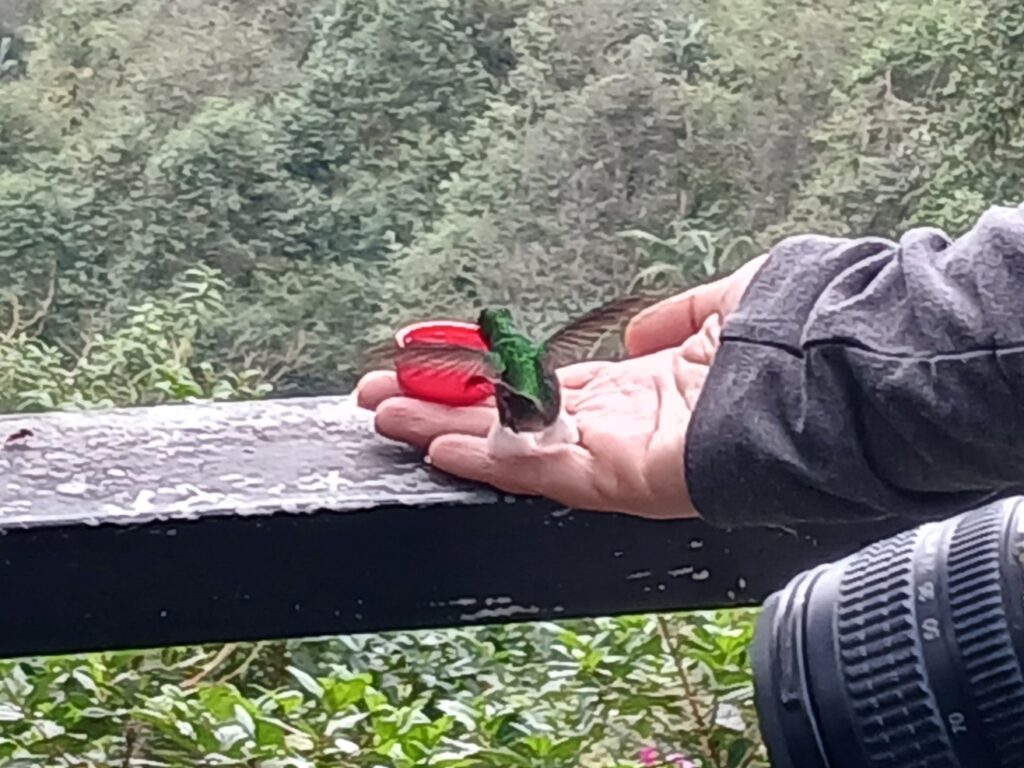
Photo credit: Christian Korey
Living in the Real World
Of course, when lack of money represents a real threat to short-term survival, people make the choices they feel they have to make. I understood very clearly that selling land to a lumber company for a short-term windfall may be necessary, but it also eliminated generational wealth and a place future generations could call home. In retrospect, while I didn’t judge the people making those decisions, I think I still couldn’t understand how someone could go through with them. On the other hand, I definitely judged the companies coming in to harvest the lumber and the (many) American consumers buying it.
During that month-long field trip, we spent about a week in the Cloud Forest, a mountainous area sitting between about 3,000 and 8,000 feet in elevation and named for its regular misty conditions. The Amazon rainforest gets a lot of attention for its biodiversity, but the Cloud Forest is one of the most biodiverse places on the planet. This hotspot stretches from Panama to northern Ecuador and contains 1,600 species of birds, 4,000 species of orchids, and (only) 200 species of lizards, to name a few.
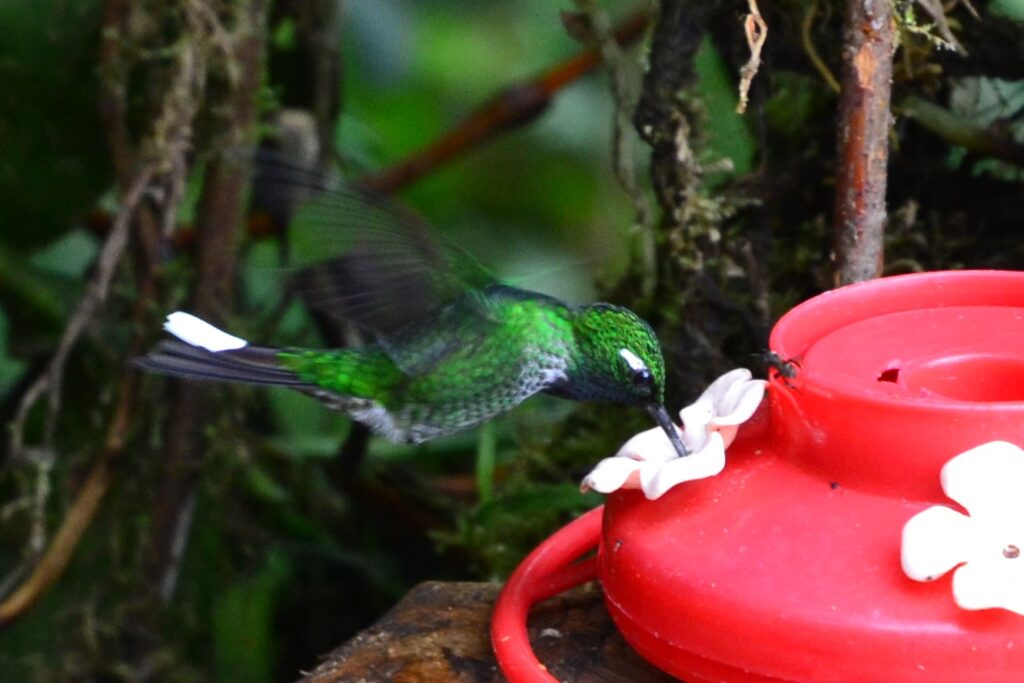
In the early 2000s, tourism was a small but growing industry in Ecuador, with ecotourism representing an important differentiator from more mainstream “sun and beach” tourism. Ecotourism was what first took me to the Cloud Forest, where my classmates and I stayed in an eco lodge, learning about the incredible diversity of wildlife and traditional culture nearby, with trips to visit local cottage industries for products such as shade-grown coffee and plant-based apparel, which locals made and sold to tourists as the economy shifted to support more visitors. (I will note that I didn’t make it to some of those visits because I was very sick with amoebic dysentery, but that is a topic for another post.)
Because of that foundational exposure to the concept of ecotourism, I still try to shape my travel around its principles of educational, low-impact visits characterized by exchange, rather than extraction. [1] And because ecotourism was on the rise in Ecuador when I first went there, I was very much in favor of this concept as an alternative to locals selling their land to lumber companies. If, instead, locals could welcome tourists to a practically pristine paradise and make money by helping them experience virtually untouched natural beauty, that seemed like a win-win: supporting the local economy and preserving the local ecosystem.
Birding Sneaks up on You
Our trip to Ecuador this spring didn’t leave us nearly enough time for sightseeing. When we travel, my husband and I typically schedule about 150% of the activities we realistically should have on our itinerary, and I still felt like we barely scratched the surface of what Ecuador has to offer in the 10 days we were there. One visit we could not skip, however, was the Cloud Forest, and although we didn’t have time for an overnight, we managed to find a driver to take us there for a day trip from Quito.
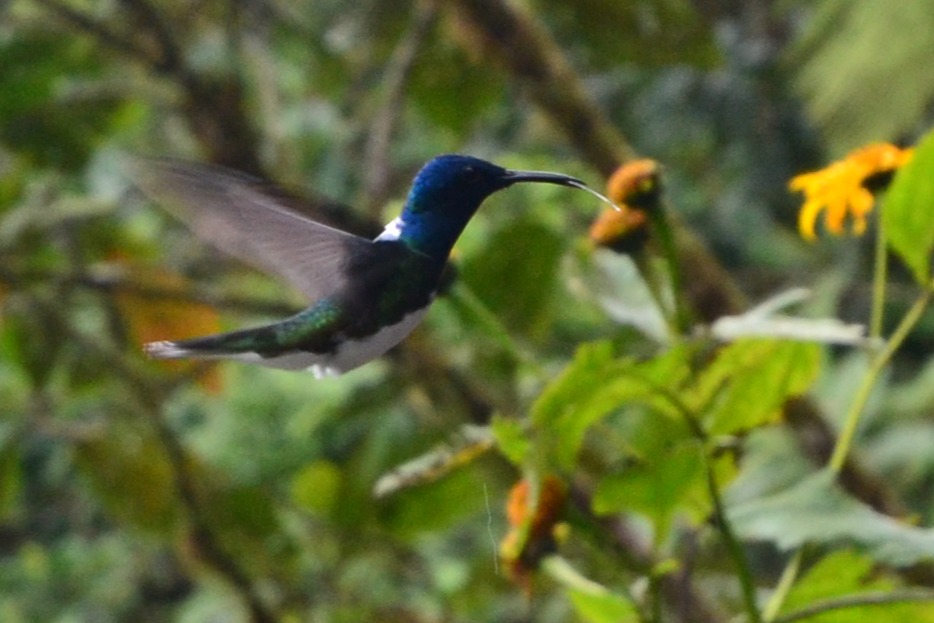
Wildlife and birding reserves continue to be a growing niche of tourism in Ecuador, taking ample advantage of the biodiversity there. And although I had been there before, I got to try something new, something that was very much set up for tourists (not students who were supposed to be learning). The first stop of our tour was just outside the town of Mindo, where we were able to view and feed hummingbirds. And I didn’t care how touristy it was; it was a highlight of our consistently amazing trip.
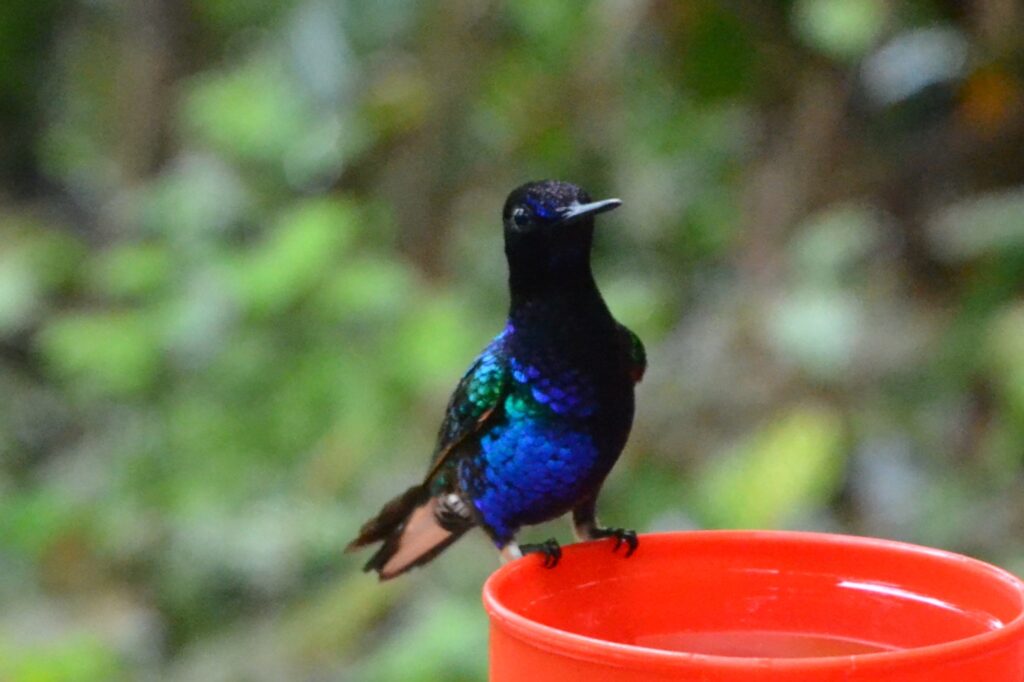
Depending on whom you ask, Ecuador is home to between 130 and 150 types of hummingbirds. [2] Having probably only seen one or two species in my garden at home, those numbers were mind-boggling to think about and jaw-dropping to see in person. I’ve always loved birds, but I have undoubtedly become more of a birder with age. I’ll often point out visitors on our bird feeder by name (“that’s a white-breasted nuthatch!”), to which Christian will respond, “that sounds made-up.”
And our tour guide, being a good tour guide, rattled off the obscure, complex, and borderline ridiculous names of all the birds we could see from the viewing platform. I was impressed with the wealth of knowledge she had, but it made sense once I learned that tour guides in Ecuador are all supposed to be licensed and consequently spend a massive amount of effort cramming relevant information into their heads. On the two-hour drive north to Mindo, Amanda explained that she wasn’t always a tour guide. In fact, she used to work in Ecuador’s largest export sector as a petroleum engineer. (Given my work, we had plenty to talk about in the car.) Ultimately, she just liked being a tour guide better, getting to meet new people and show off the beauty of her country.
Tourism: Good or Bad?
Tourism is still a growing industry in Ecuador. Although national tourism revenue quadrupled in the two decades since I first set foot in the country, [3] the entire tourism industry still only makes up about 1.5% of Ecuador’s economy; double that if you want to add indirect impacts. [4] Driving to and from Mindo, I saw far more tourist-oriented restaurants, lodges, experiences, and products than I expected, and I asked Amanda about it. I told her about my research in college and how sad it was to see families selling their land and that land being cleared, all for short-term profits. She told us that there are certainly more ecological preserves now, where nature is protected, and those conservation efforts are often financed with ecotourism dollars.
Much like my time there as a student, I didn’t ask any follow-up questions and simply assumed what I wanted to hear: that the landowners were managing these ecotourism efforts on their own or cooperatively, which may or may not be the case. As always, real life is more complicated. In doing some very cursory research for this post about tourism trends in Ecuador during the first quarter of this century, I encountered some perspectives indicating that ecotourism isn’t necessarily all it’s cracked up to be, and that some landowners have sold their land… to ecotourism companies. From a conservation perspective, that situation is wildly better than the alternative, but from an equity perspective, you’re still seeing people lose the land they’ve owned for generations (and the leverage that comes with it) because they need money, creating a different situation with the same inequitable power dynamic. [5]
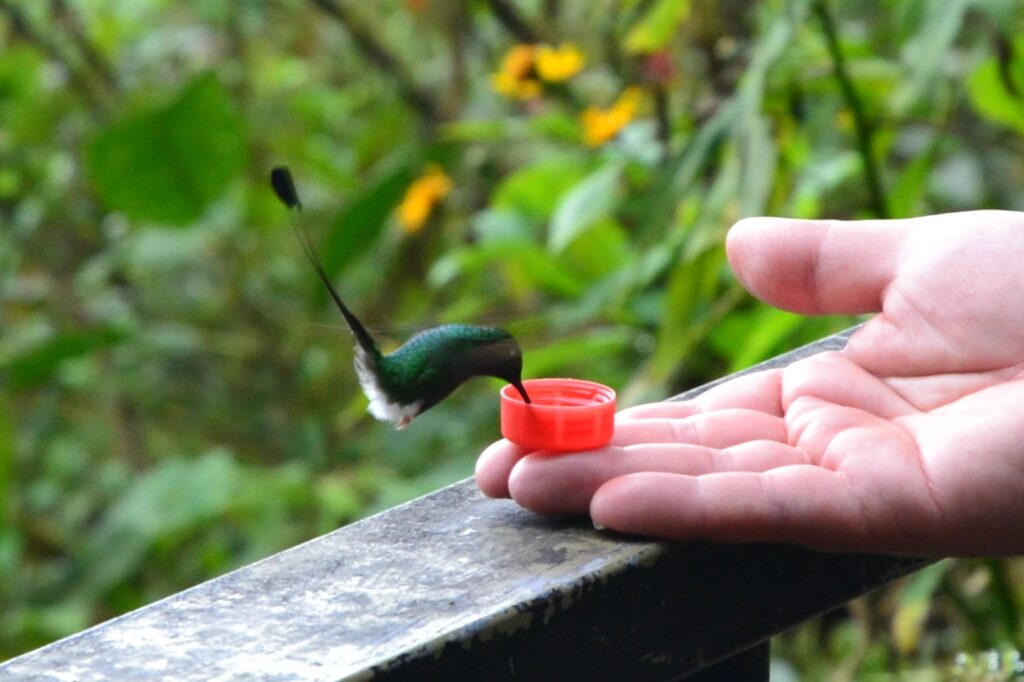
Did it unexpectedly turn into something more insightful than my (literally) sophomoric research on ecotourism in Ecuador? Probably also yes.
Did this Booted Racket-tail accept Christian’s offering of sugar water? Again, yes.
The article highlighting these challenges points out that some residents have seen benefits as tourism dollars filter into the local economy, and that such development can be done effectively and equitably if all stakeholders (including residents) are included in the process from the start. That concept is something I know, something I encountered repeatedly in my Climate Lab, [6] and something I regularly try to incorporate into my day job, but it’s still fascinating to examine my blind spots when they show up. I thought this post would be a quick one: fun and straightforward, taking an easy opportunity to show off my hummingbird photos and celebrate ecotourism as a win-win for communities in the Cloud Forest. Although I recognize that change is hard and slow, I still get surprised by examples of change being hard and slow. And that is part of why travel can be so valuable: if we’re willing to open our eyes a little, we can see where our blind spots are, if we’re not too distracted by the stunning natural beauty.
~
Have you been to the Cloud Forest or other areas designed for conservation-focused tourism? I’d love to hear about what you saw and what you learned.
Thank you for reading!
[1] https://radicalmoderate.online/tuscan-agriturismo/
[2] https://www.hummingbirdcentral.com/hummingbirds-of-ecuador.htm
[3] https://www.worlddata.info/america/ecuador/tourism.php
[5] https://earth.org/private-conservation-and-ecotourism-a-case-study-of-rural-development-in-ecuador/
[6] https://radicalmoderate.online/tag/climate-lab/
2 Comments
Charles Korey · July 13, 2026 at 9:20 am
My mother talked about the hummingbird population in the Cienaga de Zapata in Cuba near where she lived in Cardenes. She swore they were same ones that would come to our feeders in Pittsburgh and she was probably right since they would migrate north in the summer. They are the green ones I see around here.
Was she right???????
Journey to the Center of the Earth – Radical Moderate · October 3, 2026 at 10:56 pm
[…] Ecotourism in the Cloud ForestJuly 12, 2026 […]