My original plan when removing the dead plum tree in our front yard [1] was to put in a new tree where it was. That plan hasn’t changed, but it has expanded. I had already decided on a native tree (Allegheny serviceberry) to fill the empty space, but the more I looked at my original garden plan (which had plenty of perennials and shrubs, but not much else), the more I started to think that I was missing a golden opportunity to really transform my yard – not just into a garden but into a habitat. And, truly, my yard is certified as a wildlife habitat (the last birthday present my mom gave me), so I started to think bigger, with the help of some free and downloadable native landscaping plans from the PA Department of Conservation and Natural Resources. [2]
Type and Quantity
The purpose of planting a native pollinator garden was initially to create a safe haven for my neighbor’s bees, but it has become so much more than that in subsequent years. Insect populations in the yard have grown, followed by birds that have learned they’ve got a tasty buffet here. There are some old brush piles in the back yard that provide some shelter for small ground-dwelling animals, but the front corner of our yard (which was lawn up until a few years ago) doesn’t have much to offer except native flowers for a few months out of the year. I realized I could absolutely be doing more when it comes to building a thriving ecosystem, which is why the night before heading down to my favorite native plant nursery for the first time this season, I was out in the yard measuring distances and poring over designs for multi-story gardens, which included multiple types and sizes of trees.
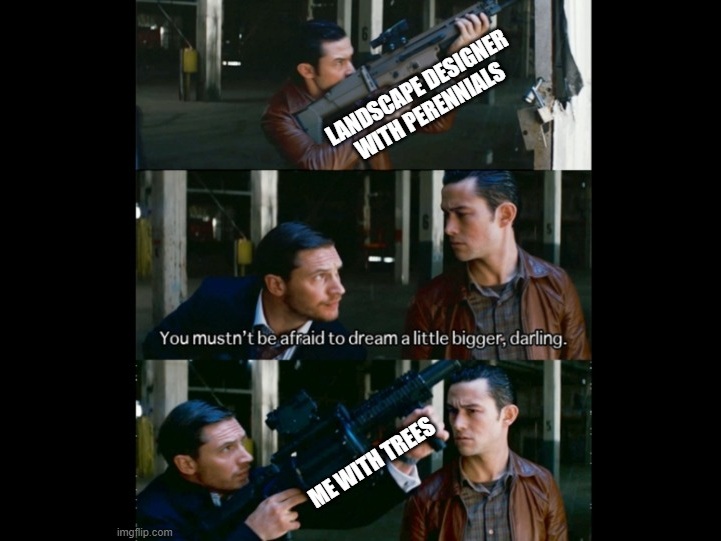
Image credit: [3]
Living in suburbia, we have a lot of the standard trees one might expect: maples, magnolias, pines, firs, a few oaks, and a lot of Bradford pears in our neighbor’s yard (don’t be like our neighbor [4]). I was thrilled to bring home three trees that are native to the area but that I haven’t seen anywhere near our house: an Allegheny Serviceberry, [5] an Eastern Redbud, [6] and a Black Gum. [7] All three do fine in dry, high-clay soil (which is exactly what I have), and all have high wildlife value, supporting bees, butterflies, birds, and small mammals. The tall, expansive black gum will be moving into the central spot of the garden, with the other two serving as understory trees. And the redbud and the serviceberry will have a trio of blackhaw viburnum between them, [8] creating another level of practical use and visual interest before we even start talking about perennials.
I am excited about the prospect of a multi-story garden for multiple reasons, including supporting more biodiversity among garden visitors, better soil health, and more climate resilience amid changing weather patterns, [9] but I was also somewhat curious about why it hadn’t occurred to me sooner. The house I grew up in is surrounded by multiple types and sizes of trees, while the one I live in now feels oddly exposed, with shade from only one large maple. It felt like something was missing, even as I expanded the garden into the yard with increasing enthusiasm every year, but I really couldn’t put my finger on it until now. And I’m not alone: the suburban aesthetic is large lawns and few trees. I have no doubt that that has limited my creativity when it comes to what I think of as a “garden.”
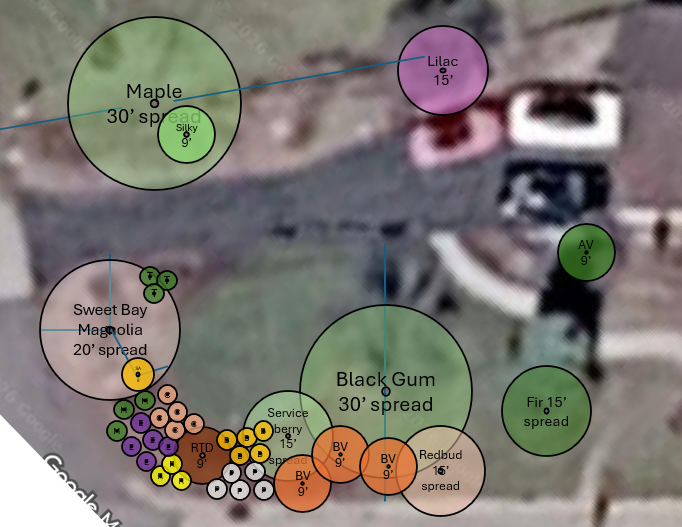
Given that we are still in a neighborhood, it is important to consider the size of these trees when they are grown. The “Sunny/Dry Garden” template that is strongly influencing the new look of my garden is densely packed (so much so that I wondered if the scale was correct.) When planting large canopy trees with understory trees, you will put them closer together than if the trees were intended to grow completely independently. For example, if I am planting what will be a 30’ wide black gum with a 15’ wide serviceberry, I would probably plant them about 22’ apart (average of the mature spread of each tree, trunk to trunk) if I didn’t want them to interfere with each other too much. But if I’m hoping for overlapping layers, which I am, recommendations are to reduce that distance to about 50-75%, or about 11-17’ between these two. These are important considerations to ensure that the trees aren’t crowded once they grow up but that they’re not isolated either. [11]
Selection and Maintenance
I am by no means an expert (as you’re about to see), despite being the daughter of a tree man. I do know that trees represent a massive investment of time and money, but that they more than repay that value if tended well. Not all the trees in our neighborhood are tended well, as seemingly anyone with a chainsaw can offer “pruning” services that make it look like tree removal is on the agenda. As much as I would like to leave trees to their own devices, I recognize that I have certain responsibilities to my neighbors, and there are sometimes necessary maintenance tasks, including removing dead or dangerous branches, as well as thinning out certain growth in order to promote a stronger tree structure. Specific attention to growth patterns can make a big difference early in life, especially when selecting trees and “training” them into certain shapes while they’re young.
Depending on greenhouse conditions when they’re just getting started, trees may grow into odd shapes. Tree experts recommend selecting trees with a straight central trunk, which can help the tree grow tall and healthy; if there aren’t any trees available in that category, selecting an option that can be pruned to encourage a straight growth habit is the next best option. I believe the black gum I bought was crowded in among other plants when it was young, only ever had light from one angle, and may have even been on a bottom shelf with upward growth limited: it had multiple large horizontal branches growing in the same direction, like a capital “F.” The top horizontal branch was as thick as the trunk, but it had a smaller branch growing out of it in a somewhat upward direction; I removed the thick horizontal one and kept the thin, somewhat upright one in order to promote something akin to a straight trunk in the future. The whole tree rocked to an angle after losing that weight – fortunately, it isn’t in the ground yet, so I’ll be planting it in a somewhat straighter direction.
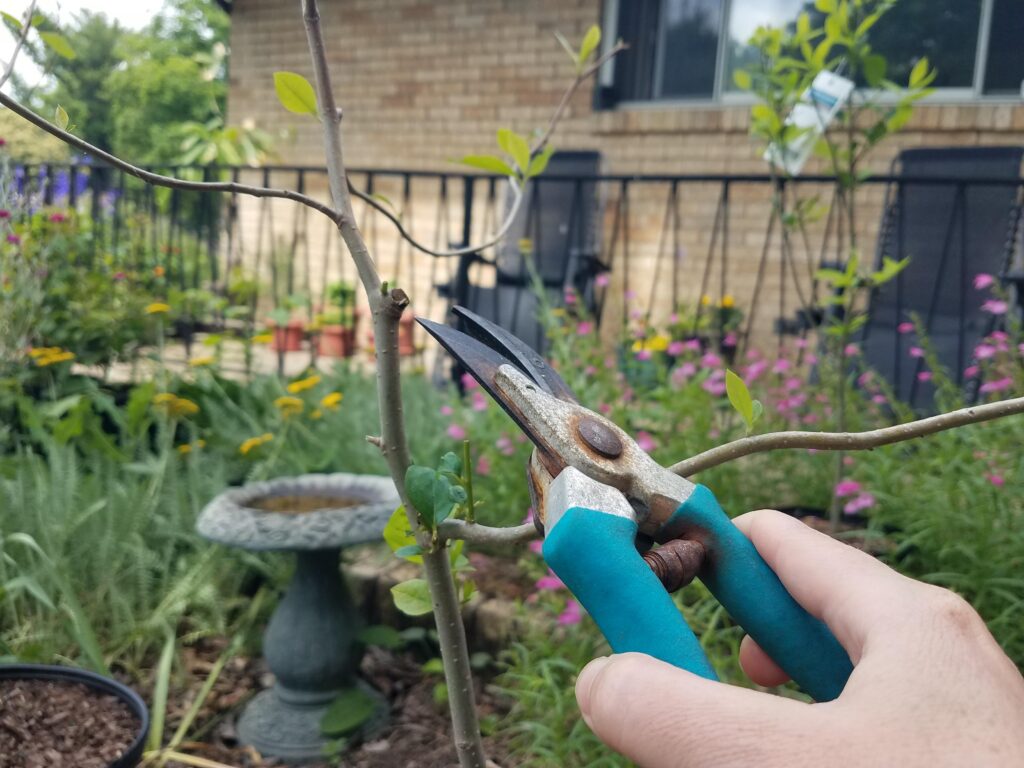
The serviceberry had a broken limb that created a gash in the trunk, and the trunk itself is extremely crooked. I removed the broken limb and will likely be pruning the tree toward as straight a shape as possible in the coming days. I bought the biggest, leafiest one there out of enthusiasm for getting this project going as quickly as possible, not out of any thought for the long-term success of the tree. And we’ll see where it goes. Certainly, imperfect trees happen in nature – even the large fir tree in our front yard has a double trunk. I personally don’t care about the aesthetics, but I have learned that odd structures, such as double trunks, can result in weaker joints that are more likely to break, as debris fills up in the crotch. I’d like to keep these trees as healthy for as long as possible, which is why I’ve been giving myself a crash course on this subject the last few weeks.
There are plenty of expert resources online for things like effective pruning of young trees [12] and shrubs, [13] the kinds of things that are simple and cheap enough to do yourself but that often represent a knowledge barrier for many people who have never had to learn and may not have considered exploring a more tree-heavy landscape. As for me, I’m clearly still learning as I go, but part of the beauty of gardening is that on a long enough timeline, nothing is ever final, and there are always opportunities to try out new things as you go.
~
How about your gardening adventures? Have you taken steps to create a more wooded, forested, or less-conventional landscape? I’d love to hear about it below.
Thanks for reading!
[1] https://radicalmoderate.online/removing-and-replacing-trees/
[3] https://imgflip.com/i/aub3kt
[4] https://www.thespruce.com/bradford-pear-trees-care-problems-solutions-4125147
[5] https://plants.ces.ncsu.edu/plants/amelanchier-laevis/
[6] https://plants.ces.ncsu.edu/plants/cercis-canadensis/
[7] https://plants.ces.ncsu.edu/plants/nyssa-sylvatica/
[8] https://plants.ces.ncsu.edu/plants/viburnum-prunifolium/
[10] https://elibrary.dcnr.pa.gov/GetDocument?docId=1750567&DocName=SunnyDryNativePlantTemplate.pdf#
[11] https://naturehills.com/blogs/planting-guides/the-importance-of-proper-plant-spacing
[12] https://yardandgarden.extension.iastate.edu/how-to/pruning-young-trees
[13] https://extension.umd.edu/resource/pruning-shrubs-and-hedges-home-garden/
2 Comments
Removing and Replacing Trees – Radical Moderate · October 3, 2026 at 10:37 pm
[…] Planting and Pruning Trees – Radical Moderate · June 14, 2026 at 1:03 pm […]
Garden Update, 2026; or, A Weed by Any Other Name – Radical Moderate · October 4, 2026 at 12:11 pm
[…] big activity this year was taking out our old plum tree [4] and designing a new garden, [5] which extends up into the yard from the corner of our property, connecting the corner garden with […]