Disclaimer: I am not a medical professional. The content of these blog posts is based on my own experience and research. Always talk to your doctor before making any changes to your medications, diet, or activity.
I’ve never traveled to a developing country without experiencing some kind of impact on my digestive system. That’s not a complaint but simply a fact. I doubt my husband would agree with this statement, but speaking solely for myself, the benefits of travel have always outweighed the costs. For that reason, I consider sickness during travel to be a calculated risk. Having encountered some interesting (scientifically speaking) situations over the years, I’ve taken an ongoing interest in gut health: characteristics of it, risks to it, and what the scientific community is learning about its broader impact on our physical and mental wellbeing. Needless to say, details on bacteria, parasites, and bodily functions will follow, so consider this disclaimer fair warning for the squeamish.
Bacteria
About halfway through our trip to Ecuador this spring, we noticed what we expected would happen at some point. Nothing too serious, but definitely a change from normal. Traveler’s diarrhea is a fairly standard occurrence when traveling in developing countries, usually a result of consuming contaminated food or water. The vast majority of the time, people get sick from one of the big names: Salmonella, E. coli, Shigella, or Campylobacter. [1] (We learned about “Campy,” as we call it, after we picked it up in Fiji.) The severity of the case can depend on a couple things, including the level of exposure to the bacteria and how resilient your guts are to such invaders.
Since healthy guts are equipped to fight off strange and harmful bacteria, mild cases tend to clear up on their own in about 3-5 days, with standard medical guidance focused on treating the symptoms, not the cause, and staying hydrated through the whole process. [2] (My first time in India, I was surprised when the friends I was visiting recommended Imodium and not something stronger.) However, more severe cases, which may include symptoms lasting longer than five days, pain, fever, or blood, may require something stronger – namely antibiotics. Christian, having wound up in the emergency room on our way home from Fiji, came to Ecuador prepared with a Z-Pak, which he used when our symptoms showed up.
I, however, am allergic to the macrolide family of antibiotics (of which the Z-Pak is a member), so I was prepared to tough it out if I had to. There have been plenty of times (including Fiji) during which I was uncomfortable for a few days but ultimately recovered, making my gut more resilient for the next trip in the process. I also worry about the consequences of overprescribing antibiotics. As a result of our general overuse of them, antibiotic-resistant strains of certain bacteria (such as “Campy”) are on the rise throughout the world. Antimicrobial resistance (AMR) seems to be especially prevalent in countries with extensive and unregulated use of antibiotics in medical treatment and food production. [3]
But unfortunately my symptoms continued to get worse. By the time our tour guide Amanda was driving us to the Cloud Forest on our last full day in Ecuador, [4] I was five days into my illness and wasn’t sure if I could make it through a 2-hour drive without needing to stop. Amanda took us to a pharmacy, where I asked for Imodium. The pharmacist questioned me about my symptoms and how many days I’d had them, asked about my allergies, and then gave me a 10-pill / five-day course of Cipro. Cipro, the particularly strong, broad-spectrum antibiotic with a list of severe, potentially permanent side effects, and which the FDA has warned against prescribing for non-fatal infections. [5]
Protozoa
But I already knew how easy it was to get prescription drugs in Ecuador if I needed to. And I was a little more willing to take what I was given on my second trip there because of what happened on my first. In rarer cases than your run-of-the-mill bacterial infection, travelers can encounter protozoa, which – while also single-celled organisms – tend to be larger, more structurally complex, and harder to kill than bacteria. During my college anthropology class, I had a crash course in microbiology as I became intimately acquainted with amoebas, but other famous ones include Giardia, Cryptosporidium, and – the one on everybody’s lips right now – Cyclospora. [6]

Image credit: [7]
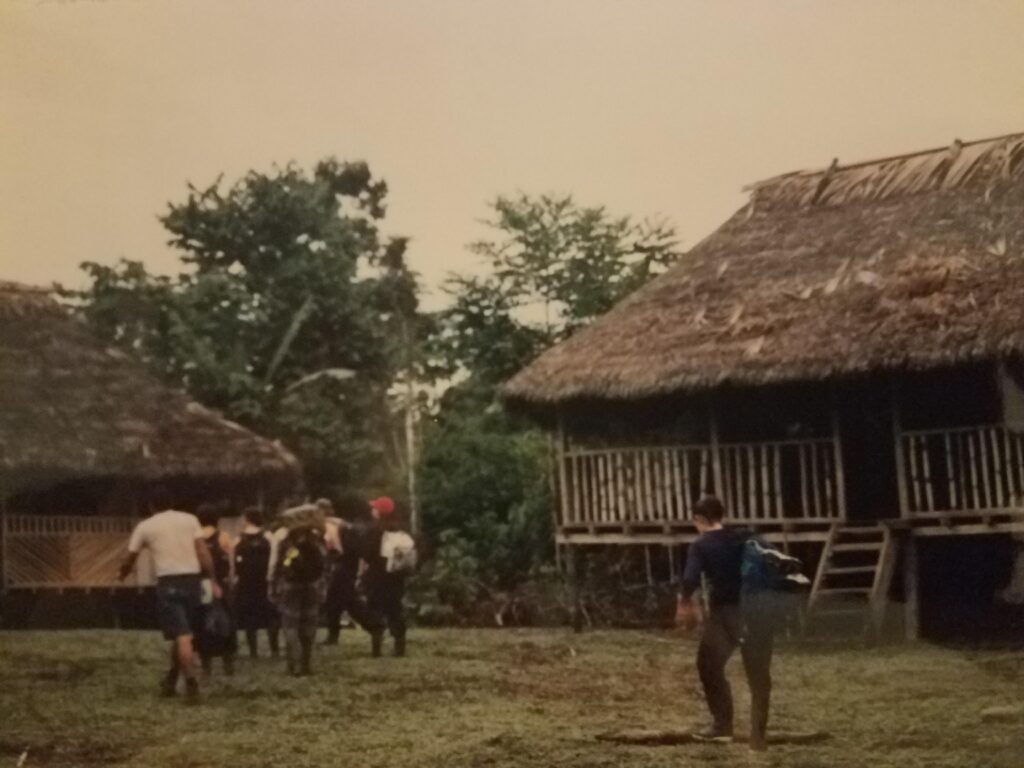
As many Americans are now acutely aware, intestinal protozoan infections are primarily caused by ingesting food or water that has been contaminated with fecal matter containing protozoan cysts. Unlike the days-long incubation period of bacteria, it can take weeks before symptoms of a protozoan infection show up. My guests from 20 years ago, likely Entamoeba histolytica, arrived in my system at some point while I was staying in a village in the Amazon. The only reason I could pinpoint it that clearly was because exactly half of our class got sick: the half that stayed in that village for a few nights before we reunited with the others in the Cloud Forest. (The other half of the class had to deal with a massive cockroach infestation where they were staying, so I still think I got the better end of that deal.)
Once these amoebas enter the body, they reproduce in the digestive tract and move to the colon, where new cysts can exit the body in the feces and get picked up by someone else. [8] Apparently one out of 10 people in the world has amoebas, but only one out of those 10 has symptoms. [9] I find that incredibly hard to believe because my classmates and I were all very sick, and we bonded over that common suffering, discussing our evolving symptoms in clinical detail, often over the dinner table, much to the dismay and disgust of the other half of the class. We were as upbeat as a group of kids away from home for a month could be, despite the abdominal pain, the vomiting, and the “watery” stool that may as well have been water.
But we knew we’d get medicine and get to go home at the end of the month. Untreated, these amoebas can cause significant long-term damage, chronic health conditions as they spread to other parts of the body (such as the liver), and death. It is estimated that amoebic infections are responsible for 50-100k deaths each year worldwide. [10] But, again, with medicine, it’s not an issue. From the pharmacist’s very nonchalant “Oh, it’s amoebas – here take this” to our professor’s similarly nonchalant “Yeah, it’ll kill you by the time you’re 40 if you don’t take care of it,” it was clear that we (the white kids from New Jersey who could afford the medicine) were going to be fine.

Image credit: [11]
Recovery and Rebuilding
And all that we needed to be fine was to provide a lab sample (only one – we all had the same thing) and get a prescription. Our professor took me to the pharmacy, where I presented my lab results confirming the presence of amoebas, and we proceeded to buy a sufficient quantity of medicine for everyone in the class who was sick. I don’t know the name of the medication I got, but it would have been an amoebicide. There are usually two medications used in tandem: one that kills cysts in the digestive tract and one that penetrates living tissue to kill any amoebas that have invaded the intestinal wall. [12] I was told not to take the medicine until I was on the plane home, in case I got reinfected before I left. (Had that happened, I certainly could have afforded an additional $6 for the medication, but it was still easier to wait.)
I was also told that the medicine would kill all the bacteria in my gut – good and bad – so that, upon getting home, I needed to eat bland foods and a lot of yogurt for several weeks in order to build up the healthy bacteria in my gut. That sounded like a good idea at the time, but that certainly didn’t happen in practice. I was going back to a college dorm room, after all, so I had plenty of pizza and soda in my future. But in the two decades since, I’ve always wondered if that missed opportunity in cultivating a healthy gut microbiome resulted in my less-than-regular digestive system. Of course I thought about that again as I was taking my Cipro this past spring, killing everything in my gut all over again. And I wondered – since I’d be starting with a clean slate again – whether I could build a healthier gut with a little research and discipline.
~
And that’s where we’ll pick up next week. In the meantime, have you gotten sick in a foreign country (or have you encountered Cyclospora at home)? How bad was it, and what was your course for recovery? Feel free to share below.
Thanks for reading!
[1] https://cdhf.ca/en/top-10-travel-destinations-with-high-risk-of-diarrhea-anti-diarrhea-tips/
[2] https://www.health.harvard.edu/digestive-health/travelers-diarrhea-a-to-z
[3] https://www.mdpi.com/2036-7481/16/11/226
[4] https://radicalmoderate.online/ecotourism-in-the-cloud-forest/
[5] https://www.nbcnews.com/health/health-news/fda-strengthens-warning-powerful-antibiotics-n617176
[6] https://www.cnn.com/2026/07/21/health/cyclospora-cases-count
[7] https://www.facebook.com/photo?fbid=1494094639409880&set=a.640608138091872
[8] https://www.healthline.com/health/amebiasis
[9] https://patient.info/travel-and-vaccinations/travellers-diarrhoea-leaflet/amoebiasis
[10] https://www.medicinenet.com/amebiasis_entamoeba_histolytica_infection/article.htm
[12] https://en.wikipedia.org/wiki/Amebicide
2 Comments
Garrod Gray · August 2, 2026 at 11:03 am
Oh yes!!! About 40 years ago, my mum, sister and myself set off for 2 weeks in India…. My mum got a severe case ameobic dissentry from having a drink with ice in it, or from a meal in Egypt as we stopped off there too. Suffice to say any hotel/ YMCA room had to be no further than 20 feet from the communal toilet.
You have so described the symptoms so eloquently …so I don’t need to, thank goodness.
It was so severe that my mum almost had to be medivacced back to the UK.
Your blog sent my mind back to that interesting 2 weeks.😁 Thank you, I think!!
Island Expedition – Radical Moderate · October 3, 2026 at 11:02 pm
[…] Gut Health: Playing DefenseAugust 2, 2026 […]