“If you wish to hide your character, do not play golf.”
– Percey Boomer
Over the weekend, I took my dad out for a round of golf, happy to get this increasingly reclusive curmudgeon out of the house for a few hours. For a man who used to be quite skilled on the links, he said it was his first time golfing in three years, and he spent much of it complaining about the high prices and his poor performance. While he played, I sat in the driver’s seat of the golf cart, cradling my coffee as a defense against the crisp breeze, watching the morning light ripple through the changing leaves, and thinking about the environmental impact of this increasingly popular sport.
For years we’ve heard concerns about the heavy resource requirements of golf courses, from water to pesticides to gas-powered maintenance equipment. I nearly dismissed a blog post on this subject out of hand because sitting at my laptop and criticizing such an easy target felt like a “gimme.” But it should come as no surprise to anyone familiar with this blog that once I started looking into the details of whether golf courses are “bad for the environment,” it became clear that the answer is a little more complex than I originally assumed.
Noble Origins
The game of golf originated along the eastern coast of Scotland, typically played among sand dunes. Walking along the natural terrain while hitting a pebble with a stick proved an enjoyable distraction from military training, and the game quickly gained popularity, despite a 45-year ban put in place by King James II. [1] The terrain and elements of coastal Scotland, however, played a huge role in the game itself: bunkers and hazards were frequent, and changing winds could easily ruin a good shot. In short, luck was as much a factor as skill in a good game – and a good game was exceedingly rare.
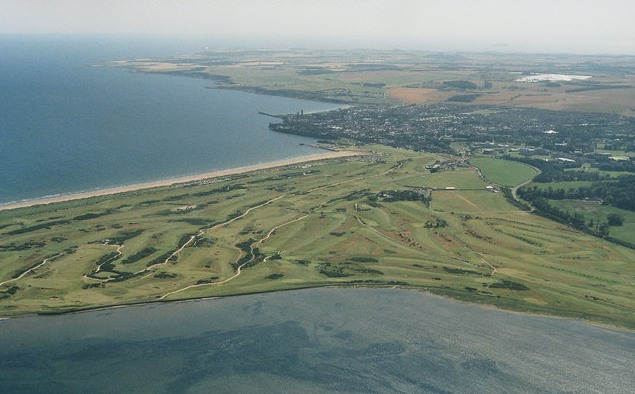
Image credit: [2]

It has been said that the value of the game is not in scoring well but rather in comporting oneself well through a test of character, a point that was raised in a fascinating opinion piece I read for this post. This piece described the differences between where and when golf was invented (Scotland) and where and when it was popularized (America). Scotland in the 16th century was heavily influenced by the Protestant Reformation and the teachings of John Calvin, who believed that our souls have been predetermined by God to go to Heaven or Hell, with many of us doomed to Hell, regardless of any good works we do during our time on Earth. If you’ve ever played a round of golf, this concept of Predestination may resonate.
Having been raised in the Presbyterian and Reformed traditions of church teachings, it makes sense that I’ve been attracted to activities that are not about the victory, but the struggle (gardening is a key example). [3] But as an American, I also crave victory. And American golf is a product of Enlightenment ideals, notably the concept that “Man, through reason, could and should alter nature and society to make life and all institutions better.” [4] Through our own agency, we humans were capable of improving our world to increase our happiness – and why not apply that to the game of golf? Architects and land movers created perfectly sculpted, beautifully manicured courses that reduced the luck factor and boosted the skill factor. Consequently, the golf industrial complex took off by shifting our fate into our hands: expert lessons, better gear, and newer tech, all to shave a few points off our scores.
The Price and the Cost
Modern courses, with their lush swaths of green and artful landscaping, generally look better in person and on TV than the naturalist links of old, with their brown fairways kept short by grazing sheep. The style of play is also different on modern courses, which allow for long, high shots, instead of the low bounces mandated by more treacherous terrain. Players and their families can now avail themselves of golf carts (instead of walking between holes) and luxurious clubhouses with modern amenities. The game today bears little resemblance to what was invented along the Scottish coast, and those aesthetics come at a cost.
There were 2 million acres of golf courses in the United States in 2018, and in the worst of cases they have required land clearing (up to and including deforestation), land moving to create the course as designed, massive amounts of water and fertilizer to feed non-native grass, gas-powered mowers to keep that grass clipped to very precise lengths, pesticides to protect the grass that has been stressed by being cut so short, fossil fuels to charge golf carts (yes, they’re electric, but that electricity comes from somewhere), and more water to clean all of the equipment. [5]

With fossil fuel prices trending upward and water becoming more scarce, you’d better believe that those costs will be passed on to the customer, so it actually behooves golf courses to be more conservative with their resources to save money and to be upfront about their environmental impact to improve their public image. In my research for this post, I didn’t see any denials from anyone tied to the industry, just some claims of “it’s not as bad as it used to be.” One source lists a statistic from the Golf Course Superintendents Association of America claiming a 31% reduction in water use since 2005, with biggest reductions in the Southwest, but that’s still “roughly 1.5 billion gallons of water per day across about 16,000 facilities.” [6]
Under Pressure
Despite widespread concerns about the environmental impact of golf courses, the sport’s popularity continues to grow. Statistics show a 41% increase in American participants over a six-year period since 2019, with a total number approaching 50 million. [7] Given that increasing demand, new courses are still being built to alleviate a supply crunch. But in light of public concern about these resource-intensive facilities – and the business case for resource conservation – we’re starting to see some moves toward sustainability, including training programs for superintendents [8] and certification programs for facilities [9],[10] that promote best practices, such as water recycling, integrated pest management, planting native grasses and pollinator-friendly plants, and rewilding out-of-play areas, such as meadows, wetlands, and woodlands. [11]
Public pressure isn’t the only factor forcing more attention to this issue. It turns out that Man, in his reason, has not controlled for everything, and Nature is acting with a heavy hand in response to irresponsible resource use (generally, not just from golf). Climate change is exacerbating unique risks to golf courses in their various parts of the country: for example, these facilities are seeing more flooding in Florida, droughts in Utah, wildfires in California, and higher temperatures in Ohio (which bring with them friendlier conditions for grasses that are harder to control). Courses all over the world are at risk – even the OG golf course at St. Andrew’s could be under water by 2050. The industry’s response could be to fight this change harder with increasingly limited resources… or shift. As a result, we’re seeing golf officials and golf pros alike calling for naturalization of courses and more sustainable practices. [12]
Sustainable practices begin with the design stage, when considering characteristics of the local land and weather, as well as what will have to change to make it into a golf course. The bigger the gap between what it is now and what it will be, the more resources will be needed to create and maintain that change into the future. So, even though American trends have begun to take root in Scotland, there is now a small but noteworthy push to embrace golf’s Scottish heritage, making use of natural terrain, minimizing disruption to the natural setting, and keeping native grasses and other plants suited to the local climate in order to minimize additional resource needs. [13] From certain perspectives, it’s actually pretty cool to see how some leading course designers are now incorporating concepts such as carbon accounting, winter survivability, mixed land use, and mowing efficiency based on course layout. [14]
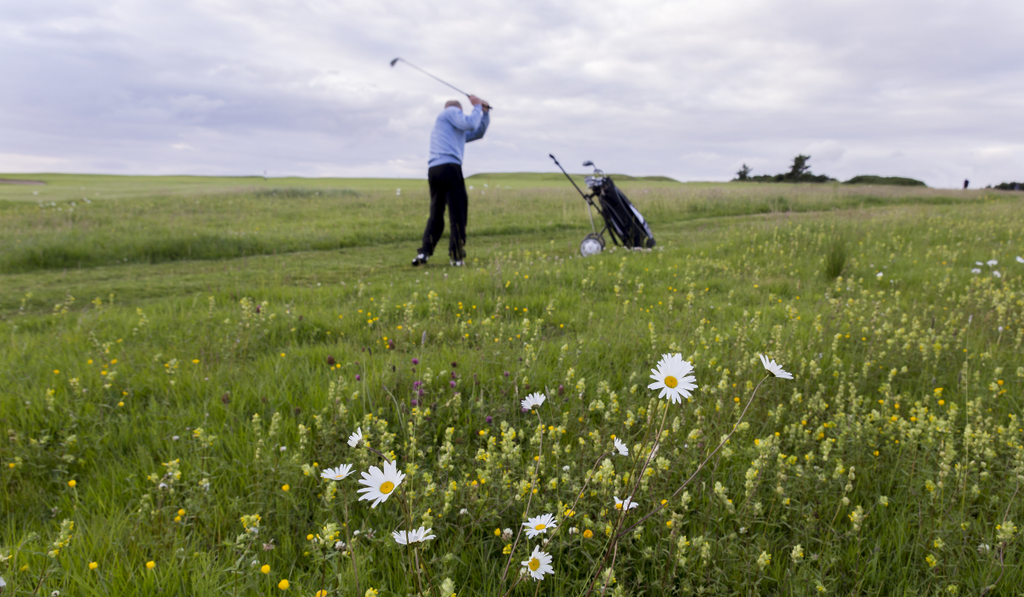
Image credit: [15]
What’s the Verdict?
So many of the opinions and statistics I’ve now read on the subject of golf course resource requirements are based on relative comparisons to either a best-case alternative (i.e. pristine, untouched nature) or a worst-case alternative (i.e. the most environmentally harmful and resource-intensive practices combined). In other words, are golf courses worse for the environment than protected, undeveloped land? Yes. Are golf courses that incorporate sustainability principles into their design and operation less harmful to the environment than golf courses that don’t? Also yes.
But those questions raise an even bigger question: how often are we, at this day in age, able to successfully preserve hundred-acre patches of untouched nature? We are fortunate to have parks and preserves throughout the country where visitors can go and experience nature in all its glory, but these days even federally protected lands are in danger of being sold to extractive industries. [16] Closer to home, I’ve seen farmland and woodlands alike get bulldozed and developed for most of my life, and that risk feels like it’s increasing with each new industrial boom. If land is being sold to a developer one way or another, it’s worth considering the impacts of a golf course alternative: a mall, an offce park, a data center…
If there are ways to maintain and preserve our natural land for its own sake with minimal habitat loss, I am in support of that. If there has to be a commercial venture attached to preserve the land, I feel like I would be less opposed to it if it incorporated sustainable land use principles and teachable moments to thousands of visitors a year. Ironically, I’m now talking about ecotourism in the United States – a subject I’ve covered frequently in relation to developing countries. [17] But, with that said, if we’re finding ourselves in a situation with people whose only goal is profit, maybe it’s time we start thinking realistically about how to capitalize on preservation.
~
I’m not sure if that conclusion sounded cynical or naive, but I’m curious about your thoughts – on golf courses, conservation efforts, and managing human impacts.
Thanks for reading!
[1] https://www.historic-uk.com/HistoryUK/HistoryofScotland/The-History-of-Golf/
[2] https://en.wikipedia.org/wiki/File:St_Andrews_Links_&_Town_from_the_air.jpg
[3] https://radicalmoderate.online/category/in-the-garden/
[4] https://www.scoregolf.com/opinion/the-contrast-between-scottish-and-american-golf/
[5] https://www.greenmatters.com/p/golf-courses-environmental-impact
[6] https://coolgolfgear.com/blogs/news/are-golf-courses-bad-for-the-environment-a-research
[7] https://www.ngf.org/short-game/golfs-growth-era-the-road-to-50-million-golfers/
[8] https://cpe.rutgers.edu/golf-turf/golf-courses-and-the-environment
[9] https://www.auduboninternational.org/acsp-for-golf/
[10] https://monarchsintherough.org/about/
[11] https://blog.allsquaregolf.com/rewilding-the-rough-nature-first-golf-design/
[12] https://www.cnn.com/2021/12/08/golf/climate-change-sustainability-spt-intl-cmd/index.html
[13] https://blog.golfshirehomes.com/en/post/these-7-golf-courses-are-putting-the-green-back-in-golf
[15] https://blog.allsquaregolf.com/rewilding-the-rough-nature-first-golf-design/
[17] https://radicalmoderate.online/tag/ecotourism/
0 Comments