Fall has arrived in Pittsburgh, and along with it our first night of closing windows and turning on the furnace. I was very sad, feeling like I barely got any time to enjoy the summer. But it’s also time for my annual garden update, which usually summarizes everything that I have put in the ground over the course of the season. However, for the second year in a row, I’m not even done with my spring planting (and I’m certainly not done weeding… though I’ll never be done weeding…).
In last year’s garden update [1] I mused that perhaps if I had a summer without any major curveballs from life, I might actually have time to take care of my garden. I also theorized that perhaps my garden certification signs (from Natural Wildlife Federation [2] and Monarch Watch [3]) were, in fact, the things keeping my borough from sending me a warning about yard maintenance. Apparently, I was wrong on both counts.
New Additions
My big activity this year was taking out our old plum tree [4] and designing a new garden, [5] which extends up into the yard from the corner of our property, connecting the corner garden with the space around the old plum tree. I have complained before that my garden design feels pretty boring, with a lot of perennials crammed in together, but not a lot of variation with trees or shrubs for visual interest. For that reason, I wanted to add some vertical layers to my ever-expanding garden. To do that, I would replace the plum with a large canopy tree, add some understory trees, and shrubs below that, before filling in with perennials.
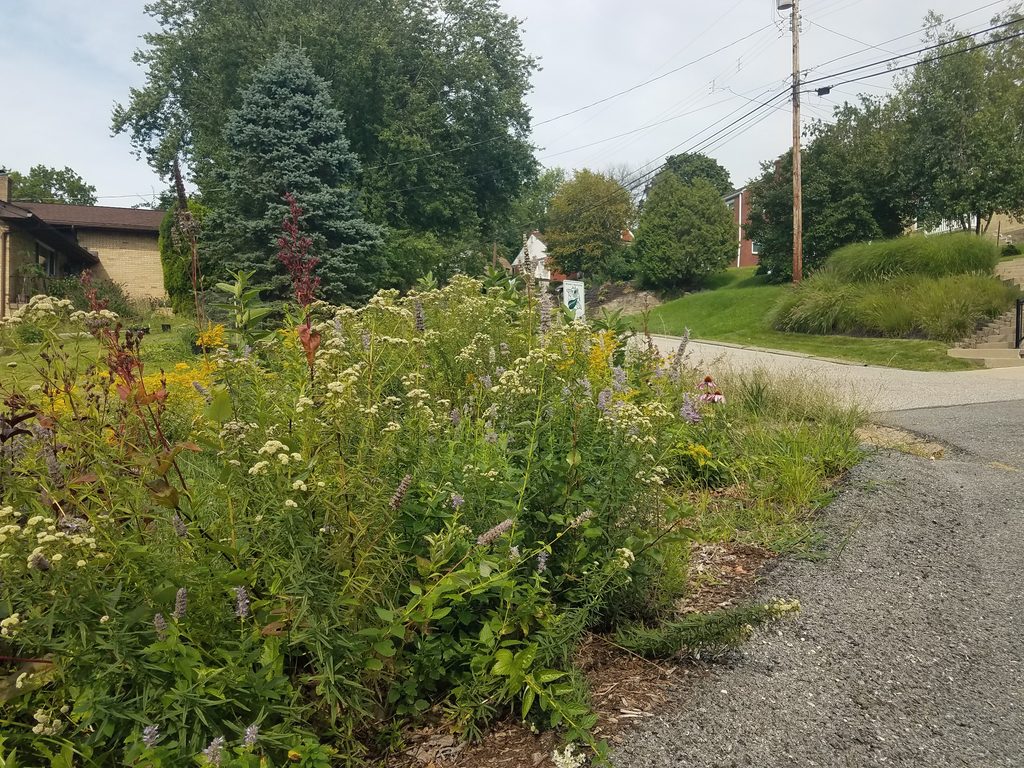
My first (and likely last) pilgrimage of the year to the native plant nursery down in Washington, PA [6] resulted in a small haul (in plant quantity, but not in price) of trees:
- Black gum – Nyssa sylvatica [7]
- Allegheny serviceberry – Amelanchier laevis [8]
- Eastern redbud – Cercis canadensis [9]
… shrubs:
- Blackhaw viburnum – Virburnum prunifolium [10] (x3)
- New spicebush – Lindera benzoin – to replace one in the back hedge that didn’t die after all [11]
(It still needs to go in the ground, somewhere. I will probably put it along the front walk and trim it to be taller rather than bushier, like the ones in the hedge.)
… and perennials:
- Milkweed – Asclpias tuberosa [12] (x5)
(Unfortunately, all five died in the incredibly hot, dry weather we had this summer, despite my best attempts to water them every day. Unexpectedly, the ones I grew from seed several years ago and planted along the driveway–which I thought were gone–made a comeback, so I will replant those seeds in the new garden once their pods start to pop.)
The trees will likely grow about a foot per year, meaning it will take some time for them to take up the space and provide the shade intended – decades for the gum. My aunt even joked that my “understory” trees, the serviceberry and the redbud, will probably be “overstory” trees for a while until the gum grows in stature. The garden plan I originally referenced in designing this garden extension included several shade-loving plants, such as Pennsylvania’s state flower, mountain laurel, [13] but I will most certainly have to wait until conditions are more favorable for them before I plant any. In the meantime, I expect to see some sun-loving volunteers for several years.
In that vein, I also made an impulse purchase halfway through the summer when I was buying compost to fill in the hole that the plum tree made:
- Black-eyed Susan hybrids – Rudbeckia ‘American Gold Rush’ [14] (x7)
(Only three of them are in the ground so far, and I’ll be tucking the other ones in where there are bare spots throughout the yard … once I weed again and make space for them.)
Building the Wall
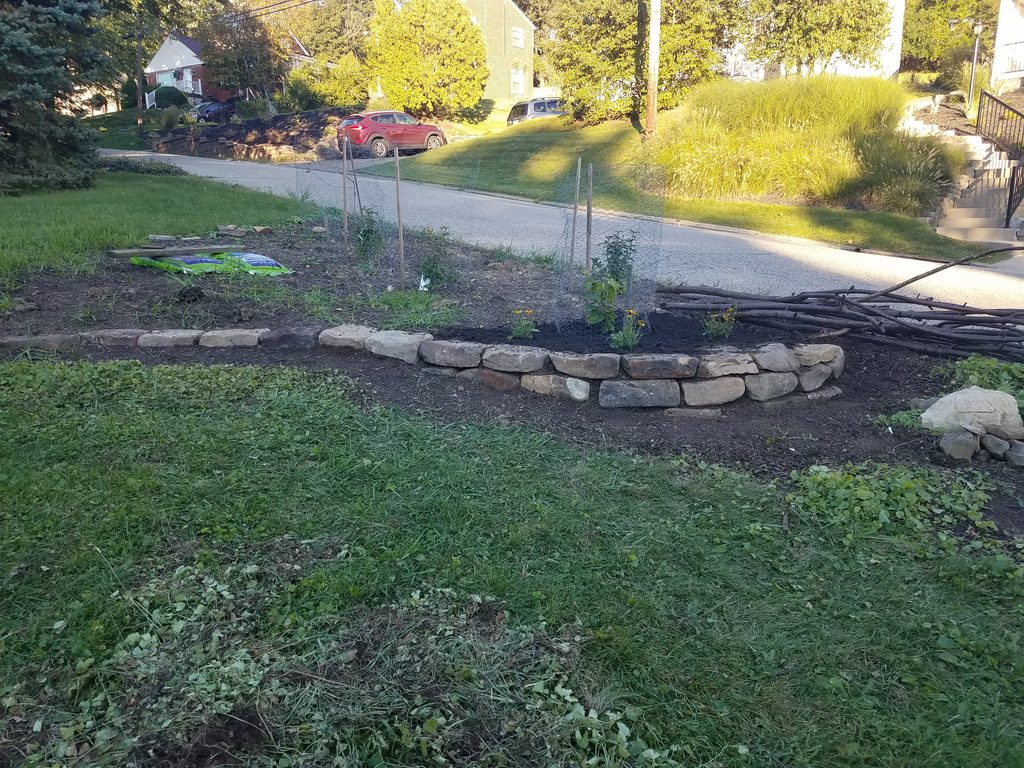
My desire to provide a little more visual interest in the garden with trees and shrubs stimulated my latent creativity, and I decided to add a little more texture and dimensionality to the new garden with a rock wall. Since the whole yard is on a gentle slope downward, I thought it would be a nice touch to create a slight terraced effect with the trees and the newer patch of garden on the higher level and the older garden on the lower level, with much of the rock wall visible in the “putting green” of lawn that still remains.
In the end, I wound up buying 650 lbs of field stone, which, over the course of two days, took shape as a low, curving rock wall about 20ft long and shockingly level (once I meticulously dug appropriately shaped holes for the first row. The upper end by the gum tree is only one stone tall, but as the ground slopes downward, the lower end by the redbud is three stones tall, though the bottom level disappears into the ground. The stones were relatively uniform in size, which helped, but they were not identical, so it still has a natural look to it. I wasn’t able to offset the stones perfectly on each subsequent level, but I keep reminding myself that nature isn’t perfect.
The lower end of the wall curves around the redbud, and I backfilled it with topsoil to make the ground above a little more level. The biggest rush with getting the wall in place was that the black-eyed Susans I had bought in the middle of July were still languishing in their black plastic pots, waiting for a home. Consequently, I assigned myself this fun (if back-breaking) project over Labor Day weekend while Christian was out of town. And, honestly, I really enjoyed the challenge and the structured procrastination this project offered, since it was an alternative to weeding (of which there had been plenty this summer… and there is still plenty to do this fall).
Up to Code
But speaking of the constant need for weeding in my yard, in late June, it finally happened: I got a letter from the borough informing me that I needed to cut the weeds along the street and our driveway. Several of my neighbors were surprised to hear that, especially the ones who regularly tell me how pretty my garden looks. I heard from one of my neighbors that we got a new code enforcer this year, so I’m also not sure if we simply didn’t have one in the past year or two (when I really neglected the garden), or if he was enthusiastic to do a good job.
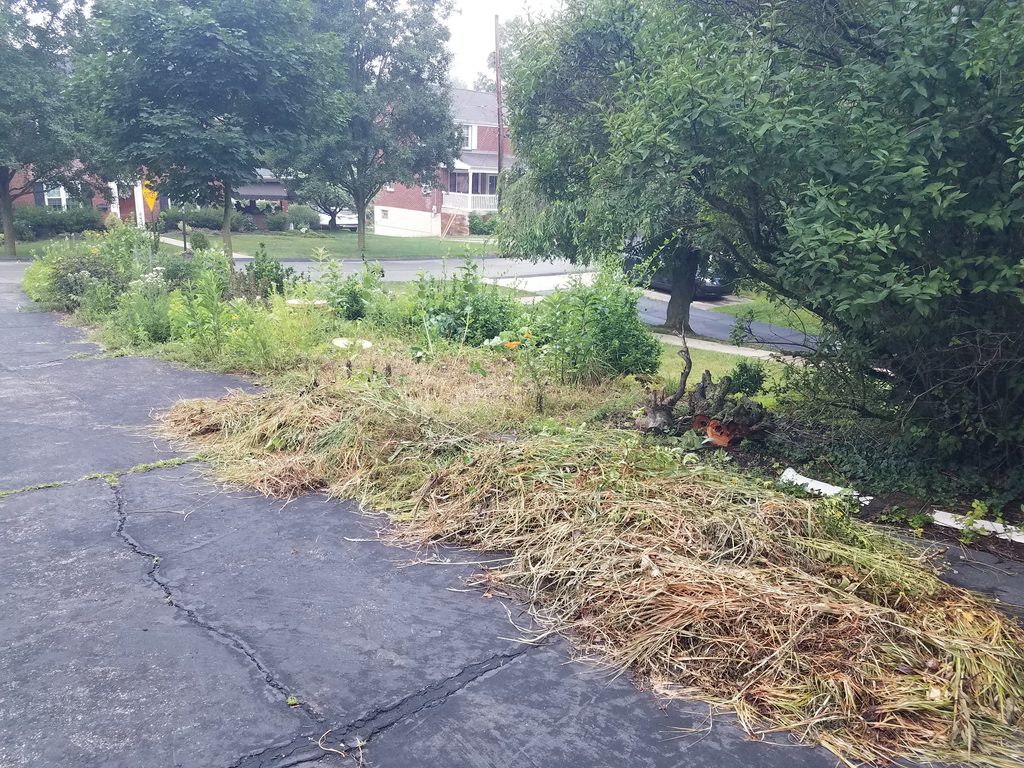
To be fair, weeding absolutely needed to happen. I have, thankfully, come around on leaving some beneficial weeds alone, because I would never make any progress, compared to the slow progress I currently make. (Dandelions are one in particular that I’ve decided to let help me as I wait for the soil to improve. [15]) But the grass was bad. Two years of letting the grass proliferate throughout the corner and driveway gardens, forming a thick network of roots under and through plants I want there, meant I had a lot of work ahead of me. And with this letter, I only had a short period of time in which to comply because our code officer thought compliance would be as simple as mowing.
The violation in question was Section 302.4 of the International Property Maintenance Code: “All premises and exterior property shall be maintained free from weeds or plant growth in excess of 10 inches (254 mm). All noxious weeds shall be prohibited. Weeds shall be defined as all grasses, annual plants and vegetation, other than trees or shrubs provided; however, this term shall not include cultivated flowers and gardens.”
I gave him the benefit of the doubt that he might not know it was a garden (despite the signage) or what was supposed to be there and what wasn’t. I responded with what I considered to be a very polite letter, but for someone who doesn’t know me, I imagine it could have come off as very passive-aggressive. Sandwiched with some niceties, I made the following points:
As of the date of this letter, I have removed any offending weeds and grasses from the garden beds around the front of our yard and along our driveway, as noted in your request. However, I will note that many of the plants in our yard, some of which may resemble weeds before they bloom, are, in fact, native plants that contribute to an extensive pollinator garden that now constitutes the majority of our property.
This garden is certified with the National Wildlife Federation as a wildlife habitat, providing sources of food, water, and cover, and with Monarch Watch as a monarch butterfly waystation, providing a variety of milkweeds and other sources of nectar. As such, I have kept records of new plant additions as the garden has grown, as well as the effectiveness of various sustainable maintenance practices.
If you plan to come by the property for an inspection — or if you would be interested in a visit — I would be more than happy to give you a tour of the garden or at the very least a list of the plants I have added to it over the years (including name, quantity, and year planted).
And in the meantime, I got to work pulling the grass throughout the corner and driveway garden patches. His response was short and cordial, stating that no inspection was necessary. (It’s a shame – I really would have liked to give a tour… for as much as I bemoan all the work that needs to be done, it really does make me happy to see all the visitors making use of it.) That exchange was in early July, and those gardens are ready to be weeded again, but now I’ve got grass going to seed along the front and back walks, which need to take priority. Gardening is a constant process with few victories, but I am very excited to say that at least the back walk is choked with grass and not thistle… and that’s a story for next week.
Thanks for reading!
[1] https://radicalmoderate.online/pollinator-garden-update-2025/
[2] https://radicalmoderate.online/pollinator-garden-update-2023/
[3] https://radicalmoderate.online/monarch-waystations/
[4] https://radicalmoderate.online/removing-and-replacing-trees/
[5] https://radicalmoderate.online/planting-and-pruning-trees/
[6] https://arcadianatives.com/
[7] https://www.wildflower.org/plants/result.php?id_plant=NYSY
[8] https://www.wildflower.org/plants/result.php?id_plant=AMLA
[9] https://www.wildflower.org/plants/result.php?id_plant=CECA4
[10] https://www.wildflower.org/plants/result.php?id_plant=VIPR
[11] https://www.wildflower.org/plants/result.php?id_plant=LIBE3
[12] https://www.wildflower.org/plants/result.php?id_plant=ASTU
[13] https://www.wildflower.org/plants/result.php?id_plant=KALA
[14] https://plantfinder.mobot.org/PlantFinderDetails.aspx?taxonid=371952
[15] https://radicalmoderate.online/dandelions-friend-or-foe/
2 Comments
Garrod · September 27, 2026 at 10:32 am
You’re doing a great job with your garden 👏👏👏
A Good Walk, Spoiled – Radical Moderate · October 3, 2026 at 11:21 pm
[…] Garden Update, 2026; or, A Weed by Any Other NameSeptember 27, 2026 […]