Disclaimer: this post about maintaining good kidney health contains some details of physical pain and medical procedures, so be warned if you’re squeamish. Also, I am not a medical professional, so do not use this post as a substitute for advice from your doctor.
I’m not great at long-term, consistent self care. People in my life, especially my husband, know that fact all too well. Fortunately, Christian is often the Samwise to my Frodo, typically making sure I’m getting some food, water, and sleep while other things weigh on my mind. But on the day before Halloween last year, he literally had to come to my rescue.
In all honesty, the timing could not have been better: I started to feel an unusual, sharp pain in my back on Sunday night, while at the Steelers / Green Bay game with friends. I normally don’t take anything for pain, but it got so bad over the next few days during a work trip to Harrisburg that I needed whatever the hotel concession stand had to offer, just to make it through Wednesday’s meetings and drive home. Thursday morning I woke up to the most intense pain of my life, and I was barely able to drag myself to the bathroom before throwing up.
I lay on the hallway floor, unable to move, but nevertheless texted Christian to inform him that I was going to drive myself to the hospital. He offered to leave work and pick me up, and when I accepted his offer, he knew it was serious. I was incredibly grateful that he was willing and able to come get me, because the short drive to the ER was challenging enough as a passenger. I was also grateful that whatever was happening (I correctly assumed it was a kidney stone) had waited until I was back home.
Attack of the Stones
Kidney stones are small clusters of minerals, acids, and salts, most often made of calcium and oxalates. These substances regularly travel through the urinary tract but can build up in the kidneys, especially in people who are chronically dehydrated (such as myself). Drinking sufficient quantities of water can help flush out the kidneys and prevent buildup, and for most people, that’s enough to prevent them. However, about 1 in 10 people will get a kidney stone in their lifetime, and certain medical conditions (e.g. diabetes, gout, high blood pressure) increase that risk. [1]
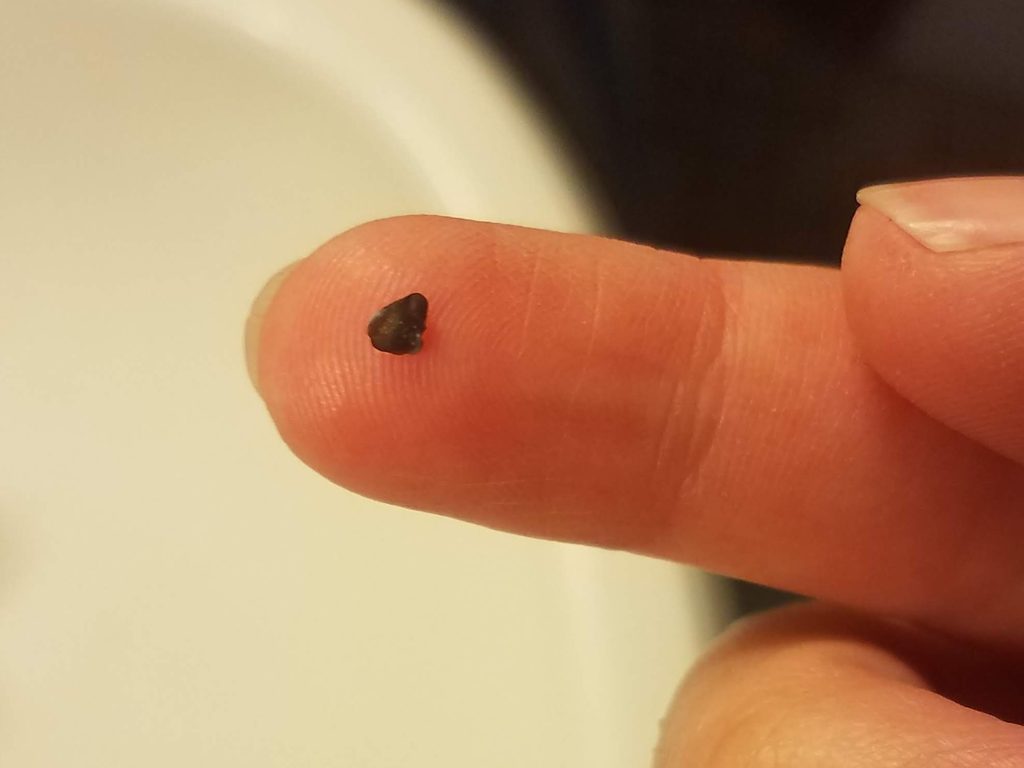
Stones 3mm in size (which this one was) are large enough to get stuck; stones larger than 6mm may not pass on their own.
These stones can be as small as a grain of sand and pass through the urinary system unnoticed. If they’re larger, however, they can get stuck or block the flow of urine from the kidneys through the ureter to the bladder; some become so large that they cannot leave the kidney without surgery. The ureter is about 3-4mm wide, so anything that size or larger can result in an obstruction. But the stone’s size isn’t the only factor in whether it gets stuck – the shape matters too: some can be jagged, while others are smooth, and irregular shapes are more likely to get stuck on their way out. [2]
After it was all over, I encountered two types of people who had been through the experience: those who wanted to empathize and those who wanted to compete. We know someone in the latter group who dismissed my 3mm stone as nothing compared to the 10mm ones he usually gets. His, however, are typically smooth and far easier to pass than those that are jagged or oddly shaped. I have since learned that it is not the size of the stone that determines the pain, so much as the extent to which it causes an obstruction, because the backup of fluids into the kidney causes the bulk of the pain. [3] I’ve also heard from multiple people who know from experience that the pain of kidney stones can be worse than the pain of childbirth.
Never Again
But, again, it’s not a competition – it just makes me feel more justified in gladly accepting several rounds of IV painkillers during several hours in the ER. My pain went in waves as the stone slowly moved south, usually resulting in more vomiting. Every time I thought I had experienced the worst pain of my life, the next round surpassed it – it was all I could do to lie on the bed, doubled over, and breathe. (Prior to that day, the most painful experience of my life, by far, was getting my first IUD, [4] but I’d take that again over a kidney stone in a heartbeat.)
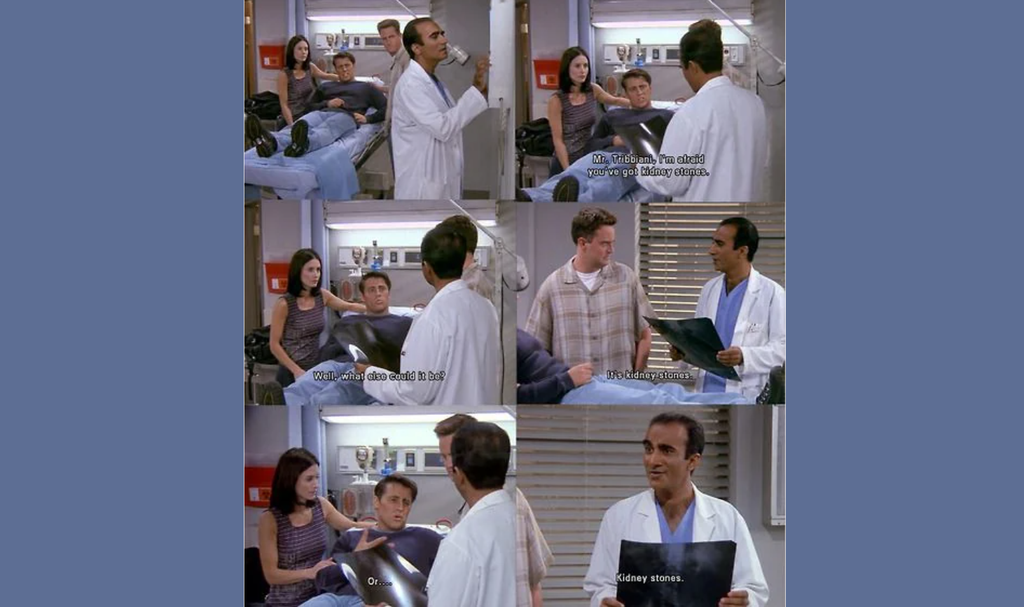
Image credit: [5]
Christian sat next to my bed the whole time, getting me blankets and plastic bags as needed, trying to keep me amused without making me laugh, and ordering a new water filter online to encourage my hydration habits. By the time we were looking at the CT scan of my stone on a computer monitor, I was pretty sure it had passed into my bladder. After the final wave of pain, I felt a sense of relief that none of the IV meds had brought. And, sure enough, it left my body entirely as soon as we got home. By then, I didn’t even need any of the medications they sent home with me, and I was feeling so much better that I immediately went back to working on our Halloween costumes.
But one question I fielded in the ER stuck with me: it wasn’t an intake question or on any form, but the physician’s assistant was very curious as to whether I was a tea drinker. When I said yes, she nodded with a knowing smile – apparently most people she’s seen with kidney stones are. Now, it was pretty obvious to me that it was my poor hydration habits that landed me in the hospital, but I know that tea is a diuretic, and I was also keen to avoid this experience again, if I could. And tea also contains oxalates – subsequent lab analysis confirmed that my stone was the most common kind: calcium oxalate. So it seemed like it would be worth looking into.
What the Science Says
For the record, I drink both tea and coffee, and it really comes down to what I’m in the mood for and what’s readily available. I don’t know that I made a conscious choice to drink more coffee and less tea after my trip to the hospital, but I think I ran out of the tea I liked and started making half-caf americanos for a while, at least until the decaf espresso I like became harder to find, and I was back to tea again. As it happens, there are numerous health benefits to both of these common drinks (both caffeinated and decaf varieties), as well as risks associated with overconsumption. [6],[7] Tea, however, has been more widely studied than coffee (and blamed) when it comes to association with kidney stones.
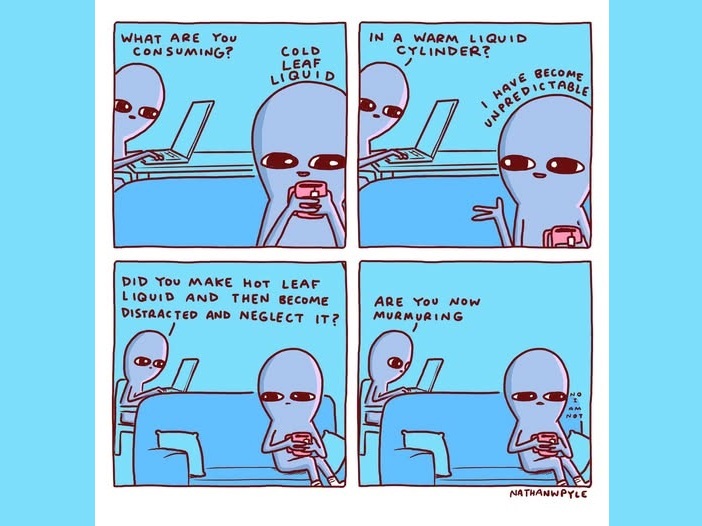
Image credit: [8]
I was skeptical when looking at study results because men are approximately four times more likely to get kidney stones than women, and since I found a lot of information on men’s health websites, I didn’t want to assume that women were necessarily included in studies cited (if any were cited at all). One mixed-gender study of 215 patients demonstrated that those who drank four or more glasses of tea a day had a greater risk of calcium oxalate stones compared to those who drank less than two glasses a day. Coffee consumption seemed to have less of an impact, but the authors noted that the population of coffee drinkers was small in this study, so results should be “interpreted cautiously.” [9]
Meanwhile, Harvard points out that it’s not oxalate intake that’s the problem as much as oxalate absorption: dietary calcium binds to oxalate in the intestines, preventing it from being absorbed into the bloodstream and traveling through the kidneys. Consequently, eating foods high in dietary calcium, such as dairy, tofu, broccoli, collards, black beans, and almonds (i.e. all things I like already) will help reduce the risk of oxalate absorption. The same article also points out that because tea is mostly water, the extra fluid intake from drinking it likely offsets the oxalate it contains. [10]
I probably get more fun that I reasonably should out of reading health studies in my spare time (especially since I do a lot of it for my day job), but I do feel more prepared for exploring research that can support or challenge common perceptions. Of course there are going to be extenuating circumstances for individual health conditions, but I was fascinated to see that a meta analysis (a study that examines multiple previously conducted studies) demonstrated an inverse relationship between tea consumption and kidney stone development across 1.2 million participants. In other words, this study implied that regular tea consumption decreased the risk of kidney stones. [11] The one thing everyone seems to agree on is that moderation is important, which doesn’t surprise me at all.
~
These days, I’m still drinking one or two cups of tea in the morning, but I’ve also been drinking a lot more water than I was this time last year. And as I’ve recently upped my tea intake (in the form of kombucha for gut health [12]), I feel better knowing that there’s more I can do from a food standpoint to reduce the risk of oxalate buildup going forward. As for you, dear reader, I hope some of the information here helps you avoid what I went through last year (and helps me avoid going through it again.)
Thanks for reading!
[1] https://my.clevelandclinic.org/health/diseases/15604-kidney-stones
[2] https://int.livhospital.com/kidney-stone-size-chart-shapes-types-explained/
[3] https://www.everydayhealth.com/why-kidney-stones-cause-much-pain-when-it-goes-away/
[4] https://radicalmoderate.online/copper-plumbing/
[5] https://www.reddit.com/r/howyoudoin/comments/ffvw1l/i_have_a_suspected_kidney_stone_and_this_scene/
[6] https://pubmed.ncbi.nlm.nih.gov/24915350/
[7] https://pmc.ncbi.nlm.nih.gov/articles/PMC12348139/
[8] https://www.facebook.com/nathanwpyle2
[9] https://link.springer.com/article/10.1007/s11130-021-00933-4
[10] https://www.health.harvard.edu/diseases-and-conditions/how-do-you-avoid-kidney-stone-attacks
[11] https://link.springer.com/article/10.1007/s11255-023-03918-1
[12] https://radicalmoderate.online/gut-health-a-strong-offense/
1 Comment
A Cup of Ambition – Radical Moderate · October 3, 2026 at 11:14 pm
[…] Coffee, Tea, My Kidneys, and MeSeptember 6, 2026 […]