Our planet is an amazing place, and I was absolutely thrilled to learn whatever I could about it when I was in college, whether through anthropology (which took me to Ecuador for a month) or physics, which taught me how our solar system behaves. I remember watching a video in one of our physics classes that featured ivy league students being interviewed on graduation day. Clad in caps and gowns, these best and brightest of America’s youth were asked basic physics and astronomy questions, such as “why is it colder in the winter and hotter in the summer?” Our class watched in shock as more than one of these students responded with “because the earth is closer to the sun in summer.”
We may have thought slightly less of these students at the time, but the point our professor intended to make was about the poor state of science education in our country. I then remembered a substitute teacher incorrectly explaining the relative movement of the earth, sun, and moon to my fourth grade class. (Because of my own anxiety about speaking up and contradicting a notoriously mean teacher, I said nothing, but I was nonetheless shocked, even at the age of 10, that she was allowed to come into our classroom and tell us things that were patently false.)
North vs. South
Astronomy was my great love in the world of science when I was a kid, so much so that I put glow-in-the-dark stars on my ceiling in the shape of actual constellations. It was my astronomy professor in college who first encouraged me to major in physics, and I wound up spending my work-study hours running our school’s research-grade telescope and tutoring astronomy students on the roof of the science building. For my first trip south of the equator, my mom bought me a star map, since I would be seeing different constellations than the ones at home. (And as exciting a concept as that was, it was truly disorienting and even anxiety-inducing in the moment for someone who grew up knowing how to orient herself by what was happening in the night sky.)
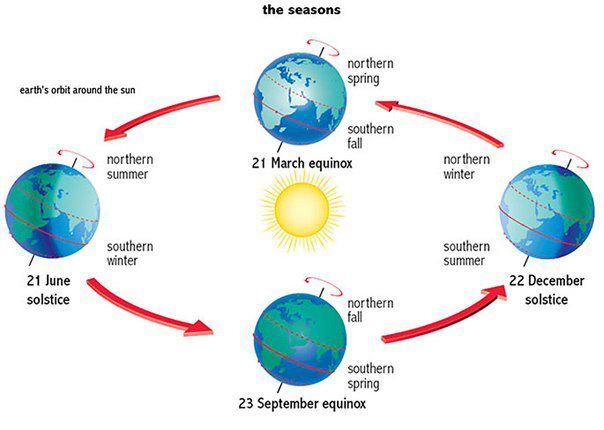
Image credit: [1]

And when I say “south of the equator,” I mean it in a “technically correct” sense, as the country of Ecuador sits on the equator itself… hence the name. Ecuador’s capital Quito is a long, narrow city because of where it sits in the Andes mountain range: it is roughly 25-30 miles long and 2.5-3 miles wide. Just within the northern city limits lies a monument to mark the location of the equator… but, actually, there are two. The more popular and official-looking “Mitad del Mundo” monument’s position is based on a French expedition in 1736. [2] While the calculations were extremely advanced at the time, the more scientifically accurate location, based on GPS information, is the Intiñan Museum, which sits less than 800 ft to the north [3] and includes some less-than-scientifically-accurate exhibits demonstrating strange phenomena associated with the equator.
During my month in Ecuador for an anthropology class, we visited Mitad del Mundo and took pictures of our whole group straddling the fat yellow line painted on the ground, marking the separation of the northern and southern hemispheres. I believe I also had a picture of myself sitting on the line with one foot on either side, but sadly those photos never came back to me after I lent them to the yearbook team. Knowing what I did about the dubious nature of the exhibits at the Intiñan Museum, it was not a high priority for me when Christian and I visited Quito this spring. I may have suggested going if we had more time in our schedule, but two days were not nearly enough to get to everything we wanted to see at the middle of the world.
Fact vs. Fiction
The equator is almost 25,000 miles long and crosses through 14 countries, including Ecuador. It is legitimately interesting enough that it doesn’t need to rely on pseudoscience to make it “cool,” though you’ll find plenty of it if you go there. As I mentioned in last week’s post, [4] the earth is thicker at the equator (by about 27 miles compared to the poles [5]), and the atmosphere is about twice as thick. Between the centrifugal force you feel at the equator and the increased distance from the earth’s core, you do actually weigh about 0.5% less than you would at the poles. [6] For those reasons, equatorial regions are actually better for space launches than other places in the world.
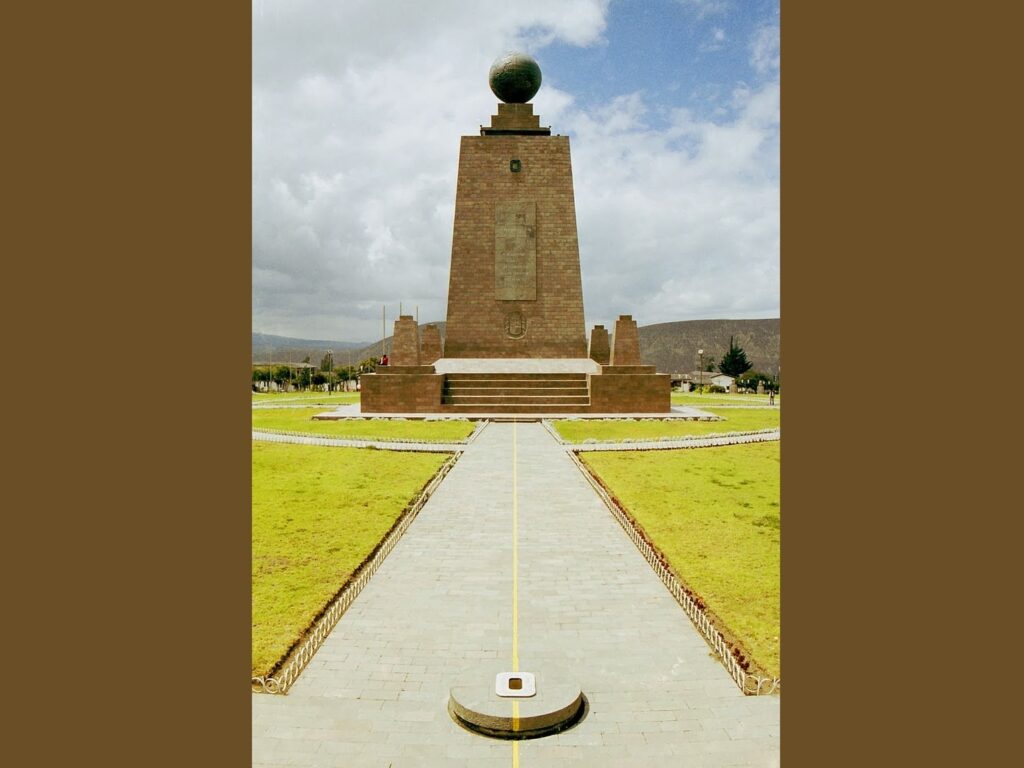
Image credit: [7]
The reason we have seasons is not (as those ivy league graduates thought) because the earth is closer to the sun in the summer. In fact, the earth is closest to the sun (called “perihelion,” about 91.4 million miles) during early January and farthest (called “aphelion,” about 94.5 million miles) during early July. Because the earth spins on a tilted axis, the sun’s rays hit temperate zones more directly during our summer months and less directly during our winter months. Meanwhile, the sun hits the equator most directly on the spring and fall equinoxes. Consequently, Ecuador has different seasons than we do in temperate zones of the world: instead of summer and winter seasons created by axial tilt, they have a wet season from December to May and a dry season from June to November, which are more strongly influenced by weather patterns than by extreme temperature variations. [8]
Now, it is true that there are common but inaccurate perceptions about earthly phenomena held by intelligent and highly educated people around the world. And it is not entirely their fault, either: throughout our lives, many of us are exposed to concepts that aren’t necessarily based in science, authority figures who don’t actually understand or can’t effectively convey the subject matter, and situations in which we are discouraged from asking questions or applying critical thought. To my physics professor’s point, we as humans are often inclined to believe what we’re told, and we’re very inclined to believe what we think. I’ve encountered the need for critical thinking in multiple academic subjects over the years, so it is by no means unique to the realm of science, but the scientific method does provide a nice framework for built-in skepticism. [9]
In Balance
Skepticism as a concept gets a bit of a bad rap, when at its core it is nothing more than “a reluctance to believe claims without evidence,” a willingness to approach unclear situations with an open mind and be influenced by data. It is not inherently negative, and I think it is often confused with cynicism, which represents suspicion of others’ motives. One article about the two summarized the difference far more succinctly than I could have: “cynicism is a lack of faith in people; skepticism is a lack of faith in our assumptions.” [10] And I like to think that there are more situations in this world involving people who aren’t applying healthy skepticism than there are situations involving people who are acting maliciously. Again, I have not personally been to the Intiñan Museum, where their pseudo-sciencey exhibits draw crowds (and revenue), but I have no problem with anyone going as long as they view the “experiments” as entertainment, not science.
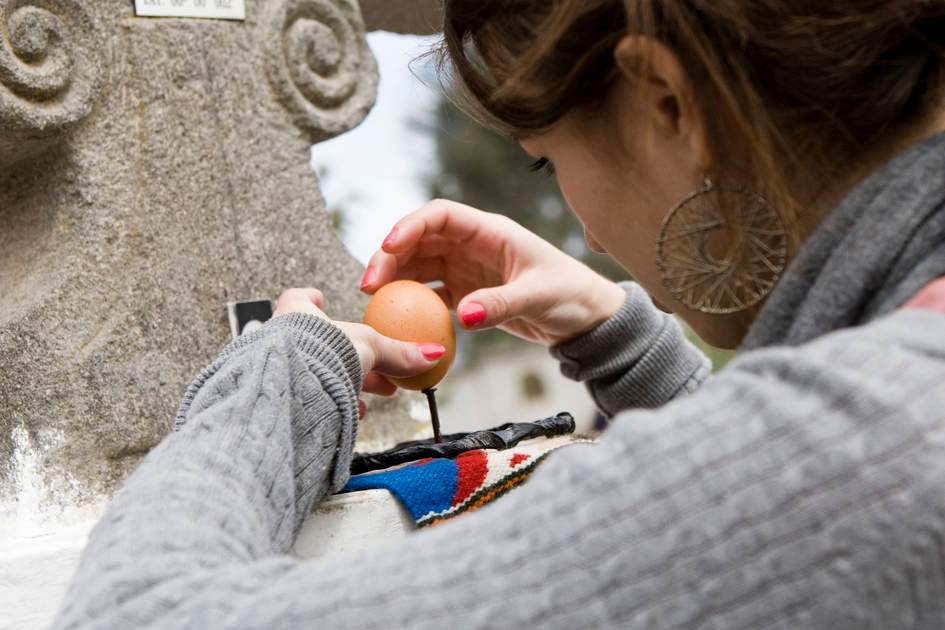
Image credit: [11]
For the record, I absolutely would have gone to have some kitschy fun myself if we’d had more time to spare, but that time was taken up by things we really wanted to see on day-trips from Quito, such as Cotopaxi [12] and the Mindo Cloud Forest [coming next week!]. Many of these “science experiments” are based on common perceptions about strange phenomena that happen on the equator or in the southern hemisphere but that aren’t real. The most common myth is that because of the Coriolis effect, water drains from sinks and toilets in opposite directions depending on the hemisphere. It is true that weather systems operate this way, but something as small as a tub of water located a few feet north or south of the equator will not see an effect from this force. What you will see at this museum is a fun sleight of hand – and it should be enjoyed as one would enjoy a magic show.
Another common myth is that you can balance an egg on its end at the equator (and nowhere else), and there is an opportunity to try it yourself at the museum. In fact, I have a friend who recently did it there. But you can do it anywhere. When I was kid, a friend and I balanced eggs on the sidewalk during the spring equinox – my mom told us we could because the earth was “straight up and down” that day (which it most definitely was not). I was disappointed to find that I could do the eggsact same thing any other day of the year, but the important thing was that I was ready to try it myself and collect additional data. Self-proclaimed “guerrilla skeptic” Rob Palmer describes observing these experiments [14] on the equator and recounts one instance when a tour guide was asked about trying to balance an egg elsewhere – apparently the guide’s response was “Why would I? It wouldn’t work anywhere else!”
For the record, I am not trying to burst anyone’s bubbles or telling people not to have fun – just have fun with your eyes open. Our planet is such an incredible place that we don’t have to make stuff up to be in awe of it. If we exercise healthy skepticism, keeping our minds open and being willing to have our minds changed by data, we can be much better equipped to navigate (and protect) this amazing, complex, mysterious world. And there will be more to come about our awesome experiences in the middle of the world in the next few weeks.
~
Have you been to the equator, and have you tried any planetary science experiments? I’d love to hear about what you saw and learned.
Thanks for reading!
[1] https://i.pinimg.com/originals/12/a2/dd/12a2dd02d75085f263d7545ea2fca57a.jpg
[2] https://www.amusingplanet.com/2014/02/the-equator-in-ecuador.html
[3] https://www.wonderfulmuseums.com/museum/intinan-museum-quito/
[4] https://radicalmoderate.online/top-of-the-world-cotopaxi/
[5] https://education.nationalgeographic.org/resource/equator/
[7] https://www.amusingplanet.com/2014/02/the-equator-in-ecuador.html
[8] https://www.worldatlas.com/articles/do-places-near-the-equator-have-seasons.html
[9] https://www.britannica.com/science/scientific-method
[10] https://behavioralscientist.org/instead-of-being-cynical-try-becoming-skeptical/
[12] https://radicalmoderate.online/top-of-the-world-cotopaxi/
[13] coming soon!
[14] https://skepticalinquirer.org/exclusive/ecuadorian-equatorial-pseudoscience/
1 Comment
Top of the World: Cotopaxi – Radical Moderate · October 3, 2026 at 10:54 pm
[…] Journey to the Center of the EarthJuly 5, 2026 […]