This post contains spoilers for The Lord of the Rings. If you haven’t read the books, you may not be aware of one of the most meaningful plot points in the story. So read on if you dare.
Hollywood storytelling has done many disservices to us when it comes to our perception of reality. I often pick on the concept of “happily ever after” in romance movies, which is most certainly not a thing (at least not without a boatload of work from both parties). A separate but somewhat related peeve of mine is the trope of killing the main villain at the climax of the story and then encountering nothing but relief and accolades afterwards – a “happily ever after” in its own way. We often see a complete resolution to the conflict, with the threat irrevocably vanquished.
The Trouble with Humans
You will see this trope in many vampire movies (e.g. killing the head vampire kills them all), but it also shows up in other monster movies, and it certainly plays out this way in the Lord of the Rings movies. Once the ring is destroyed – and Sauron, and all his minions with it – no one appears to encounter any challenges for the rest of the story, except Frodo’s wound from Weathertop that will never heal. One can argue that that format makes for exciting, cathartic, comforting movies, but it does not prepare us for effectively navigating challenges we actually face in the real world.
I’ve previously written about the three-act (setup, conflict, resolution) storytelling format we’re used to in western society and how it is enjoyable and comfortable, but that it also flattens many stories into a black-and-white, conflict-driven, zero-sum game situation. We’re actually so used to seeing that narrative structure in our entertainment that we’re more likely to look for it in real life, where “good guys” win and “bad guys” lose definitively after some kind of final event. [1]
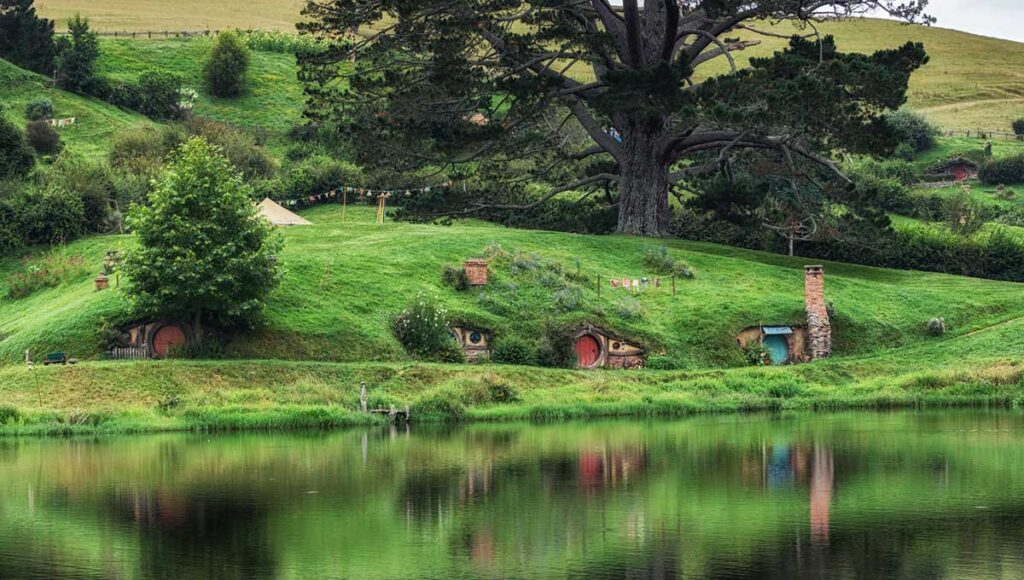
Image credit: [2]
But humans don’t fall neatly into “all-good” and “all-bad” camps – we move through the world doing a mix of good and bad things (some more than others, to be fair). We, however, tend to apply labels that serve for easy categorization in order to help us process complex relationships and situations. And as comforting as it is to think of a decisive event that will represent the end of a conflict, in which the “other side” is defeated (and accepts that defeat), that is unlikely to happen as long as there are humans.
Lost Opportunities
Anyone who knows me has heard me complain about various decisions made when adapting The Lord of the Rings to the screen. My biggest objection by far is the choice to remove the final trial for our hobbit heroes upon their return home. The big battle for all of Middle Earth was won with the defeat of the dark lord Sauron by destroying his ring of power in the fires of Mount Doom, and from a cinematic standpoint, that seems like a good choice for the climax of an epic cinematic trilogy. However, from a character development standpoint, it feels like a grievous omission to gloss over the fact that there were still hardships ahead and that not all was resolved by the big boss fight.
Other forces previously aligned with Sauron (or simply out for power themselves) were still at work in unsuspecting parts of Middle Earth, far from Sauron’s realm of Mordor. The white wizard Saruman had allied himself with Sauron, at least nominally, while intending to eventually fight him for power. He provided intel on our heroes to Sauron and supplied the dark lord with armies – forces made up of genetically engineered orcs and wildlings who felt so disenfranchised by the kingdoms of men that they were ready to fight and die in hopes of regaining their ancestral lands, which Saruman had promised them.
In Peter Jackson’s adaptation, Saruman was murdered after his defeat at the Battle of Isengard; in the books, he and his servant Wormtongue fled on foot to a separate location where Saruman had had dealings for quite a while. [3] And that brings us to the real final battle of the story… In the movies, when Frodo and friends return to the Shire, clad in the trappings of war and symbols of their service to foreign kingdoms, they are met with surprise and confusion by the residents of a largely unchanged home; in the books, our heroes are more shocked by what they find on arrival.
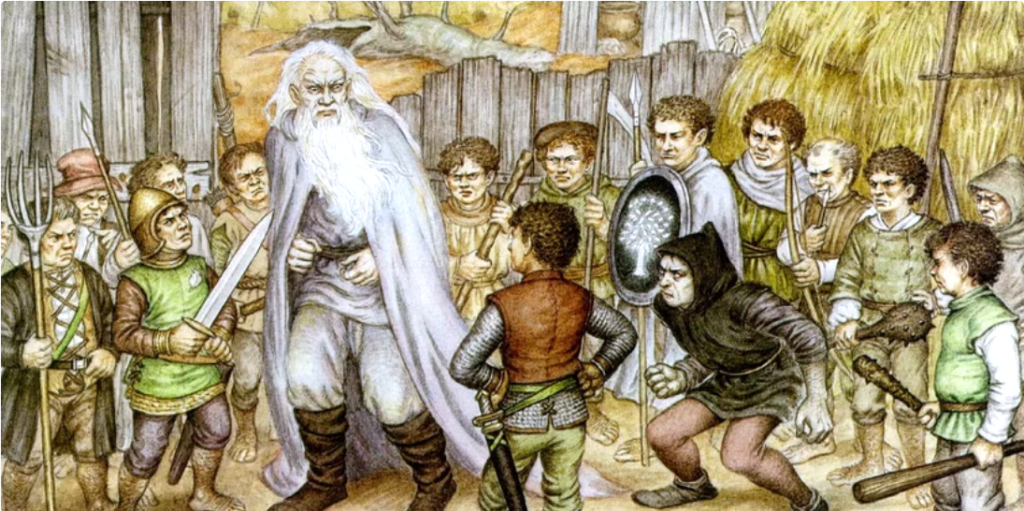
Image credit: [4]
The Scouring of the Shire
This challenge was not entirely without foreshadowing. Their friend and guide Gandalf, a wizard himself, bids them farewell on the road with the cryptic encouragement that they must settle the Shire’s affairs themselves: “this is what you have been trained for … you will need no help. You are grown up now.” But when they arrived at their home, it was worse than what they had feared; it was worse than Mordor, they said. Landmark buildings and trees had been torn down, with hastily built utilitarian structures put in their place; industrialization and pollution had marred their idyllic agrarian society; an increased police force confiscated and “redistributed” crops, enforced curfews, restricted travel, and jailed dissenters. Frequent mentions of “the Chief,” of course, referred to Saruman.
Saruman had been purchasing goods from the Shire for (possibly) years, conducting trade with Frodo’s cousin Lotho, a businessman who purchased Frodo’s mansion when Frodo was leaving on his journey. Using Saruman’s gold to back his business efforts, Lotho expanded land purchases, crop production, exports of goods, and personal security, inviting Saruman’s ruffians to the Shire to help him maintain power as more hobbits opposed his changes. Lotho imprisoned early objectors, such as the Mayor, and declared himself Chief Shirriff. But as soon as Saruman arrived in the Shire, he removed Lotho (who was jailed and eventually killed) and assumed power himself.
At the beginning of the movies, before Frodo ever leaves the Shire, we hear a line written specifically for the screenplay: “keep your nose out of trouble, and no trouble’ll come to you.” Given what happened in the books, that is empirically false. In the movies, we see a vision of destruction in the Shire, described to Frodo as what would happen if he failed to destroy Sauron. In the books, it happened despite our heroes’ defeat of Sauron. And that brings me back to my original point: the denouement of the movies depicts our heroes celebrating the destruction of the dark lord and the dawn of a new age, but we as viewers are not challenged to consider the damage wrought by others seeking power of their own, including damage done to a peaceful, isolationist society by a defeated wizard, some disenfranchised ruffians, and a handful of opportunistic businessmen.
No One is Coming to Save Us
Despite the six-month ordeal to destroy the ring of power that almost destroyed Frodo in the process, the last battle of the story challenges him and his friends in new and unexpected ways. The stakes are high: the hobbits are on their own to set things right, without the rest of their fellowship, and it is their own home they are fighting to save, even after they assumed they already saved it by defeating Sauron. In the end, of course, Gandalf was right: they knew how to organize troops and lead a battle now, and that’s what they did, swiftly and successfully removing Saruman and company from power. The whole ordeal is very short in the book, but that should not diminish the critically important fact that it is ultimately the hobbits themselves, absent any men, elves, dwarves, or wizards, who need to defend and then rebuild the Shire.
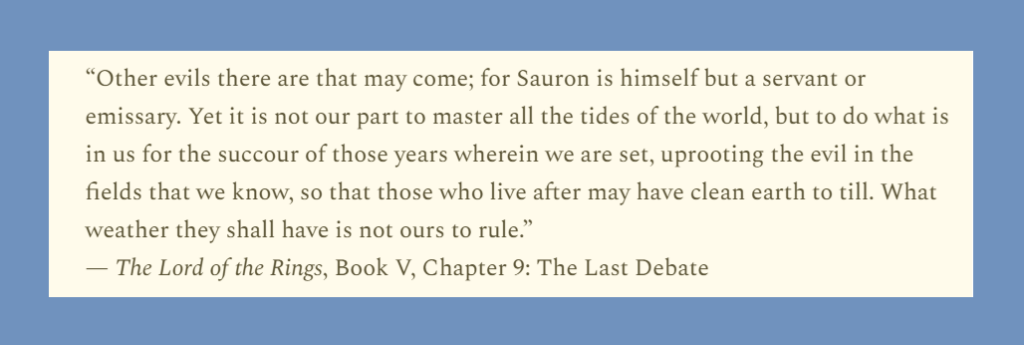
Image credit: [5]
The hobbits – the people who assumed they would be safe because they didn’t get involved with the concerns of the world – were not rendered safe from harm because Frodo went off to destroy the ring of power. Sauron’s demise arguably benefited the Shire in the long run, but his destruction didn’t solve the problems there… because he didn’t create them. A wizard, men, and even some hobbits had a hand in the destruction of the Shire, and they didn’t destroy the Shire because they were evil; the hobbits who collaborated with Saruman destroyed the Shire largely out of an ignorant, short-sighted desire for power, with no thought to the consequences.
It’s telling that a university professor chose to paint ignorance as the real destructive force in his fictional world, a fictional world that is so complex and lived-in that we can frequently see aspects of our own lives reflected back to us. At different times over the years, I’ve wanted to live in different places in Middle Earth, but with age I’ve realized that I really just want to be a hobbit. The idea of retreating to a quiet, nature-loving community where I can spend my days gardening and my evenings with a mug of ale is incredibly attractive, but I also recognize that even the hobbits – who knew and cared nothing of Sauron – were still called to take action against opportunism and exploitation wrought by others. If I’m going to be a hobbit, may I be that kind of hobbit.
Thank you for reading.
[1] https://radicalmoderate.online/the-world-of-miyazaki-narrative-style/
[2] https://newsthump.com/2017/04/22/the-shire-elects-saruman-as-new-leader/
[4] https://gamerant.com/lord-of-the-rings-saruman-movies-books-differences/
[5] https://matejcadil.substack.com/p/against-the-machine-tolkien-pope
1 Comment
Planting and Pruning Trees – Radical Moderate · October 3, 2026 at 10:39 pm
[…] When It HappensJune 21, 2026 […]