Disclaimer: I am not a medical professional. The content of these blog posts is based on my own experience and research. Always talk to your doctor before making any changes to your medications, diet, or activity.
I worry that last week’s post came off as a little horrific with descriptions of parasites and their resulting symptoms, [1] but I will reiterate what I said right at the beginning of it: the benefits of travel have always outweighed the costs, as far as I’m concerned. My worst health outcome happened in one of my favorite countries, and that did not diminish the value of the trip… it just provided some more interesting stories. When I return from travel anywhere, I bring with me new experiences, new perspectives, and new information. Sometimes I even change my behavior as a result of something that happened (at least in the short term). Usually those changes are because something has inspired me to be a better global citizen, but other times (as with both returns from Ecuador) I’ve made changes for health reasons: eating healthier foods to literally rebuild my gut microbiome.
Gut Feeling
Our guts contain trillions of microorganisms, i.e. about the same number of our own cells that make up our bodies. [2] But the gut microbiome includes a community of different types of organisms, including bacteria, fungi, and even viruses that hunt certain kinds of harmful bacteria in order to keep us healthy. We often think of them playing an important role in digestion, as they break down food so our bodies can absorb nutrients, but they also impact our immune system (training it to identify beneficial vs. harmful microbes), our endocrine system (secreting hormones that regulate metabolism), and our nervous system (sending signals to our brains about our wellbeing). [3]
In fact, we are so impacted by what’s in our guts that an imbalance of the microbiome is linked to “various human diseases, such as anxiety, depression, hypertension, cardiovascular diseases, obesity, diabetes, inflammatory bowel disease, and cancer.” [4] It’s not just us, either – lab studies with rats and bees demonstrate “greater susceptibility to infection by opportunistic pathogens” when their microbiomes are damaged. Evidence suggests that is actually the mechanism through which Roundup (an herbicide, not a pesticide) plays a role in bee population decline: by harming gut microbes that respond to glyphosate in ways similar to plant cells. [5]
Scientists are continuing to learn more about the two-way signals that travel between the brain and the gut, with more attention being paid toward the impacts of gut health on mental health in recent years. One study I reviewed for this blog posted noted that that “bacteria in the gastrointestinal tract can activate neural pathways and [central nervous system] signaling,” which impacts mood, [6] and I’ve already written about how the gut microbiome interacts with our body’s endocannabinoid system to regulate stress responses. [7] The fact is that our gut plays a bigger role in our health than most people realize, and for that reason, we should be thinking more about how we can do more to protect its health.
What we eat, drink, and the medicines we take can have a significant impact on the makeup of our gut microbiome. Certain foods, such as fiber, can play a role in supporting healthy gut microbes (including some that can protect against inflammation), while others, such as sugar and alcohol can break down into compounds that feed unhealthy microbes. Worse yet, broad-spectrum antibiotics, such as the kind I received from the pharmacy on our recent trip to Ecuador, can wipe out good and bad bacteria alike, destabilizing the microbial ecosystem and allowing opportunistic bacteria to grow. To be fair, the pharmacist also gave me probiotics to take along with the Cipro so that I could support some level of healthy microbes, but I seriously wondered whether any of it would survive. At the very least, it wouldn’t hurt.
Healthy Community
It was already my understanding that the gut microbiome was a pretty stable thing, with its makeup remaining fairly consistent throughout adulthood. Given the fact that I was killing everything in my system (good and bad), I hoped I could take this clean slate and build a healthier gut. And since I wasted that opportunity the first time I came back from Ecuador, I figured I had better give it the old college try this time. In order to do that, I was going to need a healthy mix of probiotics (live microorganisms that provide a benefit to the gut) and prebiotics (food for those microbes, often in the form of fiber that can make it through to the intestines). [8] And because I’m a nerd, you had better believe that I gathered data.
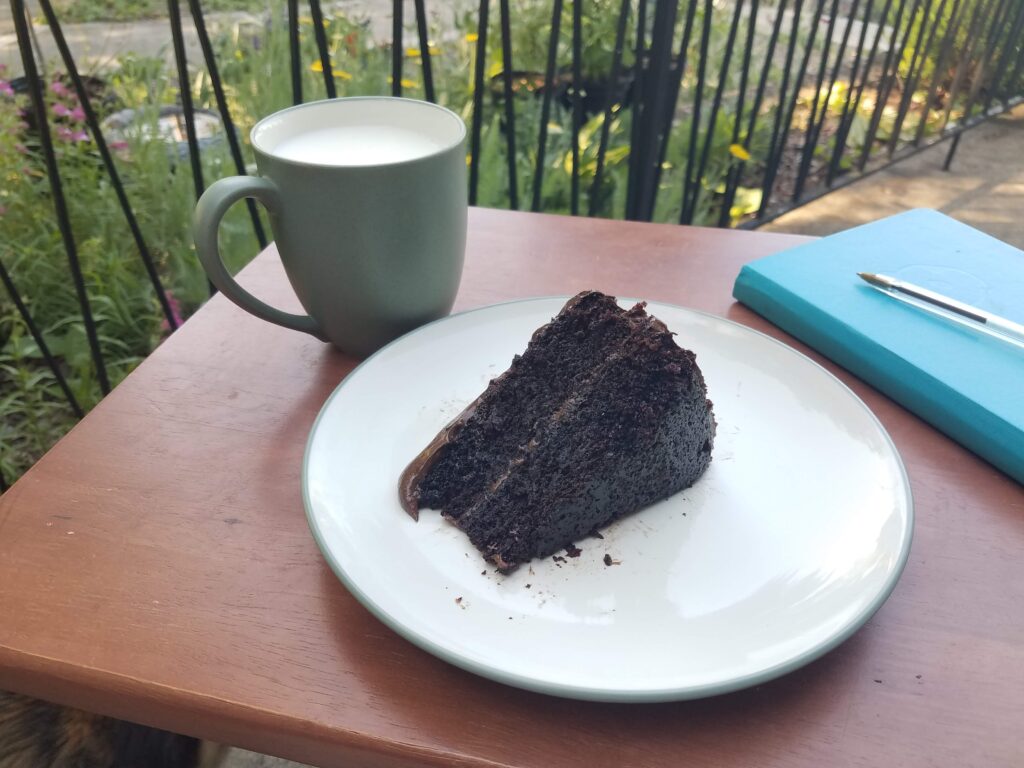
Once we got home in March, I began tracking my food consumption to observe what I was eating and how well my system functioned as a result. And, as most self-improvement projects tend to do, this one started off well, with a lot of oatmeal, yogurt, kombucha, and beans. As it happens, I really like foods that are good for you, so it didn’t feel like a chore. Probiotic foods, which are often fermented or contain living cultures, can be a little polarizing because of their flavors and/or textures, but I’m a huge fan: yogurt, kombucha, sauerkraut, kimchi, and natto. [9] Prebiotic foods, meanwhile, are far more agreeable to a broader selection of the public: garlic, onions, leeks, apples, bananas, oats, avocados, and cocoa, to name a few. [10] But, while I can confirm that changes to gut health can be evident in as little as 1-3 days, building a healthy, resilient gut takes time and consistency. And when I get busy or stressed, or when I travel, consistency goes out the window.
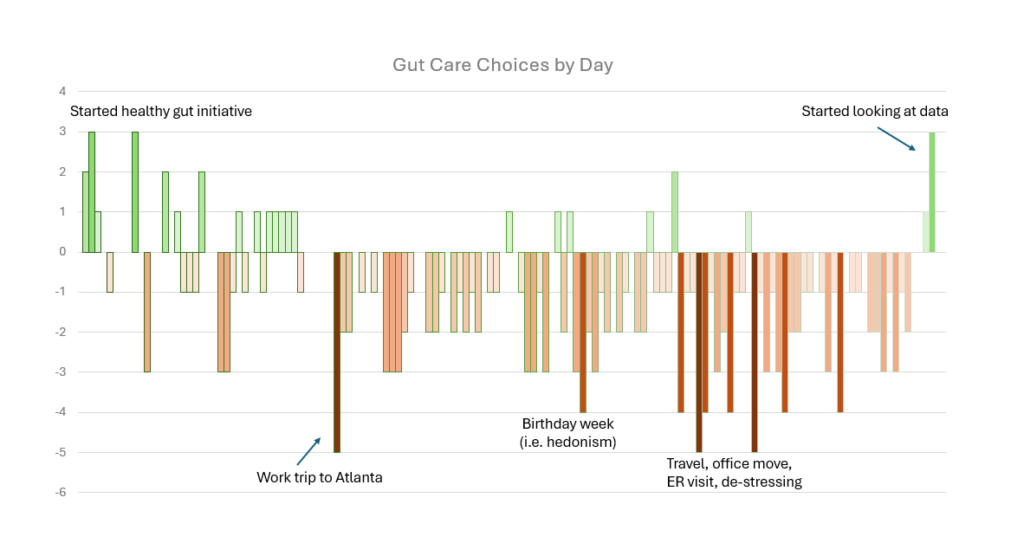
This exercise isn’t the first time I’ve used my blog to hold myself publicly accountable to something I said I would do. For the record, I didn’t think I was being particularly bad with nutrition, but I also didn’t actually take any time to look at the data until I started writing this post… almost five months after the beginning of this experiment. I did not record portion sizes – just what I ate and drank each day, so the process is a bit subjective. The point was not to draw a line in the sand and determine if any given day was “healthy” or “unhealthy” but rather to examine trends of which days were better than others, relative to each other. To make it easier to compare nearly five months’ worth of data, I coded each day with a number: the number of “good” items I had (probiotics, prebiotics) minus the “bad” (sweets, processed foods, alcohol). I didn’t like what I saw.
Course Corrections
Of the 140 days between when I stopped taking Cipro and when I wrote this post, 34 of them were scored “0,” or evenly good and bad. There were 22 days ranked better (ranging from 1 to 3), and 84 days ranked worse (ranging from -1 to -5). The three worst days included a conference in the south (involving fatty foods), a trip to see my dad (involving alcohol), and an evening out at a movie theater (involving junk food). The three best days simply involved making good choices (including no alcohol): the first two were during the first week of this experiment, and the last one was the day after I started crunching this data. Bad days happened when I was traveling, busy, or tired and started slipping into old habits; good days happened when I made healthy eating a priority. It’s just that simple.
Given that my efforts have been less successful than I had hoped, I wanted to learn more about what I can do from here, specifically how long it takes to shift gut health if you’re not building a microbiome from scratch. Some research has noted negative changes as quickly as a few days the introduction of high-sugar, high-fat foods, but I wondered if positive changes could happen just as quickly, if at all. I couldn’t find any peer reviewed research to back up claims about how long it takes to build a healthier gut, but I found overwhelming support that it can be done with a significant and consistent shift in diet and behavior.
Several online sources describe timelines from six months to two years to develop a robust, thriving community of beneficial microbes. [11] What that means is regularly consuming prebiotics and probiotics but also avoiding foods and chemicals that can harm your microbiome, such as sugar, saturated fats, processed foods, alcohol, smoke, pesticides, antibiotics, and certain medications that can change pH (e.g. acid blockers). A healthy gut can recover from a brief exposure (e.g. taking a prescription to get well) but chronic exposure can damage it by shifting the environment away from one in which healthy microbes can thrive. [12]
I truly felt physically better during the first few days of this experiment (and during the most recent ones), and I’ve really enjoyed the healthier food I’ve cooked for myself. While I’m not going to completely eliminate the treats I enjoy eating and drinking, I have yet another reason to moderate their intake.
Thanks for reading!
[1] https://radicalmoderate.online/gut-health-playing-defense
[2] https://www.nature.com/articles/s41522-024-00580-y
[3] https://my.clevelandclinic.org/health/body/25201-gut-microbiome
[4] https://www.frontiersin.org/journals/microbiology/articles/10.3389/fmicb.2022.999001/full
[5] https://radicalmoderate.online/roundup-and-glyphosate-part-3/
[6] https://www.sciencedirect.com/topics/medicine-and-dentistry/gut-microbiome
[7] https://radicalmoderate.online/stress-management-endocannabinoids/
[8] https://cdhf.ca/en/digestive-conditions/the-microbiome/
[9] https://www.healthline.com/nutrition/11-super-healthy-probiotic-foods
[10] https://www.healthline.com/nutrition/19-best-prebiotic-foods
[12] https://my.clevelandclinic.org/health/body/25201-gut-microbiome
3 Comments
Coffee, Tea, My Kidneys, and Me – Radical Moderate · September 6, 2026 at 2:53 pm
[…] last year. And as I’ve recently upped my tea intake (in the form of kombucha for gut health [12]), I feel better knowing that there’s more I can do from a food standpoint to reduce the risk of […]
Kombucha: Home-Grown Health? – Radical Moderate · September 13, 2026 at 2:53 pm
[…] on my radar again this year as I was researching probiotics and gut health (for personal reasons [1]), and it seemed like a good time to revisit the science of this living drink to see what it does […]
Gut Health: Playing Defense – Radical Moderate · October 3, 2026 at 11:06 pm
[…] Gut Health: A Strong OffenseAugust 9, 2026 […]