As always, the content of this blog is my opinion and not the position of any organizations with which I am associated.
When I first moved in with Christian (officially 9 years ago; functionally, 10), I started campaigning for a kitchen upgrade. He had an electric oven that was original to our 1950s house and an electric range that did not seem to be much younger. I previously had gas ranges in my kitchens and loved the responsiveness of the heat compared to electric – plus, there’s a common perception that gas cooking is just better. Knowing what I know now, I am very glad that he pushed back against converting our cooking equipment to gas. His reluctance ultimately reduced risks of health hazards in our home and made it even easier to convert to what we have now: an induction cooktop.
Perception vs. Reality
The catchphrase “Now you’re cooking with gas” was popularized almost a century ago by the natural gas industry, encouraging people to perceive gas cooking (as opposed to wood or electric) as the best option available to them. The phrase has since spread outside the realm of cooking to imply that things are moving along smoothly or quickly. [1] However, we now know that gas cooking is not the best option – for the environment or for the health of people nearby. In addition to the most extreme and obvious risk of fire hazards (resulting in an average of over 150,000 deaths per year in the US [2]), breathing in the gas itself can increase the risk of health harms, from asphyxiation, [3] to cancer, [4] to asthma. [5]
In recent years, we’ve seen a push to move away from gas stoves for health and safety reasons, but also because there are more efficient options that carry environmental benefits with them as well. Certainly, it is important to remember that if you’re cooking with traditional electric stovetops or induction cooktops, you’re most likely still using gas somewhere in the process. In Pennsylvania, almost 60% of our electricity is generated from fossil gas [6] – what that means is that you may have reduced gas-related health risks in your home by using electricity to cook, but there are still risks to people living near gas infrastructure and, more broadly, to the global climate.
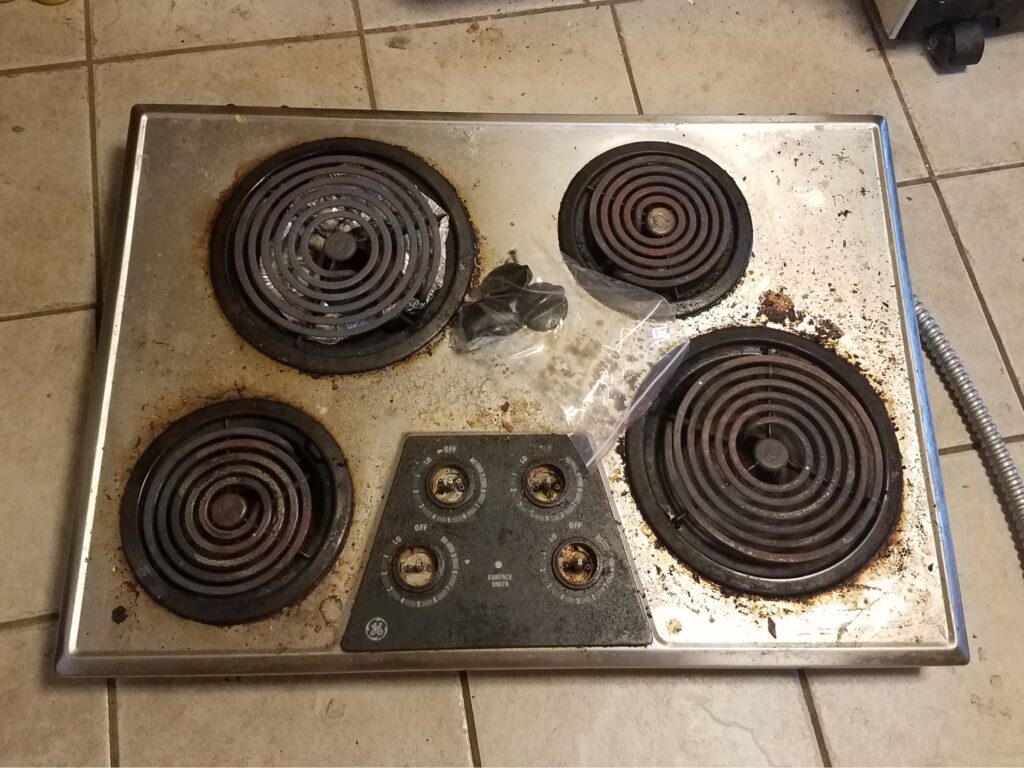
For the record, we buy “green” electricity, which is not in any way a regulated term, but it does make me feel like I’m being marginally more responsible with my consumption. [7] In our plan, we’re still using electricity from our regional grid, about two-thirds of which is generated from fossil fuels, but we automatically pay for Renewable Energy Credits to offset our fossil consumption and invest in bringing more renewable generation capacity onto the grid. [8] As I like to remind people, the cheapest, cleanest, healthiest kilowatt-hour is the one that isn’t used, so energy efficiency and usage reduction measures are always preferable to simply switching your energy source. And in that vein, I was pleasantly surprised to learn that induction cooking is three times more efficient than gas (and about 10% more efficient than an electric range). [9]
Fun with Physics
The reason why induction is so much more efficient than other methods is because those other methods rely on thermal conduction (i.e. applying heat to the pans). Electric stove coils, for instance, get hot by resisting the electric current that runs through them – they are, by definition, inefficient. Efficient electronics use low-resistance metals for their wires to minimize the heat generated and get as much of the electric current where it needs to go, but heating elements are the opposite: they are made from metals that have high resistance and therefore generate heat when in operation. [10] It takes time for the metal coil to heat up, and once it does, heat energy will transfer from the hotter coil to the cooler pan sitting on it until they reach equilibrium, which takes time. It also takes time to adjust the heat down on an electric stove because the element needs to cool to the new temperature, but until it does, it is still keeping the pan (and – thanks to the laws of thermodynamics – the food) hot. [11] Gas is more responsive than electric heat because you’re applying heat to the pan through a flame, and the intensity of the flame changes as quickly as you can adjust the gas flow, but there is still a lot of heat lost to the surrounding air, instead of using it all to heat the pan.

Photo credit: Christian Korey
But magnetic induction doesn’t rely on heating the pan by transferring heat from something else that’s already hot; the induction process simply makes the pan hot. The behavior of electric fields and magnetic fields are interrelated, and those behaviors are described through a set of four equations, which were first assembled by James Clerk Maxwell: “Maxwell’s Equations.” Two of them explain that an electric current creates a magnetic field, and, conversely, that a changing magnetic field induces an electric current. [12] In our electrodynamics class in college, we mostly talked about electric currents being induced in conductive wires (as you would see in a transformer [13]), but for induction cooking, the changing magnetic field generated by the coiled wires of the cooktop creates friction in the pan at the atomic level, which causes the pan to heat without applying heat to it. This process of heating the pan begins almost instantaneously, assuming the pan is responsive to magnetic fields: if a magnet doesn’t stick to the bottom of the pan, it will never heat on an induction stove.
Adjustment Period
This radically different method of cooking was something I first got to try when I was taking part in an indoor air quality workshop with a local nonprofit group here in Pittsburgh – we all made breakfast together on portable induction burners during our last morning meeting. (Ironically, that workshop was the reason / excuse as to why I started staying at Christian’s on the regular – I needed a place where I could take indoor and outdoor air quality readings over the course of a month, and I had nowhere to put an outdoor monitor at my apartment.) Induction cooking was touted by that group as being better for indoor air quality, since it didn’t use gas, and since it was also far more responsive if something got too hot and started to burn. [14] Nevertheless, I persisted with my belief that gas was better for several years until I got a better understanding of all the health risks – notably that gas stoves still tend to leak, even when they’re off, releasing benzene and other hazardous chemicals in the process. [15]
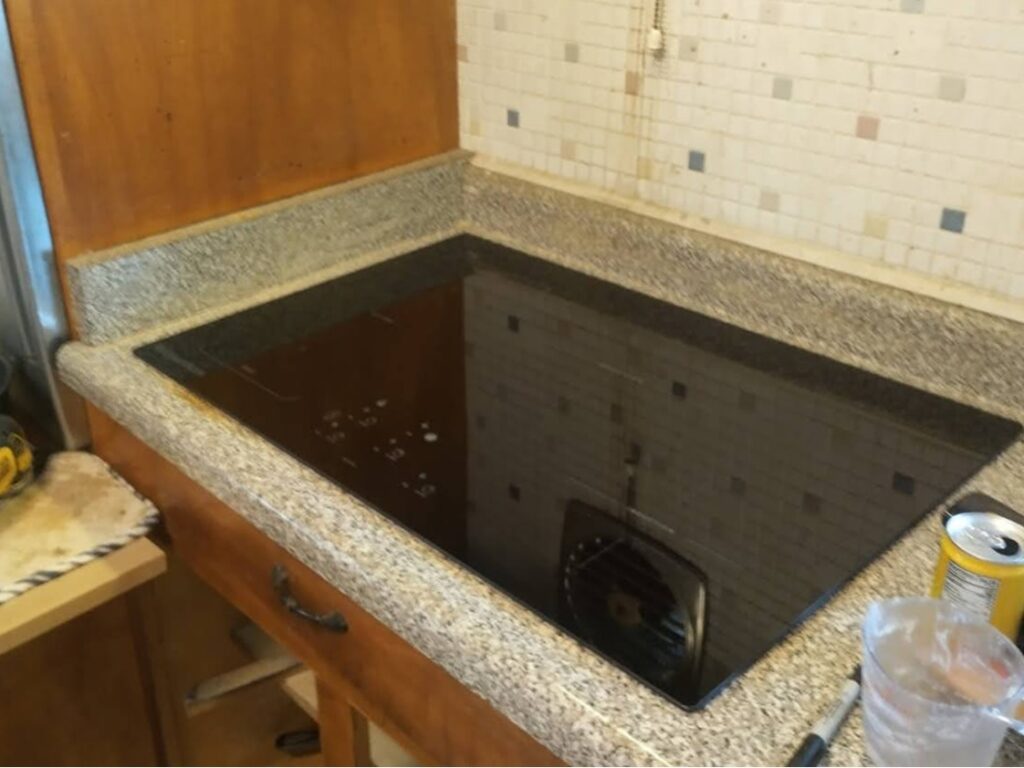
Photo credit: Christian Korey
Christian recently found a good deal on a new induction cooktop (under $300), as our electric conduction one was wearing out. Since we already had electric appliances in our kitchen, removing the old one and hard-wiring the new one was an easy swap that he handled himself when I was away one weekend. We’re still getting used to some changes, such as finding the right temperature settings for the desired heat level and remembering to stir the contents of the pan while it’s on the stove rather than picking up the pan to toss what’s in it. Nevertheless, I would agree with all the “pros” that are commonly noted: it’s fast, powerful, responsive, easy to clean, and safe. (For example, I was using it as additional workspace to dry zucchini slices, and I kept hitting the controls by accident, but it never heated up since there was no metal on the cooktop). And it cools down quickly too – the only reason the cooktop gets hot at all is because it’s touching the hot pan (thermal conduction in the other direction), and as soon as the burner is off, it’s cool enough to pat with my hand (briefly). [16]
Of course, not all of our pans worked for induction. In fact, if you’re in the market for induction cookware, it’s best to take a magnet with you to the store and check it yourself, even if the packaging says it’s induction-friendly. Fortunately for us, we already had two enameled cast iron dutch ovens, two cast iron skillets, and a stainless steel soup pot and saucepan with some kind of magnetic core on the bottom. We probably won’t have to buy anything new, at least not at the moment, but we are getting used to using different pans for certain dishes. For instance, Christian has learned an important lesson for cooking with cast iron: low and slow heating before putting anything in the pan is necessary to get the true nonstick effect from seasoned cast iron – just because you can heat it quickly in turbo mode doesn’t mean you should. [17] We’re also aware that putting all four burners on at the highest setting will trip our circuit breaker – we haven’t done that yet, but it’s something I’ll keep in mind ahead of my next dinner party…
~
How about you? Do you have an induction cooktop, or have you tried it? I’d love to know what you think in the comments below.
Thanks for reading!
[1] https://insideenergy.org/2014/06/26/ie-questions-now-were-cooking-with-gas/
[3] https://montskyrealestate.com/left-gas-stove-on-no-flame-safety-tips/
[4] https://www.psehealthyenergy.org/case-study-on-gas-stove-research/
[6] https://en.wikipedia.org/wiki/List_of_power_stations_in_Pennsylvania
[7] https://radicalmoderate.online/renewable-energy-and-energy-independence-part-1/
[8] https://radicalmoderate.online/third-party-electricity-suppliers-part-1/
[9] https://www.energy.gov/articles/making-switch-induction-stoves-or-cooktops
[10] https://en.wikipedia.org/wiki/Electrical_resistivity_and_conductivity
[11] https://en.wikipedia.org/wiki/Laws_of_thermodynamics
[12] https://en.wikipedia.org/wiki/Maxwell%27s_equations
[13] https://radicalmoderate.online/more-than-meets-the-eye/
[14] https://rocis.org/cut-it-off-at-the-source-tips-for-reducing-indoor-emissions/
[15] https://www.psehealthyenergy.org/case-study-on-gas-stove-research/
[16] https://www.americastestkitchen.com/articles/3865-is-induction-the-future-of-cooking
[17] https://radicalmoderate.online/cast-iron-cooking/
3 Comments
Garrod · August 3, 2025 at 1:36 pm
Hi,
Yes, we’ve been using an induction hob for several years…. We like it.
We used to have gas stove but decided to change for the same reasons that you mention
More efficient
Safer
The additional preparation space in our small kitchen.
I always like your blog because of the research you put into all your blog topics.
Keep it up, you’re doing a great job👍
Alison · August 4, 2025 at 9:17 am
Thanks, Garrod! I’m curious – is gas or electric more common for stoves in the UK?
Garrod · August 10, 2025 at 6:09 pm
About 50/50 but probably gas, because, at one stage, Gas was a lot cheaper than electric. 👍