Two summers ago I wrote about the property line we share with our neighbor “M” and the various issues we’ve discussed over the years with weeds and yard maintenance. [1] Christian first got to know her before I moved in when the retaining wall (the de facto border between our properties) collapsed, and he rebuilt it. I first struck up a conversation with her during the pandemic when I was hoping to eradicate the weeds coming over the wall and through the fence on our side. Now that I have torn down the rickety fence, the topic of conversations with M has shifted to what else borders the wall: a large Rose of Sharon hedge.

Rose of Sharon is a hibiscus plant, hardy and quick-spreading. Its large pink, purple, and white flowers make it an attractive addition to many yards in our neighborhood, but given its prolific ability to take over a given area, I was not surprised at all to learn that it is considered invasive in Pennsylvania.[2] Native to Asia, the plant has been used fairly often in ornamental landscaping, but it is very aggressive and difficult to remove once established, as I can attest.
Garden Reclamation
Four years ago I started transforming a strip of grass between the retaining wall and our driveway into garden space. That patch runs back from the street for about one third of the property line – it’s also where the hedge lives. Prior November 2019, when it was lawn, it was easy enough for Christian to mow over any seedlings that popped their heads up. But now that I have taken responsibility for that part of the yard, constant vigilance and seemingly constant labor are required on my part to keep the Rose of Sharon at bay.
For the record, M has told me that the hedge was originally on our side of the wall, but it spread to hers over the years. I am unclear, however, as to why there are virtually no Rose of Sharon plants on our side if that is indeed where they started.
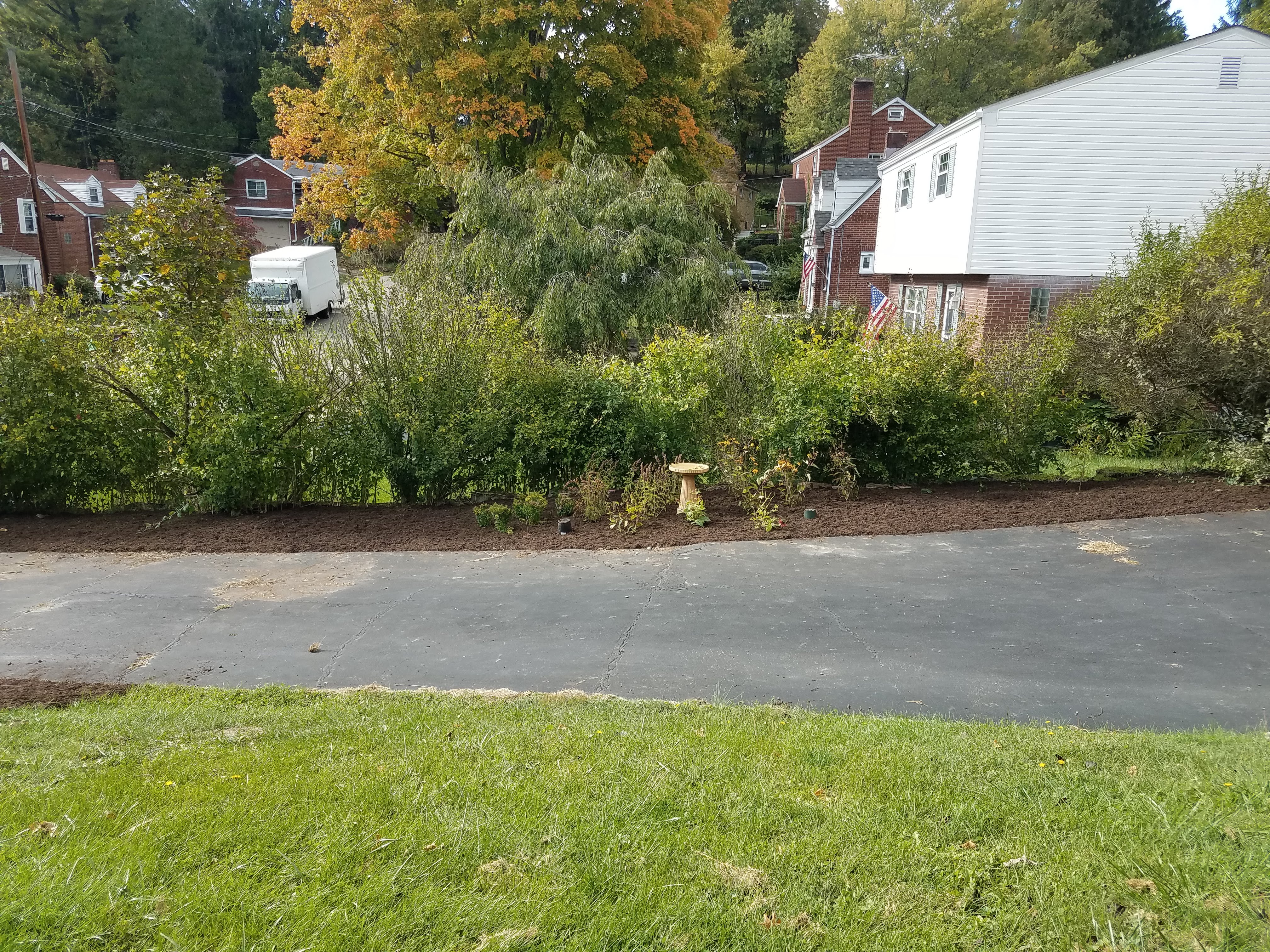
Over the past few years while trying to establish this part of our yard as a garden, I have removed a few dead Rose of Sharon plants (including one large one that could have been the original), pulled any new shoots coming up, and pruned overhanging growth back to the wall. Nevertheless, this battle is becoming more difficult to wage over time as the garden fills in with more plants, making the hedge and its progeny harder to access. In writing this post and learning more about the plant itself, I’m thinking it may be easiest to attack from M’s side, requiring another request to access her yard for weeding purposes.
Dealing with Unwelcome Guests
Honestly, it would make me very happy to remove it and replace it with something native, but I know that is far easier said than done. M tells me that she asked about pricing for having it taken out, but she was told that it would destroy the wall. I remain skeptical, since very little of it is actually in the wall, but established Rose of Sharon plants have deep taproots and are very difficult to remove. Even if it were possible, I do believe it would take years of work to achieve. In the meantime, I will be employing a multi-pronged approach to keep things from getting worse around here and discouraging old Sharon as much as possible.
Prevention
I have written before on this blog about using corn gluten as a pre-emergent weed killer. [3] I was wondering how effective it really was, feeling like it had not done much in previous years. Boy, was I wrong! I did not get around to using it in the spring, which is when Rose of Sharon seeds germinate, [4] and I was inundated with so many seedlings that they looked more like groundcover in front of the hedge. If you’re dealing with them on that scale and don’t want to pull them all by hand, one of the easiest methods is covering them with cardboard and mulch. Since I had other small plants coming up that I didn’t want to smother, I resorted to pulling them by hand.
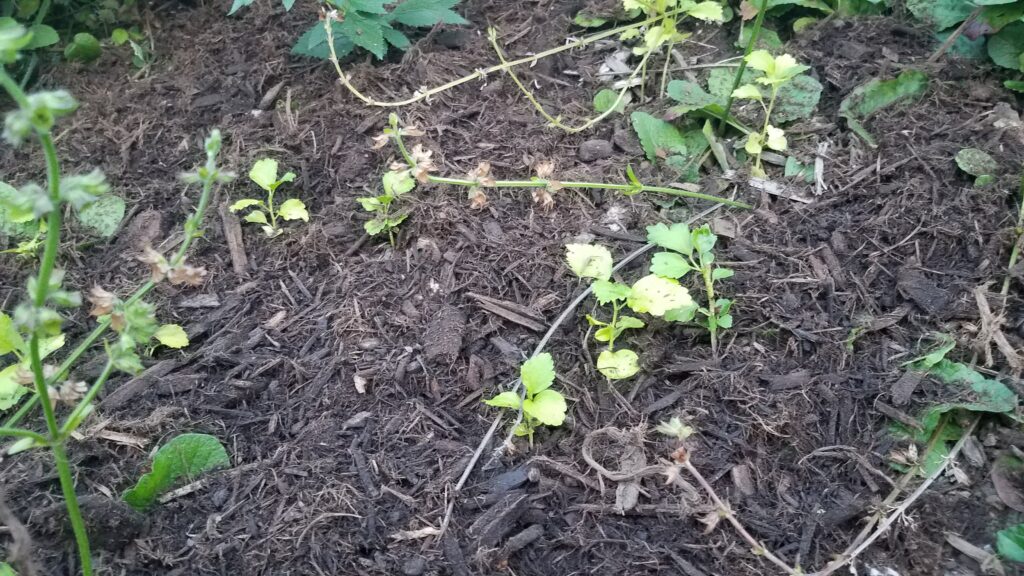
I’m not a huge fan of labels, particularly when it comes to stereotyping people, but I do have to admit a certain level of amusement that I was dealing with an invasive plant sporting a meme-able name that connotes entitlement. [5]
Pruning
Certainly, pruning Rose of Sharon plants after they flower in the summer but before they start dropping seeds in the fall will help prevent their spread as well. Some sources recommend deadheading, and pruning is a much more extreme (and efficient!) version of simply clipping each individual seed pod. If you are looking to prune Rose of Sharon to maintain it, that should be done in late winter or early spring because blooms form on new growth. But if you are looking to perhaps get rid of it, as I am, cutting it back earlier may be a better option (pruning too early can “shock” the plant and potentially cause damage). It sounds harsh to put it that way, but no more harsh than actually removing the plants from the ground, if you can.
Removal
Again, pulling them by hand is an option when they are little. I have found that they are easiest late in their first year, once the stems have enough structural integrity to bring the root with it instead of just snapping off at ground level. However, after 2-3 years of growth, they really start to take hold and require much more effort to remove. According to some sources it is possible to transplant them, [6] though I have had a lot of difficulty getting them out of the ground with a shovel once they’re established. In my reading, I did discover a product called a pullerbear, which can be used to pull out large weeds and small trees. [7] I am willing to try it, especially if it works – it could pay for itself after avoiding three post-yardwork massages!
~
There will be more updates to come in the future, I’m sure, but I’m more optimistic about just getting rid of the hedge than I was when I started researching this post. Have you successfully removed Rose of Sharon? What worked for you? I’d love to hear any suggestions you have below.
Thanks for reading!
[1] https://radicalmoderate.online/bad-fences-make-good-neighbors-catchweed-and-pokeweed/
[2] https://www.invasive.org/weedcd/pdfs/wow/rose-of-sharon.pdf
[3] https://radicalmoderate.online/pollinator-garden-update-2021/
[4] https://www.thespruce.com/get-rid-of-rose-of-sharon-seedlings-2132694
[5] https://www.newstatesman.com/science-tech/2018/01/karen-sharon-becky-chad-feels-name-becomes-meme
[6] https://www.gardeningknowhow.com/ornamental/shrubs/rose-of-sharon/moving-rose-sharon-shrubs.htm
[7] https://www.pullerbear.com/
7 Comments
Sungreen · August 22, 2024 at 11:09 am
Bad fences may indeed make good neighbors. How can property owners find a balance between privacy and openness when designing boundary fences?
Alison · April 26, 2026 at 9:58 am
It may sound simplistic or idealistic, but I would start with an open conversation with the neighbor to identify what each party wants – privacy vs. openness, hedge vs. fence, etc. Not everyone wants the same thing out of a property line or a garden, so understanding that is a good first step.
I feel like we just take for granted in our society that we’re going to argue with our neighbors over things like trees, fences, borders, etc. without being taught to have conversations with them and identify paths forward that involve finding common ground for shared spaces.
Steve Williford · September 26, 2024 at 3:45 pm
I would love to know how well the Pullerbear worked on your local Rose of Sharon problem. I, too, have many to deal with at home and have been eyeing the larger Pullerbear for my purposes. Please let me know your experience with it. Many thanks.
Alison · April 26, 2026 at 10:08 am
I only just used my Pullerbear for the first time this spring, and it did a great job at pulling out a range of Rose of Sharon sizes, including really small ones that were already too established to pull by hand. The largest size Pullerbear definitely felt like overkill for new shoots, but there were some larger, more established Rose of Sharon plants (2-3″ in diameter) I could not get out on my own, even with the leverage of the Pro XL. I plan to ask my husband for help on those.
Kate · September 27, 2025 at 11:08 am
How do you put up with that neighbor?
Alison · April 26, 2026 at 10:10 am
I usually smile, shake my head, and laugh it off. She’s old enough that she’s not going to change her ways (or opinions) at this point — I have to recognize that I can provide her with facts, but it’s up to her to accept them (and not my fault if she doesn’t).
Treated Wood – Radical Moderate · January 21, 2024 at 3:44 pm
[…] Bad Fences Make Good Neighbors: Rose of Sharon September 10, 2023 […]