Disclaimer: I am not a medical professional. The content of these blog posts is based on my own experience, research, and conversations with my doctors. Always talk to your doctor before making any changes to your medications, diet, or activity. There’s also a lot of conjecture and curiosity in these posts (especially in Part 2), with as many questions as there are answers on this evolving topic.
My husband and I recently returned from a camping / mountain biking trip in West Virginia, and it’s at least the third time that a trip to our favorite town there has inspired a blog post. [1],[2] There’s clearly a connection between those trips as an effort to manage my stress and these blog posts as an effort to remind myself (and others) how valuable it is to take regular time to rest and rebalance. And since I write about it this frequently, that’s probably a good indication that I am not taking my own advice. (As far as I can tell, it has been over three years since we last went on a trip there for downtime in the woods.)
Chronic Stress
For years I’ve been using this internet soapbox to preach about the stress cycle: modern-day humans generally face very different stressors than our hunter-gatherer ancestors, but our lizard brains often create the same type of fight-or-flight response, whether we’re faced with a charging predator or an unpleasant email. Our bodies need physical cues to tell us that the danger has passed so we can move through the process and complete the stress cycle. Such cues include physical activity (cardio), physical contact (hugging), or very hard laughing or crying. For the record, I got all of those on this most recent trip, which required some intense emotional releases after a difficult period of time at work.
In an effort to better understand (and manage) the physiological responses to stress in my body, I’ve been learning more about the systems that control these processes. Most of us have heard of the “fight or flight” response to things our brains perceive to be threats. When that happens, the sympathetic nervous system increases heart rate, blood pressure, breathing rate, and pupil size, among other things that will prepare us for strenuous physical activity necessary for survival in our immediate surroundings. Not as many of us, I’d wager, are familiar with the alternate state of “rest and digest” that we experience after the threat has passed. In that situation, the parasympathetic nervous system allows the body to relax and heal itself. [3]
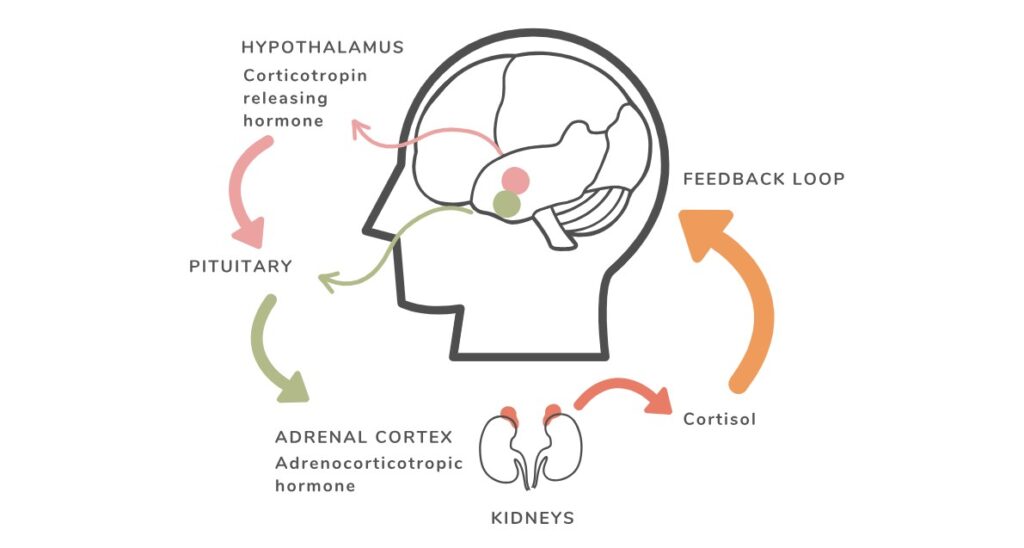
Image credit: [4]
However, many adults have been experiencing a growing sense of anxiety over time. I’ll speak for myself and say that each recent year has seemed more stressful than the previous one (both personally and professionally), but there is data to back up this statement more broadly, with many Americans noting a broad spectrum of current events contributing to anxiety. [5] Without healthy stress management techniques, we run the risk of keeping our stress response systems constantly activated. That means that, although our bodies are constantly on high alert for threats, we are less and less capable of handling them when they arise. This situation was first described to me as a “Dysregulated Nervous System,” [6] in which the body is constantly challenged and no longer capable of effectively regulating its own processes.
Simmer Down
The part of the body that is responsible for regulating the vast majority of our biochemistry is called the Endocannabinoid System (ECS), and it is responsible for keeping our bodies in balance (i.e. temperature control, hunger, sleep, pain control, immune responses, emotional processing, etc.) whenever we encounter some kind of internal or external stressor. Microbiologist Dr. Tanja Bagar describes the role of the ECS as “defining the importance of the situation, determining how big of a threat it is, and to tune the right behavioural responses, which are essential for the organism’s long-term viability, homeostasis and stress resilience.” [7]
But for as critical as the ECS is, we haven’t known about it for long: scientists began discovering endocannabinoid receptors (part of a cell that can receive a message from a chemical compound) in 1990, and have since found them in nearly every organ in the body. [8] We produce endocannabinoid molecules (or ligands) to send messages to these receptors, and when a receptor receives one, the cell responds in a certain way. CB1 receptors are more densely grouped in our central nervous system and turn certain functions up or down, depending on what is needed to maintain balance. CB2 receptors are located more in our peripheral nervous system and deal more with our immune functions. [9],[10]
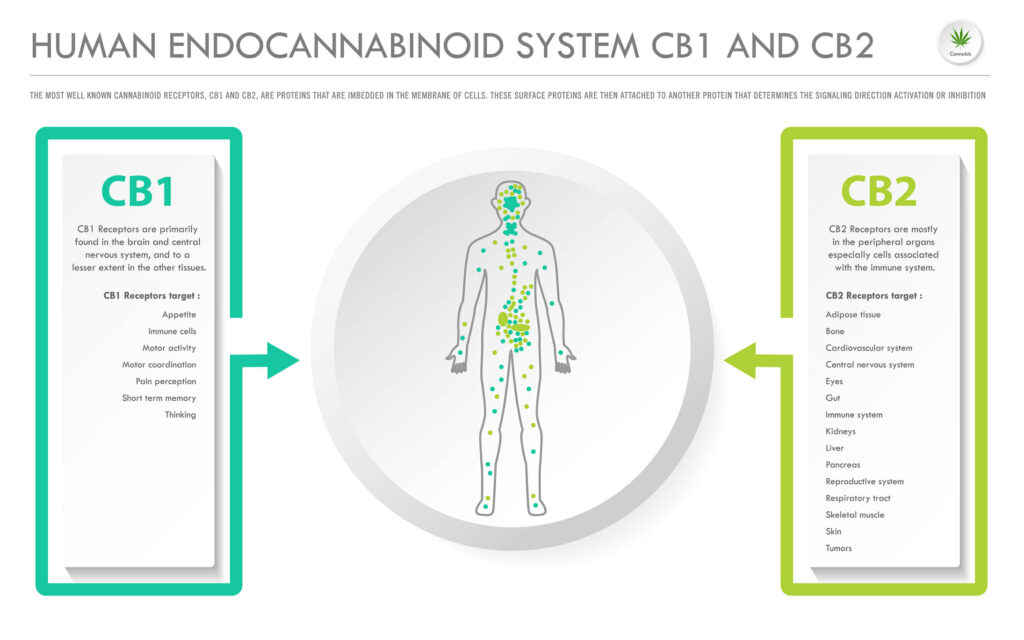
Image credit: [11]
These receptors can accept messages from our own self-made, internal, “endo”cannabinoid molecules, but they can also accept messages from “phyto”cannabinoids, which come externally, from plants. While they can be found in many plants and foods (including dark chocolate), the entire body system is named for the most potent source of these molecules: cannabis. Humans have been using the cannabis plant for about 5000 years, and we are aware of multiple therapeutic applications, including stress management. However, as marijuana has been classified as a Schedule I substance since 1970, [12] it is difficult to examine its effects outside of government-approved research studies.
We do know that regions of the brain involved in stress processing have high densities of cannabinoid receptors, and that a properly functioning ECS can help de-escalate a feedback loop of panic, enabling us to effectively turn down the noise and think more clearly. [13] There is also some evidence that cannabinoids (whether natural or artificial) can provide myriad benefits, including anti-inflammatory, anti-oxidant, and analgesic properties, as well as support in increasing neurons in the brain. [14] We also know that chronic stress (or anxiety, or PTSD) can limit the ECS’s ability to function properly, meaning that, no matter how you personally may feel about the legalization of marijuana, it behooves us all to support our own endocannabinoid systems to the greatest extent possible, whether or not we’re able to supplement with phytocannabinoids.
Surviving and Thriving
“Diet and exercise” sounds like a cliche solution to throw into the mix at this point, but it is true that the more stress management we can achieve on our own, the less burden we’ll put on our hard-working ECS. What that means is…
- turning to activities that can complete the stress cycle as often as possible: getting cardio, a 20-second hug, a good night’s sleep, [15] or a really hard laugh or cry,
- consuming foods rich in omega 3 fatty acids (including flax seeds, walnuts, and certain types of fish), which help us produce endocannabinoids, [16]
- consuming extra virgin olive oil, which was mentioned by multiple sources as having neuroprotective effects, [17] being associated with the improvement of anxiety or depression symptoms, [18] and supporting a healthy gut microbiome, [19]
- and building/supporting a healthy gut microbiome, which interacts with the ECS for the regulation of stress responses and metabolism. [20]

Image credit: [21]
A healthy body, healthy gut, and healthy ECS all contribute to stress resilience, but we humans have unique internal and external factors that might make it difficult to achieve that ideal state on our own. (Anyone close to me knows that I certainly didn’t have the ability to cook healthy, balanced food for myself last year; if I was microwaving frozen, processed food wrapped in plastic, at least I was eating.) For that reason, I will mention external help from a very specific phytocannabinoid: CBD.
There are more than 100 phytocannabinoids in marijuana, but tetrahydrocannabinol (THC) is the one that produces the high for which the plant is notorious. Cannabidiol (CBD) does not create a high, is not addictive, and has been best studied for stress prevention and management. Furthermore, it was recommended to me by my doctor specifically to help support my endocannabinoid system and fight burnout. We’ll pick up with a deeper dive into the promises and concerns around medical applications of cannabis in next week’s post, but for now I’ll leave you with these closing words from Dr. Bagar:
“CBD can, to some extent, do what our endocannabinoids should be doing. It regulates how much cortisol and neurotransmitters we produce and can give us the needed distance from stressful situation. Using CBD as a part of recovering strategy from burn out and fatigue has proven very successful. It helps with neurogenesis in brain regions damaged from prolonged/unpredicted stress, offers cardiovascular protection and modulation of the entire HPA axis. The body can regenerate, when we can turn down [the] volume of the surrounding world, rest, digest and restore balance. And cannabinoids can aid significantly in this pursuit.” [22]
~
What are your thoughts? Have you heard of the endocannabinoid system, and are you taking steps to protect yours? Have you tried CBD, and have you felt a benefit? I’d love to hear your comments below.
Thanks for reading!
[1] https://radicalmoderate.online/sharpening-the-saw-part-3/
[2] https://radicalmoderate.online/cyclophobia/
[3] https://www.health.harvard.edu/staying-healthy/understanding-the-stress-response
[4] https://tempotherapy.com.au/blog/stress-and-the-hpa-axis/
[5] https://www.stress.org/who-gets-stressed/adults/
[6] https://radicalmoderate.online/this-is-fine/
[8] https://www.pbs.org/video/what-endocannabinoid-system-crcghr/
[9] https://www.health.harvard.edu/blog/the-endocannabinoid-system-essential-and-mysterious-202108112569
[10] https://www.medicalnewstoday.com/articles/does-weed-kill-brain-cells
[11] https://www.endocannabinoidmedicine.com/introduction-to-the-endocannabinoid-system/
[12] https://www.dea.gov/sites/default/files/2020-06/Marijuana-Cannabis-2020_0.pdf
[14] https://pmc.ncbi.nlm.nih.gov/articles/PMC8541184/
[15] https://www.youtube.com/watch?v=CyppUSV1FN0
[16] https://www.healthline.com/nutrition/12-omega-3-rich-foods
[17] https://olivewellnessinstitute.org/article/extra-virgin-olive-oil-for-brain-health/
[19] https://www.noisyguts.com/blog/extra-virgin-olive-oil-and-the-gut
[20] https://pmc.ncbi.nlm.nih.gov/articles/PMC9130962/
[21] https://www.cannaspecialists.org/supporting_your_endocannabinoid_system_beyond_cannabis
2 Comments
Chuck Korey · August 19, 2025 at 9:23 am
I have tried CBD and it works so much better than alcohol
Garrod · August 26, 2025 at 9:41 am
I finally got to read this blog….. when in combination with the following blog it begins to make sense… and as a bonus…After 69 years I’ve learnt a new word ‘Behoove” 👍