“Oh, how the mighty have fallen,” jabbed my best friend as he watched me do battle with the weeds along my back walk. We were discussing the fact that I had recently caved and decided to try a synthetic herbicide on one (and only one) very tenacious and invasive weed in my yard: thistle. As I came to the end of my rope with this plant, I wanted to understand what options I had and how palatable they were for an (otherwise) organic gardener. Of course, this question implied the opportunity for experimentation and data collection. (But if you read last week’s post, [1] you probably already know that that didn’t happen – at least not to the extent intended.)
Uninvited
I don’t know where it came from – seeds floating over from a neighbor’s yard or delivered in a batch of mulch – but several years ago, the garden beds behind my house went from having no thistle to being exclusively thistle. And since then, I have typically gone through two or three times each year to clear cut all the thistle to the ground, often spraying the stumps with agricultural vinegar. I had some encouraging initial success with the household vinegar approach in the first year, and I was willing to be patient knowing that full eradication by cutting and spraying would take years. [2]
However, although it’s only been three years since they first popped up, it’s not my impatience that’s getting the better of me now – it’s an anecdote from a former coworker who tried for years with agricultural vinegar and had to go with something stronger for success. She didn’t tell me the name of the product she used, but she was very clear that she painted a synthetic herbicide onto the thistle with a brush (instead of spraying from a bottle) in order to target the application like a surgeon because she herself doesn’t want to use herbicides in her garden.
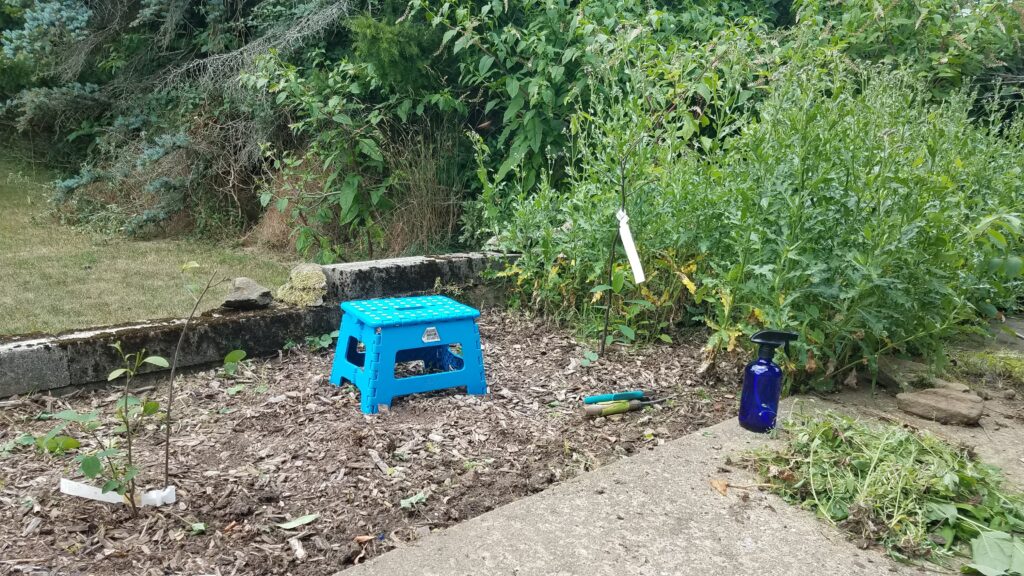
The last time my best friend was over watching me do battle with the thistle, I was armed with my vinegar spray bottle, but I had recently upped the stakes from the 4% household vinegar of previous years to 30% agricultural vinegar. Clad with nitrile gloves and sheer determination, I thought for sure there was no hope for the plants this time. But realistically, the vinegar only eats away at the plant material it touches, and thistle roots are long: tap roots can go down as far as six feet, but roots can also spread laterally, growing 10-12 feet per year.
Thistle plants can readily regrow from even a small bit of root, and it would be virtually impossible to destroy all of the root system with vinegar without devastating other plants – and animals – in the same soil. (I have accidentally hit a small number of insects with the 30% vinegar and felt guilty about each – probably excruciating – death.) As I sprayed with the vinegar, my friend read me an extensive post including these reasons for why you should not use vinegar in your garden. [3] But what’s the alternative, I wondered, if even the “environmentally friendly” option has such significant drawbacks?
Less Bad
My aunt and uncle run a garden center that specializes in organic gardening, [4] and even they stock some products that fall into the synthetic herbicide category, along with many that don’t. When I was in town for my birthday, I grabbed two different products: one that was a mixture of high-potency vinegar and salt and one that contained a synthetic herbicide called maleic hydrazide. My initial plan was to use one product on each side of my back walk and compare results. Again, that plan didn’t quite pan out.
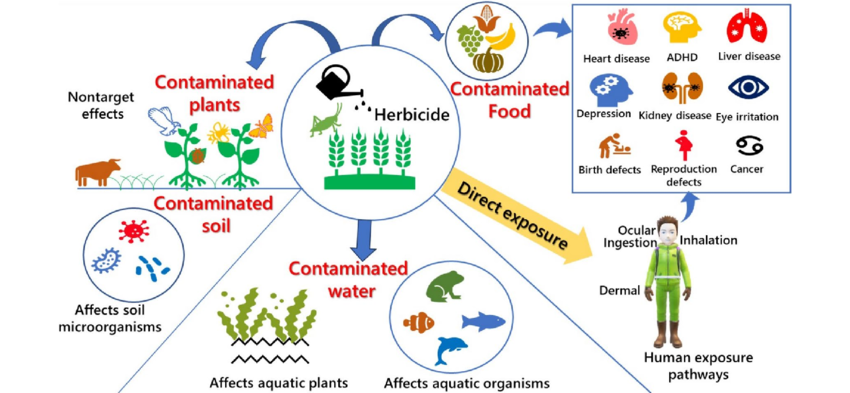
Image credit: [5]
But before we get to that, I want to explain why I chose to use this particular herbicide in my yard. I recognized that I might never succeed at eradicating the thistle with vinegar, and I was concerned about the additional harm I might bring to individual insects by accidentally spraying them with acid. Maleic hydrazide, according to my aunt’s expertise and my subsequent internet research struck me as the option that might balance two of the qualities I desired: most effective and least harmful.
First formulated in the late 1800s, maleic hydrazide acts by preventing cell growth in plants. In the US, the vast majority of it is used on tobacco, followed by potatoes, to keep them from sprouting during shipping. For that reason, humans may ingest it when consuming potato products. From a health assessment standpoint, it has been placed in Toxicity Category IV (the lowest of four) and, as of the EPA’s 1994 fact sheet, was not known to be a human carcinogen. I take that assessment with a grain of salt, however: glyphosate, the ingredient in Roundup, is in Toxicity Category III and was also described on its EPA fact sheet as non-carcinogenic [6] – though we now know otherwise. [7]
Maleic hydrazide does not persist in the environment, with a half life of less than four days [8] – compare that to glyphosate’s half life, which is generally 30 days but can stretch to nine months, depending on conditions. [9] Finally, maleic hydrazide has been described as “practically nontoxic to birds, fish, invertebrates and honey bees,” [10] but, again, glyphosate was similarly described… and, again, we know otherwise. [11] There seems to be some evidence of low levels of harm to honeybees resulting from contact with maleic hydrazide, but there are a lot of gaps in research at the moment. [12] What that means to me is that caution is necessary.
Finding the Path
When it comes to my garden, I’d love to say without a doubt that it is 100% organic. I’ve previously written about the dangers of glyphosate, [13] and I take a lot of pride in avoiding synthetic herbicides in my yard. But – as with most things I research on this blog – I’m coming to realize that reality is far more complicated. My primary goal is creating a garden that is a safe space for native pollinators, and to do that, my garden should contain a majority of healthy, native plants and minimize (if not eliminate) chemicals that can harm the creatures I’m trying to protect. The invasive thistle I’m trying to remove will crowd out the native plants I’m trying to nurture if I don’t get rid of it; in order to get rid of it, I believe I need a different approach than vinegar, which is also harmful to my garden’s residents.
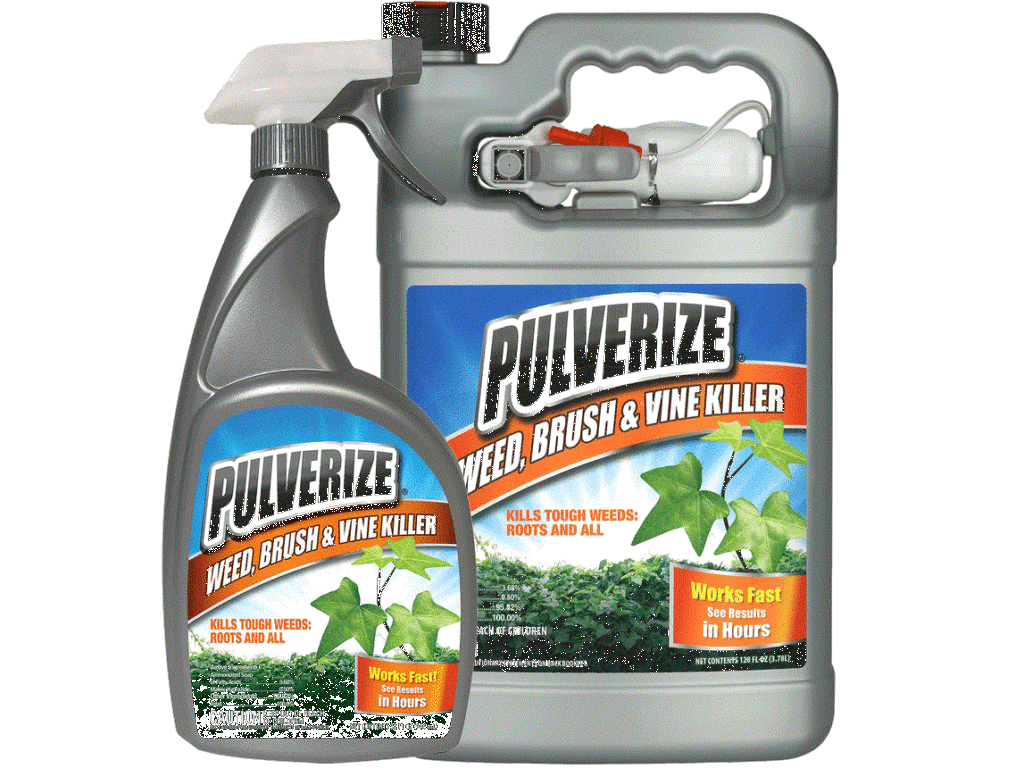
Image credit: [14]
Given that complexity, I chose to move forward with the maleic hydrazide but to do so very carefully. I cut all of my thistle close to the ground and painted the herbicide on the stumps with a paintbrush. In doing so, I minimized the amount of plant surface that needed herbicide and also minimized the amount of herbicide I needed to use. And then I painted the herbicide on new shoots every weekend for a few weeks. I did need to work around the weather forecast because it is supposed to stay on the plant for 24 hours before any rain… and it rained for about a month straight this summer. Other life events intervened too (including death, travel, and COVID), so I only got a few weeks of diligence with this process before leaving the thistle to its own devices again for a good three months.
I will say that in the few weeks I was using the herbicide, the thistle shoots seemed to become slightly less prolific. And even in my recent clear-cutting of the back garden, the thistle on the side of the walk that got the maleic hydrazide seemed to be more sparse and spindly. The other side of the walk, which got the salt and vinegar combination, seemed to have less thistle overall, and some of the new shoots that came up looked very stunted, but I was generally hesitant to use the product because I didn’t want to cause permanent damage to my garden bed with the salt.
Although I have insufficient data and can honestly say that more research is required(!), my initial thoughts are these: if you’re looking to eliminate weeds coming up through cracks in hardscapes (or other places where you don’t want anything to grow), vinegar and salt may be the best product for you there. But if you’re looking to eliminate weeds that are absolutely resistant to organic methods and are growing among flowers you’re trying to nurture, a very careful application of maleic hydrazide may be a realistic option for stopping those specific plants. If you make an informed decision to go that route, I strongly recommend using a paintbrush – just because it’s in a spray bottle doesn’t mean you need to spray it.
~
I hope to spend more time in my garden next year and get a better sense of how effective this product is. Until then, I’d be curious to hear your thoughts. Have you used a “less bad” herbicide, or do you still judge people who do? What criteria would you use to make a decision in this situation? Be kind in the comments – we’re all learning.
Thanks for reading!
Keep Reading About the Garden –>
[1] https://radicalmoderate.online/pollinator-garden-update-2025
[2] https://radicalmoderate.online/thinning-a-thicket-of-thistle/
[3] https://rdslawncare.com/dangers-of-vinegar-as-weed-killer/
[6] https://www3.epa.gov/pesticides/chem_search/reg_actions/reregistration/fs_PC-417300_1-Sep-93.pdf
[8] https://efsa.onlinelibrary.wiley.com/doi/10.2903/j.efsa.2016.4492
[9] https://pmc.ncbi.nlm.nih.gov/articles/PMC9101768/
[10] https://www3.epa.gov/pesticides/chem_search/reg_actions/reregistration/fs_PC-051501_1-Jun-94.pdf
[12] https://efsa.onlinelibrary.wiley.com/doi/full/10.2903/j.efsa.2016.4492
[13] https://radicalmoderate.online/roundup-and-glyphosate-part-1/
[14] https://messinas.com/products/pulverize-weed-brush-vine-killer
0 Comments