Part 1 – The 2,000 Watt Society
This post contains spoilers for The Ministry for the Future by Kim Stanley Robinson.
I live a life that is by no means perfect, but that doesn’t stop me from trying to do better – especially when it comes to travel. For years I have recognized the irony of flying to beautiful, delicate, remote locations around the world to appreciate them in person, while also endangering them with the very act of traveling there. That itself was a wry joke among the members of my Climate Lab cohort, as we flew around the Pacific together to study the effects of climate change on the places that are already facing the worst existential threats of sea rise and severe storms. [1]
Silver Buckshot
It was during our first in-person Climate Lab session in Hawai’i that one of our program leaders made some book recommendations, specifically climate change focused novels set in the near future, representing a mixture of science fiction and science fact (a genre often referred to as “cli-fi”). One of them, The Ministry for the Future, [2] had been recommended to me before, and I finally got around to reading it later that year. It is divisive: I know people who loved it and people who hated it. I know people who have nitpicked at details about travel methods and cultural nuances in certain countries, as well as how successful some of the climate solutions pursued in the book would actually be if applied in real life.

Of course, everyone is entitled to an opinion, especially when it comes to personal reactions to fiction, but my opinion is that anyone nitpicking bits of the book that aren’t realistic or feasible is missing the forest for the trees. If years of interest and efforts in this space have taught me anything, it’s that there is no silver bullet solution. In fact, it’s going to take a lot of trial and error to identify effective ways to minimize environmental, public health, and economic harms, while also maximizing quality of life and incorporating input from people who will be most impacted by decisions made in different states, countries, or continents.
Given the brutality of the book’s opening scene, I almost didn’t continue with the story. It doesn’t necessarily get easier, and it isn’t what I would call optimistic, but it is clear by the final pages that the future is still within our control. The extent to which we mitigate the more deadly effects of climate change (which are already here) is directly related to how quickly and decisively we take action. That portrayal of the situation as a constant slog through a grey area – where some will live and some will die, some efforts will succeed and some will fail, and we will never reach an end point where we can stop worrying about our impact – is the most realistic portrayal of our current situation that I have seen in fiction (or, for that matter, fact).
Individual Impact
It was last summer, while planning the Switzerland leg of our European road trip, that my mind returned to this book. One of the main characters, Mary Murphy, is head of the UN’s Ministry for the Future, a fictional agency that was created in 2025 as a result of the Paris Climate Accords. The Ministry’s purpose is to develop global climate policy for the benefit of Earth’s future generations. As part of her position, Mary lives and works in Zurich, leveraging political, economic, and technological strategies to drive systemic change – and, through her eyes, the reader is introduced to new (and old) concepts and technologies as she is forced to adapt in her role and her lifestyle.

Through one of the book’s other main characters, Mary encounters the 2,000 Watt Society, a group that promotes a significant reduction in resource use (without a significant reduction in quality of life) in order to counteract climate change. [3] This real-life concept was first introduced in Zurich in 1998, and residents there adopted a referendum in 2008 to lower the city’s energy consumption to 2,000 Watts per capita by 2050. For reference, Switzerland’s per capita energy consumption last saw 2,000 W in the 1960s; it was 5,000 W at the time of the referendum (though apparently back down to 4,000 W by 2020). Meanwhile, in the United States in 2008, our average was 12,000 W, with no plans to bring it down. [4]
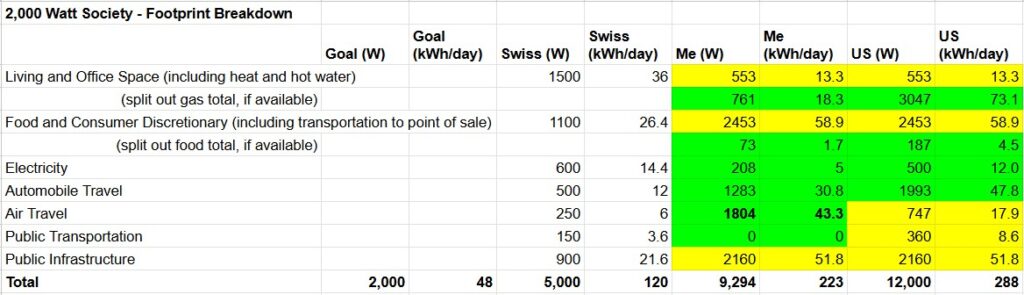
I wanted to know what that resource use breakdown looked like in reality, so I pulled together some data from various sources over various years. Unfortunately, this SWAG (Scientific Wild-Ass Guess) is not comparing apples to apples, but I attempted to make sure it was all some kind of fruit. A breakdown of the 5 kilowatt per-capita Swiss energy usage in 2008 includes resource needs for living and office space, food and consumer products, electricity, automobile travel, air travel, public transportation, and public infrastructure. I could not find specifics on how to calculate the upstream energy cost of products and infrastructure, but I made some educated guesses in scaling up certain numbers for life in America.
Death by Spreadsheet
Note: I’m moving forward in kilowatt-hour equivalents because I find it to be much more intuitive for conveying energy consumption as a function of lifestyle (vs. instantaneous demand of power in watts). For the purposes of these conversions, 2,000 W represents 2 kWh/hour, or 48 kWh/day.
Gas and Electric
From my own energy analyses (done after getting our new roof and attic insulation, [5], [6] but before our tankless electric water heater [7]), I could speak to our average electricity and gas use in 2021 and 2022: 10 kWh/day for electric and 36.5 kWh-equivalent/day use of gas for the furnace, hot water heater, clothes dryer, and grill. That makes a daily heat and electricity equivalent of 46.5 kWh for our two-person household and roughly 23.3 kWh/day for me as an individual, which is shockingly less than the 2025 US average of 85 kWh-equivalent/day/person in the residential sector. [8] These numbers (admittedly from different years) show per capita electricity use higher in Switzerland (14.4 kWh/day) than in the US (12 kWh/day), but I also imagine there is more electricity used for heating there than here. (I can confirm that was the case in our apartment in Herisau, an hour outside of Zurich.) Gas use data for Switzerland was grouped in with building space numbers, so I couldn’t do a direct comparison with the US breakdown.
Food
I don’t have current data on my personal calorie intake, but from times when I have tracked those numbers (pre-pandemic), I’ve typically come in around 1,500 calories or less per day (unless, of course, I was actively training for a marathon, in which case I could put away truly obscene quantities of food to replace the upwards of 2,000 calories in a day I’d be burning from running). Plant-based food tends to be (but isn’t necessarily) more calorie dense than meat, but the benefits for the environment are clear, which is why I’m trying to eat more vegan meals. [9] Nevertheless, looking purely at caloric intake, 1,500 kcal of food converts to about 1.74 kWh of energy. For reference, the recommended 2,000 kcal daily diet contains about 2.3 kWh of energy, but the average American ate a whopping 3,864 kcal per day in 2023, [10] representing about 4.5 kWh. Food data for Switzerland was grouped in with consumer products, so I couldn’t do a direct comparison with the US breakdown.
Automobiles vs. Public Transportation
We Americans definitely like our cars. My father is a car guy; my husband is a car guy; his father is a car guy… suffice it to say, we have more cars than we need in our family (though we still can only drive one at a time). American infrastructure favors cars over public transportation, [11] which is why it’s not surprising that the contribution of cars to our energy needs is huge. Calculations here are based on internal combustion engine vehicles, which are what we have at home. I drive an average amount (11,000 or so miles/year), but my stick-shift Camry has better fuel economy than the average ICE car on the road these days, so my 31 kWh/day makes sense compared to the American average of 48 kWh/day. [12] With a greater capacity for public transportation in Europe, the Swiss 12 kWh/day makes sense. I had difficulty getting numbers for energy footprint of public transportation use in the US, so I scaled it up proportionally from the Swiss breakdown with the other numbers I couldn’t calculate but left my own at 0 kWh/day since I so rarely use public transportation, opting instead for the convenience and access offered by more carbon intensive modes, including cars and …
Air Travel
The big one, possibly the biggest component of my individual carbon footprint. Without it, I would probably be in the “8,000 Watt Society” if I changed nothing else about my current way of life. But between (typically) one round-trip domestic flight and one round-trip international flight per year, the resources required to haul me around probably represents a good 20% of my overall energy budget. Proportional scaling of the Swiss 6 kWh/day average to 18 kWh/day for Americans (for lack of better data) makes my average 43 kWh/day in 2025 downright cringe-worthy. [13]

And airplane travel was a major target for eco-terrorists in The Ministry for the Future; they eventually killed off the industry (along with many passengers) in the name of limiting greater deaths from climate change. But another industry rose to prominence in its place, and with that in mind, I was very excited by the prospect of trying out a significantly less energy-intensive form of air travel after we got to Switzerland. More on that next week…
~
Have you calculated your carbon footprint or energy needs? What was the most surprising thing you found, and do you plan to adjust your behavior? I’d love to hear about it below.
Thanks for reading!
[1] https://radicalmoderate.online/tag/climate-lab/
[2] https://www.goodreads.com/book/show/50998056-the-ministry-for-the-future
[3] https://www.2000-watt-society.org/worldholderwork
[4] https://en.wikipedia.org/wiki/2000-watt_society
[5] https://radicalmoderate.online/weatherization-update-gas-savings/
[6] https://radicalmoderate.online/weatherization-update-electricity-savings-part-2/
[7] https://radicalmoderate.online/tankless-water-heater/
[8] https://css.umich.edu/publications/factsheets/energy/us-energy-system-factsheet
[9] https://radicalmoderate.online/vegan-january-part-5/
[11] https://sustainableamerica.org/blog/why-doesnt-the-us-have-better-public-transportation/
[12] https://8billiontrees.com/carbon-offsets-credits/how-much-co2-does-a-car-emit-per-mile/
0 Comments