It may be an odd opinion, but I love sick days. I don’t take many of them, but when I’m really under the weather, they are the unique occasions when I allow myself to rest guilt-free… especially if the reason is because of a responsible act… such as getting vaccinated. My husband and I just got our eighth SARS-CoV-2 shots this weekend, and I am writing this post while recuperating on the couch, tired and achy. We waited a little later into the fall this year because we caught the “Nimbus” variant during summer at a wedding, [1] but we wanted to make sure we were caught up on vaccinations before getting into the holidays.
Each fall since 2021, we’ve gotten the pair of SARS-CoV-2 and Flu vaccines. During that time, I’ve developed quite a nice ritual, one I almost look forward to after getting the shots: resting on the couch, watching comfort TV, eating Thai takeout, and getting extra water and sleep. Especially in the fall, when there’s so much pressure from the looming holidays, it feels wonderfully indulgent to give myself a guilt-free day with no responsibilities (quite possibly the last one I’ll have until mid-January or later). This weekend we actually binge-watched the entire second season of “Shrinking” [2] in one sitting, mostly because I knew I wouldn’t have another opportunity to finish it any time soon.
The Role of Skepticism
I know not everyone is in this camp, particularly not if it involves feeling crummy for 36 hours. There was a lot of vaccine skepticism throughout the United States even before partisan rhetoric and misinformation drove down vaccine adoption rates during the pandemic. I myself was a flu vaccine skeptic for many years until I actually started researching it in 2021, while also working at a public health organization. There are certainly anti-vaxxers on both ends of the political spectrum, but I always did find it ironic that although Donald Trump’s “Operation Warp Speed” succeeded in accelerating test phases and cutting through red tape in order to get SARS-CoV-2 vaccines onto shelves and into arms in record time, [3] so few of his supporters actually made use of them.
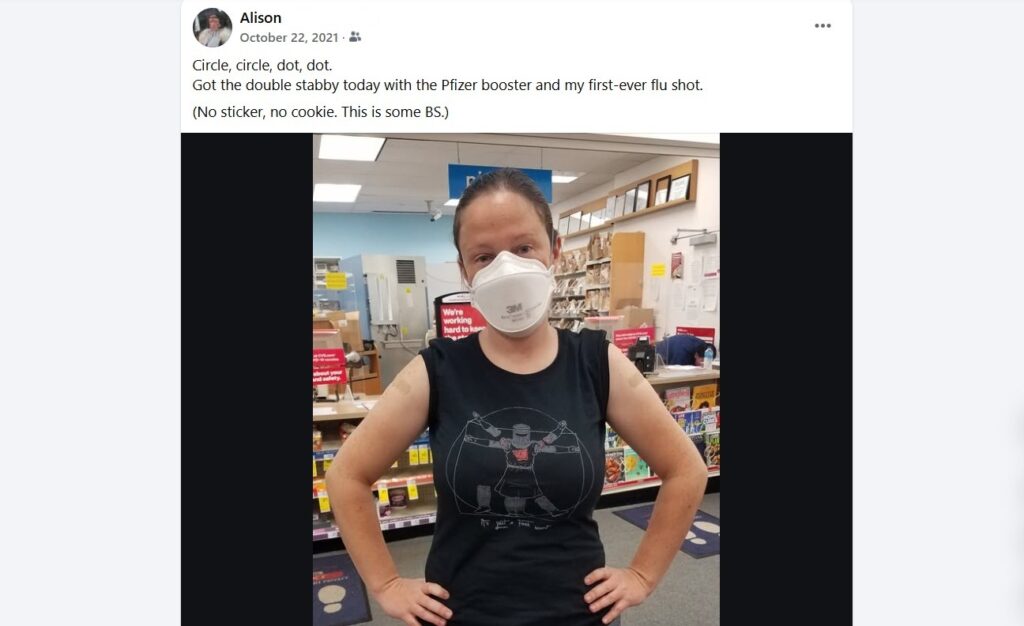
Photo credit: Christian Korey
As I’ve said many times before on this blog, skepticism is not a bad thing – it’s healthy to question the validity of what we’re told, and stress-testing assumptions is part of the scientific process. The thing that’s dangerous is adhering to blind skepticism, basing positions off of what we want to be true, and refusing to let those positions evolve in light of new information. One member of my family asked if it was safe for me to be getting “all these shots.” Yes, with very few, very specific exceptions, these vaccines have been scientifically established to be safe, time and again. [4] Another family member said the vaccines clearly don’t work if I’ve had “that many shots” and still caught COVID twice. I explained that even the World Health Organization has said that vaccines help but can’t stop the disease alone. [5]
Part of the difficulty with evaluating this situation logically is that when the stakes are high, humans tend to react more with emotions than with logic. We also tend to be more likely to connect with personal stories, rather than dry statistics. Both of those facts together can lead us to gravitate toward anecdotal information that feels true, rather than on large sets of data that better describe what’s happening on a bigger scale. Public health professionals often have to rely on information about trends to determine a given course of action that will prevent or reduce harm, but there are no guarantees about individual results. A mundane analogy is that we know that seat belts save lives, but people wearing seat belts still die in car accidents. The function of a seat belt is tangible, but vaccines are much more esoteric, making them easier to misunderstand and fear.
Post-Truth Society
I pushed very hard for adherence to COVID safety protocols both personally and professionally, especially while the pandemic was still considered a global health emergency – but that was when we had credentialed experts with relevant expertise holding positions of power and influence in our federal government. With a noted vaccine skeptic in the office of Health and Human Services Secretary, and a Centers for Disease Control director being fired for resisting changes to vaccine policy that weren’t supported by science, [6] the tables have turned. It is now I who am skeptical of what the government has to say about vaccines.
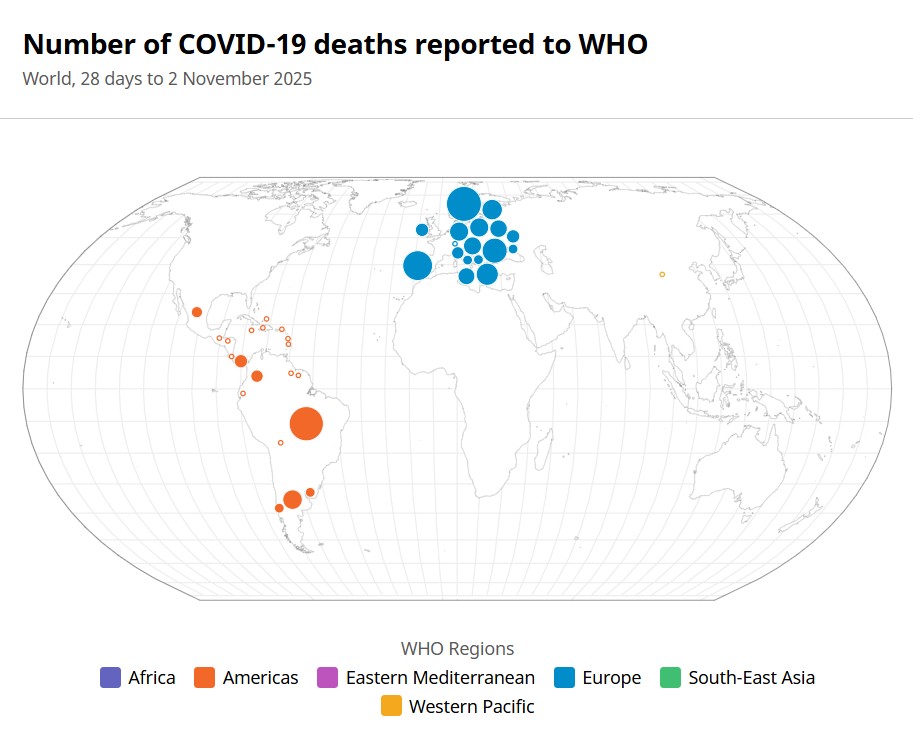
Image credit: [8]
It was unclear for a while whether SARS-CoV-2 vaccines would be available this fall or covered by health insurance. This confusion stemmed from changes to FDA and CDC guidance on who was eligible for the vaccine: eligibility was severely limited from the previous universal recommendation for everyone over 6 months of age to only those aged 65 and older or those with underlying health conditions. There was also an added recommendation of only getting the shot after talking with your healthcare provider. [9] While I did see some anecdotes on social media about difficulty getting vaccines, Christian and I had no trouble, and the pharmacist who gave us our shots said that she didn’t encounter any difficulties this fall, nor did she ever have to turn away someone who wanted a shot.
While I did have concerns about whether there would be changes to the vaccine development process as a result of US politics, Moderna’s new vaccine, targeting the LP.8.1 strain, is available in 70 countries around the world. As a result, I told myself that the development process for a globally available vaccine is (hopefully) fairly insulated from the politics of one country, even if the company is headquartered in that country. I would hope that the public health agencies of other countries would come to their own independent evaluations of the vaccine’s safety – and not hearing any fact-based concerns to the contrary, I went ahead and got it. What did give me pause was when the pharmacist casually noted that she wanted to make sure she was giving me the correct vaccine, because there are now two Moderna shots: one for those under 65, and one for those 65 and older.
Something New
That new piece of information gave me pause, and I wished I had known and done some research before getting an appointment. It turns out that the “under 65” shot, named “Spikevax,” uses the same vaccine technology we’ve come to know over the past few years, with the messenger RNA delivering the genetic information from the virus’ entire spike protein. The new shot, for those 65 and up and for those with underlying conditions, is named “mNEXSPIKE.” It targets very specific parts of the virus that trigger immune responses and delivers a much smaller dose (10 micrograms, as opposed to Spikevax’s 50). Studies have demonstrated comparable efficacy between the two. [10]
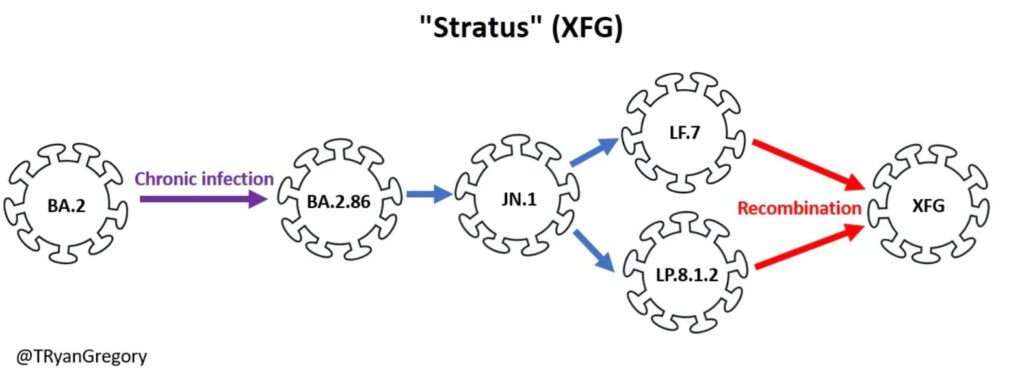
Image credit: [11]
I was also curious if this year’s vaccine wound up targeting the LP.8.1 strain of the virus, which the FDA recommended for the 2025 vaccine back in June. As you may remember from my post on the subject when I was down for the count with COVID over the summer, “Nimbus” was the NB.1.8.1 strain, quickly taking LP.8.1’s place as the dominant strain in the US. [12] I was wary about the effectiveness of LP.8.1-based vaccines after “Nimbus” was on the rise, but I’m not a virologist. (And unlike many people spewing opinions on their online platforms these days, I’m able to admit when I’m wrong.)
In fact, the dominant strain now, as of October of this year, is XFG, or “Stratus,” a recombinant of LP.8.1.2 and LF.7. [13] LP.8.1 and LF.7 are both evolved from the JN.1 line (a.k.a. “Pirola”), which was the target for the Fall 2024 booster. Again, while I am not a virologist, there does seem to be a good indication that the current vaccine should be closely related to the current dominant strain, which is not always a guarantee. And that thought is a nice silver lining as I write this post from my couch, cold, tired, and achy (but just for the next 12 hours or so).
~
How about you? Do you have questions or concerns about vaccine availability or efficacy? Have you had trouble getting a vaccine with the new guidelines? I’d love to hear your thoughts below.
Thanks for reading!
[1] https://radicalmoderate.online/nimbus-two-thousand-and-twenty-five-part-1/
[2] https://www.imdb.com/title/tt15677150/
[3] https://pmc.ncbi.nlm.nih.gov/articles/PMC7393415/
[6] https://www.theguardian.com/us-news/2025/aug/29/trump-administration-news-today-latest
[7] https://www.cdc.gov/nchs/nvss/vsrr/covid19/
[8] https://data.who.int/dashboards/covid19/deaths
[9] https://www.today.com/health/coronavirus/covid-vaccine-2025-2026-rcna228529
[10] https://secure.medicalletter.org/TML-article-1733h
[12] https://radicalmoderate.online/nimbus-two-thousand-and-twenty-five-part-1/
[13] https://covid19.onedaymd.com/2025/08/the-stratus-variant-xfg-symptoms-global.html
2 Comments
Garrod · November 23, 2025 at 11:55 am
We weren’t eligible for the Covid jab this year, the UK have changed the guidelines.🙁
Alison · November 23, 2025 at 3:02 pm
Oh no! I’m so sorry to hear that!
Do you know what the rationale was? (Maybe ignore what I said about health agencies in other countries…)