Grieving rituals have been on my mind lately, [1] as have the environmental and human rights issues associated with fast fashion and our habits of overconsumption. [2] In that churn of thoughts, my mind revisited a theory I had heard at some point over the years that ready-to-wear Victorian mourning attire represented the birth of fashion commerce as we know it today. Indeed, no one had a handle on excessive, performative social expectations quite like the Victorians, and the mid-19th century was a fascinating and tumultuous time of social upheaval and technological innovations that fed (or fed off of) each other.
Mourning Etiquette
Donning black for mourning is thought to date back to the Romans, [3] but it was truly elevated to an art form (or system of control, depending on how you look at it) in the Victorian period. The types and colors of fabric that could be worn, where, and for how long were all codified based on the type of loss experienced (i.e. relationship with the deceased). The more significant the loss, the deeper and longer the mourning period, withdrawal from society, and prohibitions on forms of merriment, particularly for widows.
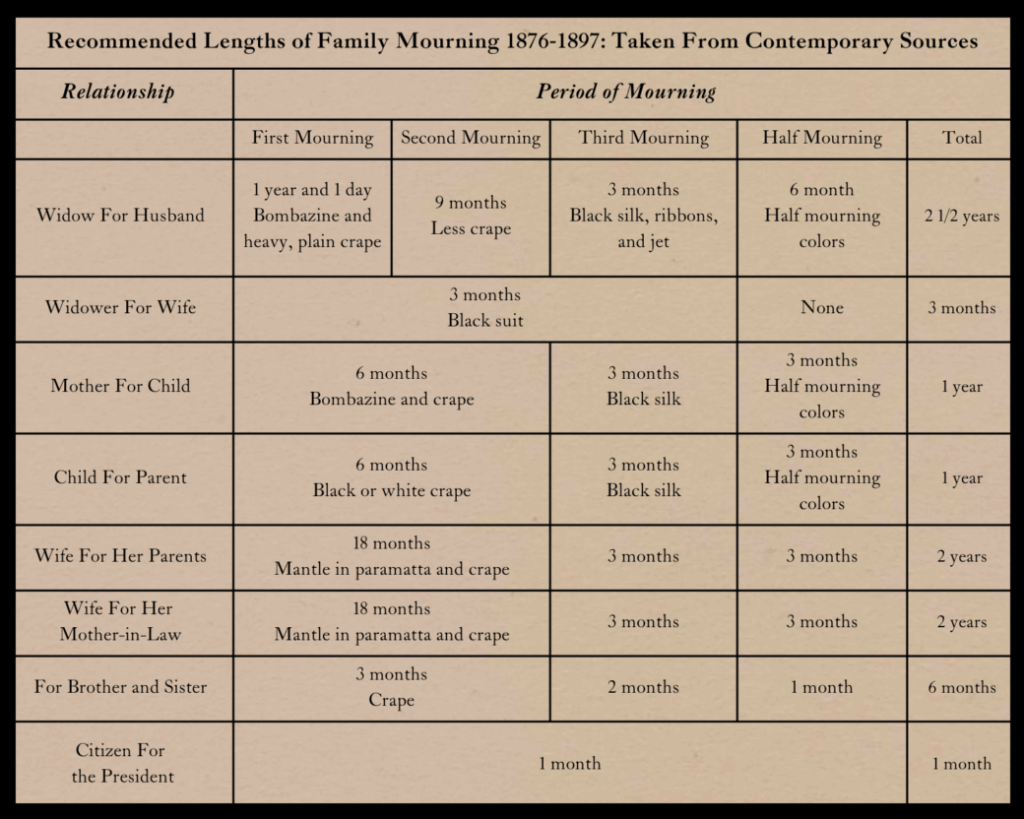
Image credit: [4]
I do my best to think of different historical practices from an anthropological perspective, but even I have my limits. Certainly, clothing and accessories have been used over the centuries to silently indicate characteristics of the wearer, informing others of what types of interaction are or aren’t appropriate – and we do that today, formally and informally. The biggest issue I take with this system is that it strikes my modern sensibilities as seemingly arbitrary and one-size-fits all. It’s one thing for someone who doesn’t want to interact with others after a loss to wear black and withdraw from social events, but many people cope with grief by getting out and taking their minds off the situation at hand.
Nonetheless, there were minimum mourning times expected for the loss of a husband (2.5 years), parent (2 years), child (1 year), sibling (6 months), etc., and any premature departure from appropriate attire and activities would raise eyebrows, usually with the implication being that the person in question was not genuinely sad (or sad enough). On the other hand, someone may never get over the death of a spouse, which was the case with Queen Victoria, who stayed in mourning for the rest of her life (40 years) after the death of Prince Albert. And because her actions had such a significant influence on her subjects (and others around the globe), it was during her extended mourning period that these rituals expanded in length and complexity compared to the early half of the 1800s. [5]
Fast(er) Fashion
With regularly evolving rules around mourning – and such high penalties for putting a foot wrong – many ladies turned to magazines for guidance on appropriate etiquette and attire, which were useful for making decisions at a time when decision making can be particularly difficult. [6] And businesses were all too happy to accommodate the need for changing styles and requirements that kept customers coming back. By 1900, there were department stores with mourning sections and mourning warehouses in major cities on both sides of the Atlantic – all stocking ready-to-wear mourning attire, circumventing the need to order and wait for a garment on short notice. [7]
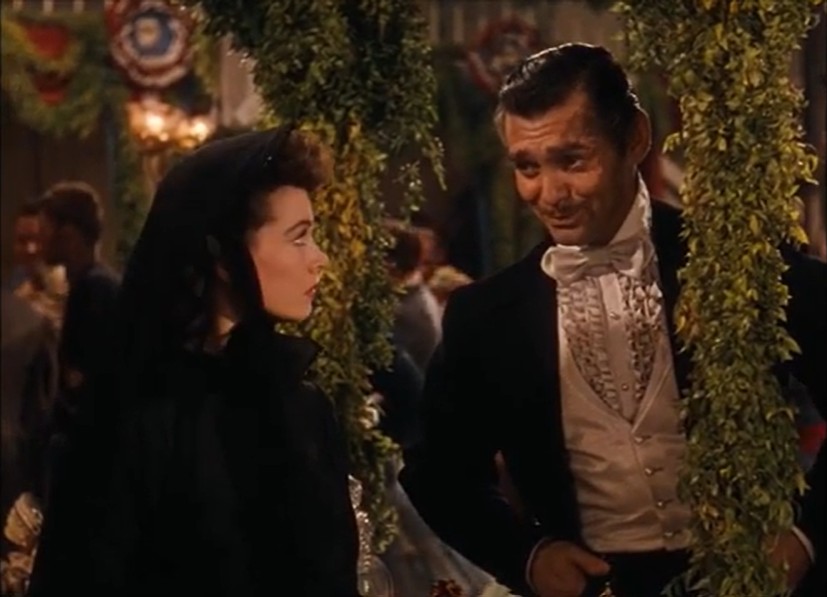
Image credit: [8]
But it is important to note that all of these changes to social behavior and commerce were taking place within the broader context of the Industrial Revolution and a rapidly developing middle class. As the middle class grew and became established, they wanted to be able to differentiate themselves from the working class, and the way to define their status was through conspicuous consumption. [9] The concept of fashion trends in mourning wear seems to be an odd novelty, but its existence becomes much more understandable in the context of what was happening with the acceleration of fashion styles and clothing consumption writ large during that time.
Some dress historians believe the concept of fast fashion really began in the Victorian Era, enabled by technological advances for producing textiles, families that wanted to demonstrate their wealth (i.e. relevance), and businesses that were poised to take advantage of both. In the late 1700s, the fashion cycle went through annual iterations, with publications showcasing the styles of the prior year. That pace increased over the coming century, with monthly updates in ladies’ magazines by the end of the 1800s and private fashion shows taking hold in the Edwardian period (early 1900s). Today we have social media and internet-based commerce with new products landing in our feeds on a daily basis. The value was not in the styles themselves but in the fact that they were new. And in order to keep up with the pace (and price) of purchasing more than we need, we have sacrificed quality in the process. [10]
Caveat Emptor
Historical dress is a passion of mine (with the Victorian and Edwardian periods being particular favorites), but I am not an expert. However, as someone who has done a good bit of grieving in the past two years, I have some strong feelings that have surfaced while reading and writing about this subject. From where I sit, it’s safe to say that Victorian grieving practices were influenced far more strongly by societal expectations than by personal needs, which opened the door for manipulation of grieving customers by businesses that were in the right place at the right time (and likely also laid the groundwork for what I refer to as the Funeral Industrial Complex [11]). As a result, it seems to me that ready-to-wear mourning attire was not so much the cause of fast fashion, but instead a symptom of the fertile ground at the intersection of growing technology and consumerism.
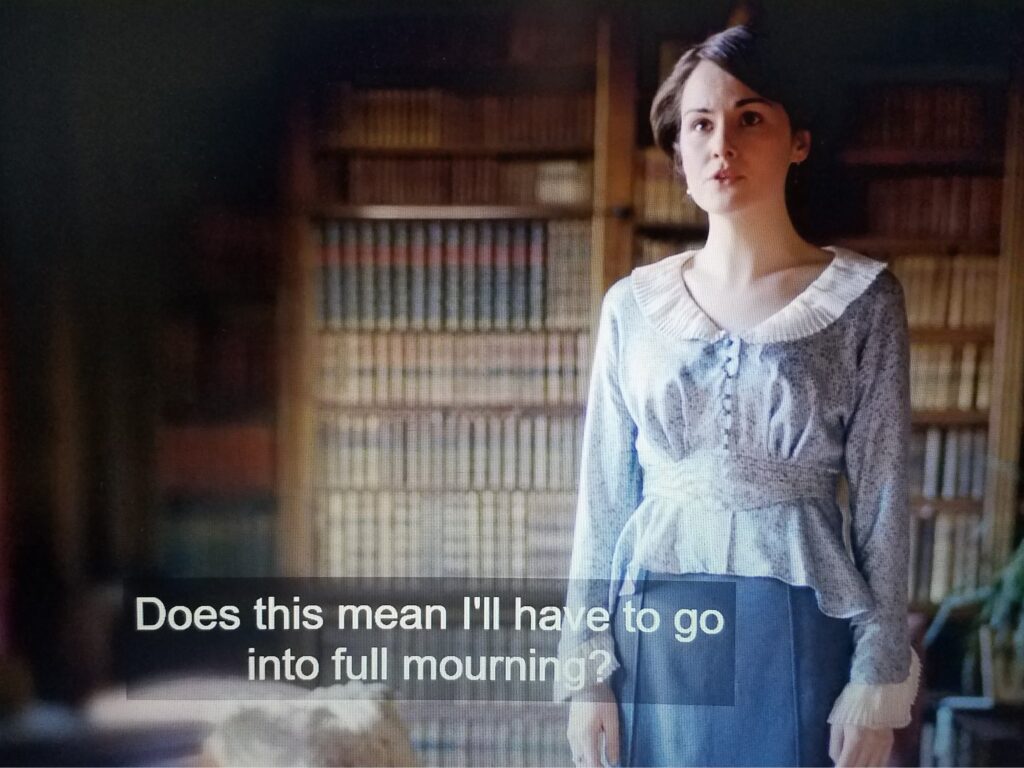
Image credit: [12]
Now, I’ve been in multiple conversations recently discussing the importance of ritual in providing comfort to those who are grieving, and I might agree with that statement as long as it is paired with a very heavy disclaimer: ritual can be comforting to those who are familiar with that particular ritual and are looking to it for comfort. Growing up in a family where I wasn’t exposed to funerals or burials (aside from our cats), I have found no comfort or closure in those practices when I’ve encountered them. In fact, I have felt that certain aspects of conventional western funeral traditions are uncomfortable, if not cruel, for those who are grieving. But that’s me, and I don’t expect someone else to abandon their practices just because it makes me uncomfortable. (Though I might ask someone who is not actively grieving to proactively consider some alternatives for the benefit of the environment. [13]) My point is that it is impossible to dictate how someone else should grieve, as long as they’re not hurting themselves or others.
I personally have been quite comfortable in black the past few weeks (though I’m in soft, cool cotton as I write this post, not stiff, heavy, crape [14]). I happen to like the color, and it’s a small relief to grab a black shirt and black yoga pants in the morning and not worry about what I look like at a time when I’m emotionally overloaded. But that’s a very different situation than what I’ve seen in the research: the fact that women already in pain were being tasked with the extra emotional labor of finding “a dinner gown which will be becoming, correct, and yet not depressing to its beholders” (as a ladies’ magazine encouraged) [15] was downright appalling to me. After a period of such excess, it wasn’t surprising that the pendulum of this trend was already swinging back in the other direction, toward simplicity, by 1915 (hastened by the First World War). Vestiges of these traditions remain today, though in relatively tiny amounts – small enough and unexpected enough that I’ve felt comfortable exploring them myself and seeing what feels right to me.
~
There are pages of untouched notes on content I wanted to include in this post about the mid-1800s, referencing literature, art, war, and social mobility, but I will have to save those for another time and another topic. Until then, I’d love to hear what you thought about this post and some of the theories presented – or, if you’re comfortable sharing, how you’ve dealt with grief.
Thank you for reading.
[1] https://radicalmoderate.online/siegfried-f-steele-obituary/
[2] https://radicalmoderate.online/clothes-of-dead-white-people-part-1/
[4] https://www.whitehousehistory.org/photos/mourning-period-chart
[5] https://victorianmourning.weebly.com/whatever-shall-i-wear.html
[6] https://victorianmourning.weebly.com/whatever-shall-i-wear.html
[7] https://journalofantiques.com/features/the-evolution-of-mourning-wear/
[8] https://www.youtube.com/watch?v=kHXj3XEnEB4
[9] https://oercommons.org/courseware/lesson/87948/student-old/
[10] https://www.youtube.com/watch?v=zYSAHXuwg1M
[11] https://evermore.org/5-things-you-didnt-know-about-the-funeral-industry/
[12] https://www.amazon.com/Downton-Abbey/dp/B006MW3VQU/
[13] https://radicalmoderate.online/green-burials/
[14] https://en.wikipedia.org/wiki/Cr%C3%AApe_(textile)
[15] https://www.edwardianpromenade.com/etiquette/mourning-in-edwardian-and-post-war-england/
0 Comments