Part 1 – Catch Me if You Can
COVID-time is here again. As with last year, when Christian and I picked up one of the “FLiRT” variants as an unwelcome souvenir from our travels to Fiji, [1] this time we brought “Nimbus” home from the Pacific Northwest. (Note: the same Canadian evolutionary biologist, who clearly missed a calling in marketing, coined both names.) [2] Consequently, I’ve had a lot of extra couch time over the last week, too exhausted to do much more than read. And unsurprisingly, I’ve taken that opportunity to dive into the evolution of the COVID-19 virus over the past (almost) six years. I personally find epidemiologic research fascinating, but what we do (or don’t do) with that information as a society has stoked nothing short of fury on my part. And what do we do with impotent rage these days? Channel it into the internet, of course! Fortunately, I have a blog for that…
All of the cool information I am about to share about viral evolution is very much tempered by the reminder that most Americans likely have at least a few major misconceptions about COVID-19 specifically and communicable diseases more broadly – perceptions that indicate a dearth of scientific literacy and critical thought. I find it safe to make this assessment based on conversations I’ve had with others, common narratives I’ve encountered on social and news media, and even things I’ve caught myself thinking. Thinking like a scientist is a matter of habit, and we are sorely out of practice in this country.
I’m Not an Epidemiologist, But I Play One on TV
While viruses are not generally considered to be living things, they do reproduce and evolve over time, [3] and it’s that evolution bit that makes them tricky to deal with. Since Sars-CoV-2 was discovered at the end of 2019 (hence the “19” in COVID-19 – yes, I have had to explain that to people), it has gone through countless mutations and developed different qualities in the process. Tracking viruses is fascinating (at least from an academic perspective) because you can view the processes of evolution and natural selection on an incredibly short timeframe. When we look at the evolution of biological organisms in hindsight, we usually see one clear, linear path from one organism to another (such as with the iconic “March of Progress” image detailing the evolution of Homo Sapiens [4]). That limited view can lead us to believe that evolution is a clean, straightforward process, when it is really anything but.
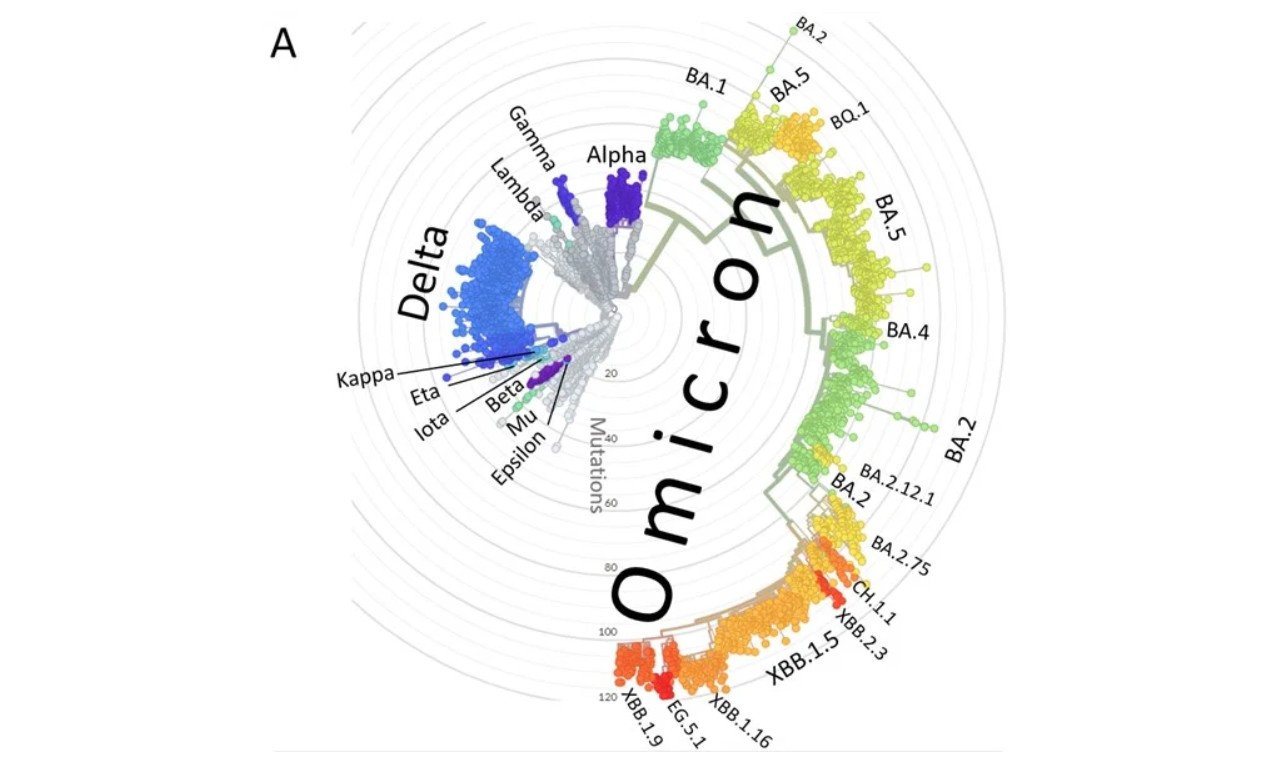
This image from 2023 (the most current I could find) demonstrates how significant the Omicron variant has become in the context of COVID-19’s evolution. The most common strains we’ve seen over the last year (descended from JN.1) aren’t even represented on this chart, but XBB’s descendants aren’t done with us yet, either.
Image credit: [5]
Evolution is messy because it is a result of random mutations going from one generation to the next. When information is copied (whether in a notebook or in DNA), there is always opportunity for transcription errors. Copy errors result in mutations, and those mutations may or may not have consequences. When it comes to viruses, those mutations are called variants; variants with distinct physical properties are called strains – they’re built differently, so they behave differently. [6] And over time, if you have many different versions of a virus, some will survive better than others in certain conditions; the ones that are better at surviving will be more likely to reproduce and create future generations. Evolution does not happen because of need; evolution happens because certain randomly acquired qualities are better suited to survival than others.
But because viruses evolve so much faster than humans, for instance, we are constantly trying to play catch-up. We have amazing scientific advancements that can help us fight back against endemic (or, regularly occurring) viruses like influenza and (now) COVID-19, but our work is inherently reactive based on what we’ve already seen. What that means is that people are already being infected with a particular virus strain once it is identified and incorporated into a given vaccine, and there are already variants of that strain in circulation by the time people are getting the shot, which is based on the identified strain, not its variants. Part of the perception that these shots “don’t work” comes from the fact that they could be based on a variant that may have been dominant six months (or more) in the past, while a new or unrelated variant has popped up in its place.
COVID-19 Variants and Vaccines
The speed with which the original COVID vaccines were released was truly astonishing from the standpoint of approval timelines, [7] which calls for some credit where credit is due to the first Trump administration for cutting through red tape to get vaccines developed and out to people at “warp speed.” (However, because of his administration’s blatant anti-science bias, public skepticism was rampant, and many shipments of these vaccines went into American dumpsters instead of American arms, while other desperate countries around the world went without.) But the technology itself was not new: research into mRNA has been around since the 1970s, [8] and it meant that a new vaccine could be developed in relatively short order as soon as the virus strain was isolated. The initial round of COVID-19 vaccines, available in the US in spring 2021, were based on the initial strain of COVID-19 identified about 1.5 years prior. But by then, the “Delta” variant was already on the rise in India and would hit the US mere months after the first wave of vaccinations, causing another spike in cases and commensurate skepticism about the vaccine’s effectiveness.
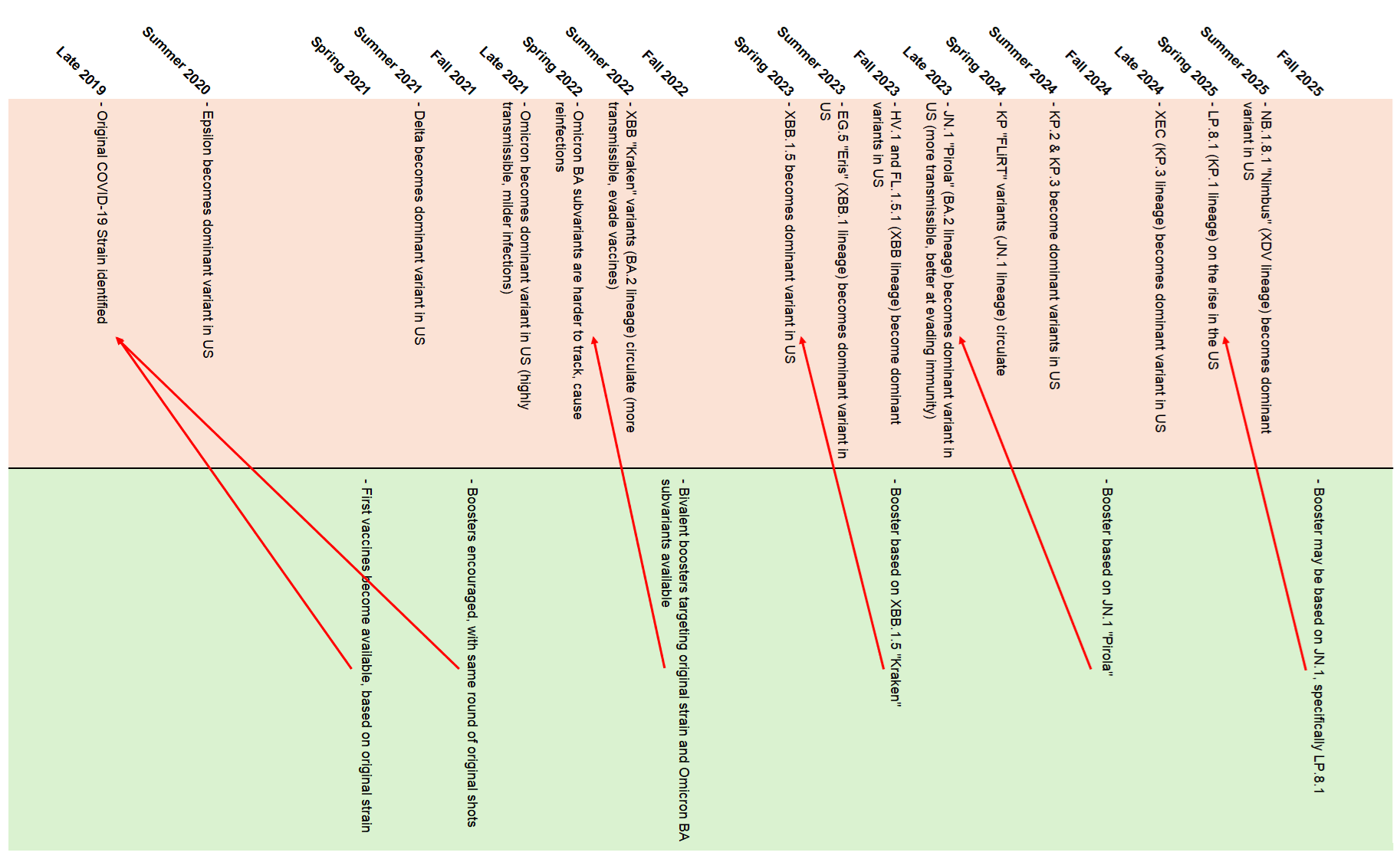
That perception is a major pet peeve of mine, because “COVID” is not a singular, unchanging, monolithic entity. Consider this analogy: if you think of the vaccine as giving your body a police sketch of the invader, your body will be on the lookout for that specific individual but might instead be invaded by a relative of the suspect. The relative might bear enough resemblance to the police sketch that your body notices and throws up some defenses, or it might not. If the virus weren’t evolving, the vaccine would probably do a pretty good job, but it is in the virus’ best interest to evolve and therefore survive, which is why successful variants have been more transmissible, less lethal, and different enough to evade tests and vaccines.
In Fall 2022 the first updated boosters were available, targeting the “Omicron” variant, which had become dominant in late 2021 / early 2022; [17] all dominant variants we have seen since are descended from Omicron, which was considered to be harder to track than the original virus and could cause reinfections. The span of time between identification of a dominant strain and its incorporation into a vaccine appears to be decreasing based on the research I did for this post, but given this year’s timing, we’re still looking at a 6-month lag:
- The Fall 2023 booster was based on XXB.1.5, a subvariant of Omicron BA.2, which was dominant in summer 2022.
- The Fall 2024 booster was based on JN.1, a subvariant of Omicron BA.2, which was dominant in late 2023
- The Fall 2025 booster may be based on a recommendation the FDA made in June for “JN.1-lineage … preferentially using the LP.8.1 strain,” which was on the rise in spring 2025, [18] but we’re already seeing that LP.8.1 may not be the variant of concern this fall.
Reading the Tea Leaves
Once again, it’s important to note that picking a variant for an annual vaccine formulation is a guessing game – one that uses all the information available, but a guessing game nonetheless. That’s why some years we’ll hear that the flu vaccine, for example, is less effective: because a different, unrelated strain has become dominant in the meantime. Sometimes a dominant variant can be a direct descendent of another, but sometimes we can get combinations of multiple variants. When someone is infected with two distinct strains, those strains can combine and create something new, what we call a recombinant virus, [19] which can have aspects of both variants, potentially giving it more versatility. And that brings us back to “Nimbus.”
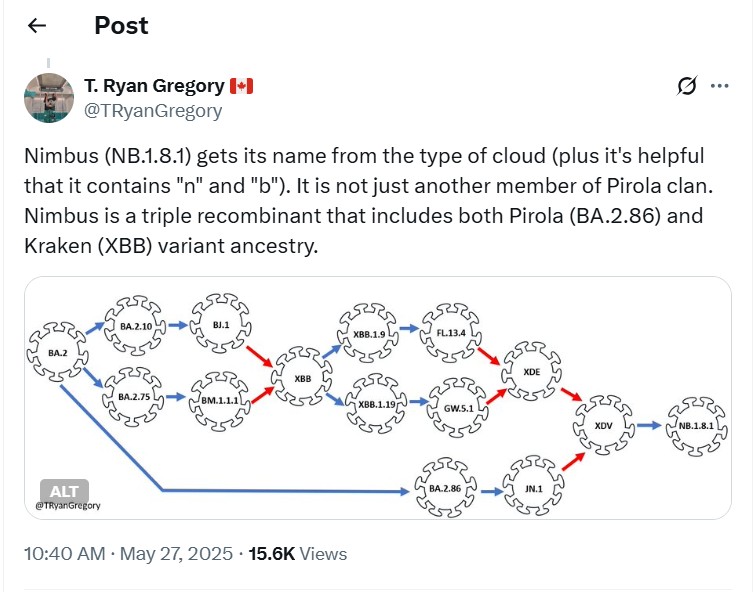
Image credit: [20]
To be clear, everything I’m about to describe is descended from the BA.2 Omicron subvariant, so the vaccines should still be generally effective… but (and I cannot stress this next point clearly enough) general trends are no guarantee of individual results, so we should all be pairing broad, regular vaccinations with other prevention measures (e.g. masking, distancing, etc.), especially when we see something new, like now. BA.2 has many descendants circulating, and these two have been responsible for several dominant variants: [21]
- XBB (“Kraken”) was a recombinant of BA.2.75 and BJ.1 (also known as BA.2.10.1.1);
XBB.1.5 was dominant in Summer 2022 and was the focus of the Fall 2023 vaccine. - JN.1 (“Pirola”) was a subvariant of BA.2.86, was dominant in late 2023, and was the focus of the Fall 2024 vaccine.
Think of XBB and JN as cousins, if you will. XBB was dominant first and got a vaccine, and then JN became dominant and got a vaccine. We have since seen some of JN’s descendants become dominant:
- The KP series (“FLiRT” variants), dominant in Summer 2024, were subvariants of JN.1.
- LP.8.1 (a subvariant of KP.1.1), dominant in Spring 2025, was the FDA’s recommended target for Fall 2025’s vaccines.
However, what Christian and I picked up was almost certainly NB.1.8.1, or “Nimbus,” which descended along a different evolutionary line. A while back (generations ago, as far as viruses are concerned), two subvariants of XBB recombined to create a variant called XDE. During the summer of 2024, a recombinant of XDE and JN.1 called XDV was dominant in China. Nimbus is a subvariant of XDV.1.5.1; it is now the dominant strain in the US and is being monitored by the World Health Organization due to its rapid spread. [22] And that brings us up to speed with me on the couch again, lying down between meetings and exhausting myself with the strenuous activity of knitting.
~
So what are we to do with continued global COVID cases (and deaths), especially amid COVID skeptics and anti-vaxxers? We will pick up there next week with (hopefully) some optimism (or at least options) to balance out the frustration. In the meantime, have you gotten one of the trendy variants? How are you faring, and what have you learned about COVID (or yourself) from the experience?
Thanks for reading!
[1] https://radicalmoderate.online/feeling-flirty/
[2] https://www.today.com/health/coronavirus/new-covid-variant-nb181-nimbus-symptoms-rcna212304
[3] https://my.clevelandclinic.org/health/body/24861-virus
[4] https://sites.wustl.edu/prosper/on-the-origins-of-the-march-of-progress/
[5] https://whn.global/common-names-for-variants/
[6] https://www1.racgp.org.au/newsgp/clinical/what-s-the-difference-between-mutations-variants-a
[7] https://pmc.ncbi.nlm.nih.gov/articles/PMC7393415/
[8] https://publichealth.jhu.edu/2021/the-long-history-of-mrna-vaccines
[9] https://www.verywellhealth.com/covid-variants-timeline-6741198
[10] https://pmc.ncbi.nlm.nih.gov/articles/PMC11286544/
[11] https://www.yalemedicine.org/news/3-things-to-know-about-flirt-new-coronavirus-strains
[12] https://www.yalemedicine.org/news/3-things-to-know-about-xec-the-latest-covid-strain
[14] https://www.cidrap.umn.edu/covid-19/who-adds-nb181-sars-cov-2-variant-under-monitoring
[17] https://radicalmoderate.online/covid-episode-ix-the-rise-of-omicron/
[19] https://en.wikipedia.org/wiki/Recombinant_virus
[20] https://x.com/TRyanGregory/status/1927374378905354507
[21] https://www.verywellhealth.com/covid-variants-timeline-6741198
[22] https://www.today.com/health/coronavirus/new-covid-variant-nb181-nimbus-symptoms-rcna212304
0 Comments