Disclaimer: I am not a medical professional and am not giving medical advice in this post. I am describing what I am doing based on my own research. If you are unsure about anything, you should take your doctor’s word for it, not mine.
The weather has turned cold in Pittsburgh, and the electric blanket has emerged once again. Pumpkin and I have been making good use of it these last few weeks, keeping in mind that it takes less energy to heat a blanket than it does to heat the entire house. But as I turned it on, I remembered something a friend of mine warned me about last year: that electric blankets are bad for your health. She couldn’t remember specifics, but it sounded like there was a concern with the electromagnetic fields they produced and how those interacted with the iron in our blood.
Now, I have done my fair share of risky behaviors to stay warm in the middle of winter, particularly when I lived in Japan and shared my tiny, insulation-free apartment with a kerosene heater. (Notably, I regularly left it on overnight, which I should never, ever have done – though at the time I weighed my options and preferred death by asphyxiation over hypothermia.) For that reason, I was a little incredulous about the relative danger of an electromagnetic field from a blanket. But as long as I was huddled under one with a laptop and a kitty, it seemed like as good a time as any to look into that claim.
Truthiness and Public Policy
In all honesty, I was curious to see what facts (if any) supported these concerns, particularly in this age of truthiness and pseudo-science impacting public health policy. I myself don’t have a formal public health education, but I’ve gotten one heck of a crash course in it through my day job since the beginning of the COVID-19 pandemic. One of the best descriptions I heard about the field of public health at that time was that “if we’ve done our job right, it will seem like we overreacted.”
Image credit: [1]
The field of public health is characterized by preventing or at least minimizing harm to the greatest extent possible. Much of that means acting quickly on incomplete or imperfect information – because in a public health crisis, waiting for one more study can waste valuable time. As more information becomes available, that course of action may need to shift. You may remember guidance related to masking and sanitizing surfaces changing over time in early 2020 – that was because our understanding of the virus changed over time.
Unfortunately, changing guidelines can also erode public trust of public officials, as it can seem that they don’t know what they’re talking about. I’ve seen frustration around subjects as mundane as whether butter is good or bad for your health. Furthermore, we now live in a world where any information we want is at our fingertips (no matter the quality), and anyone can find any fact they want to support their position (rather than using available facts to form a position). Take that situation a step further, and we arrive at the scary reality of policy being informed not by what the science says, but what people want to believe is true. But I digress to this one example of pseudoscience (or is it…?)
What’s the Risk?
Spoiler alert: the biggest health risk related to electric blankets is without a doubt the possibility of burns or fires. The next biggest concern I could find was tied to cancer, but there is no established link between electric blankets and cancer. As long as you are following the manufacturer’s instructions for proper care, regularly checking for damage, and not leaving it on unattended, you should generally be fine using an electric blanket. [2] However, there are some specific exceptions: people with neuropathy, circulation issues, or nerve damage may not feel the heat of a blanket and get burned; people with dementia, including Parkinson’s and Alzheimer’s, may have difficulty with temperature regulation and temperature sensitivity, respectively; and there have been concerns raised about the impacts of electric blanket use during pregnancy. [3]
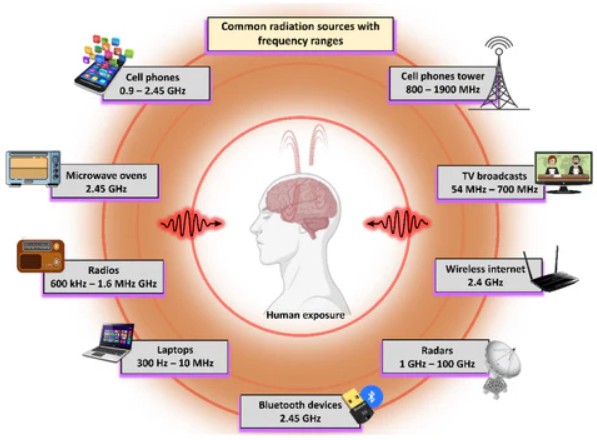
Image credit: [4]
A study indicating increased risk of miscarriage after exposure to magnetic fields was published in 2017, [5] but it has been refuted for unsound methodology. [6] Furthermore, the World Health Organization (WHO) states that the body of research shows no established increase in adverse pregnancy outcomes (though the last update to that page was in 2016). [7] Most sites I checked that weighed in on the subject said there is no established connection but still advised pregnant people to talk to their doctors before using an electric blanket.
The reason for the cancer concern is because electrical appliances create electromagnetic fields, [8] some of which can be harmful to human health at high frequencies. I’ve covered aspects of the electromagnetic spectrum before (most recently in my post on induction cooktops [9]), and it is an understatement to say that we are surrounded by equipment that creates these fields. [10]
- High-frequency electromagnetic fields (EMFs) include x-rays and gamma rays – these occur at higher frequencies than visible light and have enough energy to remove an electron from an atom (a.k.a. “ionizing radiation”), which can damage DNA or cells and can sometimes lead to cancer.
- Low to mid-frequency (or “radiofrequency”) EMFs are created by cell phones, laptops, AM/FM radios, TVs and monitors, microwave ovens, and Wi-Fi – these occur at lower frequencies than visible light and are considered “non-ionizing radiation.”
- Extremely low frequency (ELF) EMFs are created by power lines, electrical wiring, appliances, hair dryers, and … electric blankets.
Non-Ionizing Radiation
Some people have expressed concerns about possible health risks of 5G as cell phone technology evolves. Interestingly, while 4G cell phones emit radiation between 0.7 and 2.7 gigahertz, 5G technology is anticipated to use up to 80 GHz. That may sound like a big difference, but for reference, visible light (still non-ionizing radiation) has frequencies between 430,000 GHz (red light) and 750,000 GHz (blue light). Ionizing radiation begins around 2.4 million GHz. According to the National Cancer Institute, the incidence of brain or central nervous system cancers has not increased with cell phone use. [11]
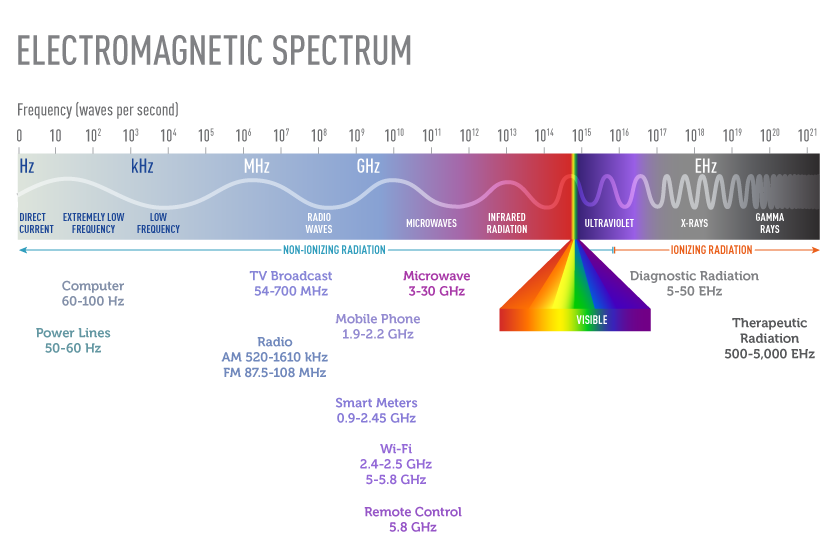
Image credit: [12]
But the question has been raised by some: we know that cell phones, etc. don’t emit ionizing radiation, but does our increased exposure to non-ionizing radiation have an effect on our health? Again, the National Cancer Institute has said that it’s unclear what the mechanism for cell damage would be without ionizing radiation. [13] However, other organizations, such as WHO and International Agency for Research on Cancer have classified radiofrequency EMFs as potentially carcinogenic to humans. [14],[15] (Still, electric blankets are not in that category.)
A possible mechanism suggested for cell damage is greater oxidative stress in the presence of EMFs. Oxidative stress is created by an increase of free radicals (unstable molecules) in the body, which can be neutralized by antioxidants (found in many fruits and vegetables). According to a 2017 literature review, “several studies have reported that exposure to EMF results in oxidative stress in many tissues of the body. Exposure to EMF is known to increase free radical concentrations and traceability and can affect the radical couple recombination.” But the same study also concluded that “people may use various antioxidants such as vitamin E, MEL [melatonin] and FA [ferulic acid] to prevent the potential adverse effects of exposure to EMF.” [16]
Paranoid or Proactive?
We live in a complex world in which we are exposed to more and more things that can harm us in ways we don’t fully understand, especially as technological advancements outpace public health research. Our understanding of public health risks is only as good as the questions we ask and the data we collect, so we’re always going to be a step behind in responding to things like pandemics and hazardous substances. The biggest weapon we in the general public have, however, is understanding what the available information says and what it means.

For example, one website focused on holistic medicine described the risks of EMFs, listing studies that indicated connections between EMF exposure and endocrine disruption, [17] mental health disturbances, [18] cardiovascular abnormalities, [19] Alzheimer’s disease, [20] tumors, [21] and increased oxidative stress. However, many of these studies have clear limits to their research, including sample sizes that are small and/or focused on occupational (not day-to-day) exposures; several of them conclude that additional research is needed to confirm their findings.
Public health research is like a puzzle: one piece alone doesn’t give the whole picture. One study can point to a very concerning conclusion, but without corroborating evidence from other studies, it can be difficult to confirm a relationship between cause and effect, let alone identify an accurate pathway of exposure. As more information becomes available and demonstrates a pattern, then we can better justify raising red flags and changing our behavior (and possibly policy). Public health is characterized by swift action, but the limited data available for informing that action also has to be reliable. When forming our (educated) opinions, it is important to weigh the quantity and quality of the research available and respond accordingly.
Should additional studies be conducted on these subjects? Absolutely. Will I be changing my behavior for the time being? Certainly not when it comes to my electric blanket (though I probably could benefit from getting more antioxidants, regardless of EMF exposure).
~
What about you? Do you have concerns about electromagnetic fields or specific electronic devices, and did this post change your mind on anything? Let me know in the comments.
Thanks for reading!
[1] https://www.atsdr.cdc.gov/pha-guidance/
[2] https://www.healthline.com/health/are-electric-blankets-safe
[3] https://www.medicalnewstoday.com/articles/are-electric-blankets-safe
[4] https://milerd.com/es/blogs/noticias/exposure-to-emfs-defining-the-impact-on-human-health
[5] https://www.nature.com/articles/s41598-017-16623-8
[6] https://www.nature.com/articles/s41598-021-01391-3
[7] https://www.who.int/news-room/questions-and-answers/item/radiation-electromagnetic-fields
[9] https://radicalmoderate.online/now-youre-cooking-with-magnets/
[11] https://www.cancer.gov/about-cancer/causes-prevention/risk/radiation/cell-phones-fact-sheet
[13] https://www.cancer.org/cancer/risk-prevention/radiation-exposure/radiofrequency-radiation.html
[14] https://pubmed.ncbi.nlm.nih.gov/27012122/
[15] https://www.cancer.org/cancer/risk-prevention/radiation-exposure/radiofrequency-radiation.html
[16] https://pmc.ncbi.nlm.nih.gov/articles/PMC6025786/
[17] https://doi.org/10.1016/j.ecoenv.2023.115837
[18] https://doi.org/10.1002/1348-9585.12136
[19] https://doi.org/10.33549/physiolres.934938
[20] https://doi.org/10.3390%2Fijerph16030337
[21] https://doi.org/10.3390%2Fijerph17218079
0 Comments