As the years tick by with my gardening / rewilding project, I am still learning new things about what’s going into my garden… and what’s coming out of it. This year we noticed some small, black beads – smaller than ballpoints – stuck to our cars, porch railing, and lawn chairs. The road in front of our house had been resurfaced, so we initially assumed that they were little flecks of tar. Under that assumption, we were not surprised at how difficult they were to remove or that they stained whatever they touched (including the windshields and body panels of our cars), but we were surprised that the county wouldn’t have notified us about the risk ahead of time – and that these beads of tar had traveled so far from the road (almost 100 feet).
In actuality, these little beads were not what we thought they were and not a result of road work. Christian first discovered the truth when he was searching for information about what they were and how to remove them from a car without ruining the paint. His results were disheartening: not only are they extremely difficult to remove, but their origin was from somewhere much closer to home than the road. They are, in fact, dark, sticky spore masses from what is commonly called “artillery fungus,” a fungus that likes to grow on decaying wood… including mulch.
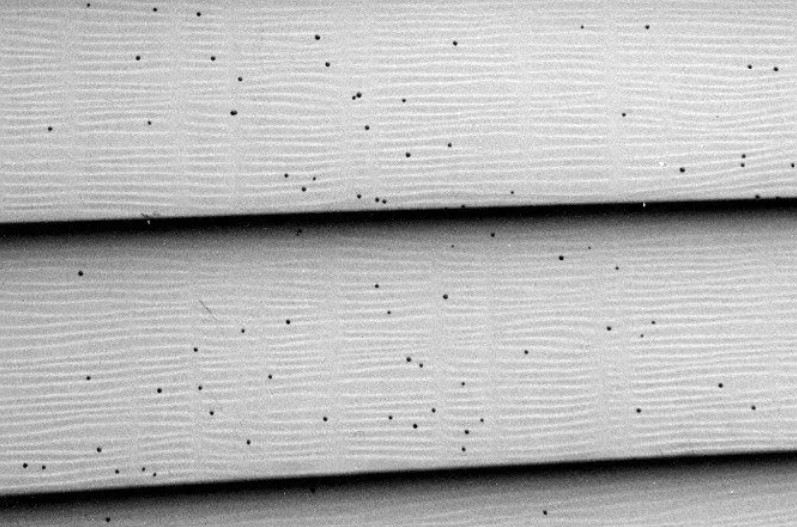
Image credit: [1]
Sphaerobolus stellatus
This fungus is not hazardous to animals or humans, though it is absolutely reminiscent of something out of a horror movie when you zoom in. It proliferates most commonly in spring and fall when temperatures are more mild, preferring 50s and 60s Fahrenheit (10-20C). It also needs a lot of moisture and light for the process. When conditions are right, it develops fruiting bodies to spread spores. White-yellowish egg-like growths, each called a peridium, grow in clusters and contain one spore mass, or peridiole. Each peridium is about 1/10 inch in diameter, but since they grow in groups, they’re easier to see if you know what you’re looking for. [2]
The fruiting body absorbs water and develops until the spore mass is ready to be ejected. At that time, the outer layer of the peridium splits and retracts, revealing a more gelatinous layer, which absolutely looks like an inspiration for the eggs in Alien. [3] Within about five hours, internal pressure increases to the point that it explodes, shooting its single peridiole (a.k.a. spore mass, or “gleba”) out into the world. For the size of this operation, the power involved is immense: the bursting membrane creates and audible pop, and a 1/10,000 horsepower force shoots the peridiole up to 20 feet away. [4]
Interestingly, the fungus tries to project the gleba in the direction of light. I was unclear on the mechanism used to achieve this goal in my limited reading on the subject, so what I can assume is that, lacking any ability to aim, the peridium itself grows in a direction from which it regularly receives light. That light doesn’t have to be from the sun – it can be reflected sunlight, which is why the sticky black spots are often found on white surfaces, such as house siding, even lighter-colored cars parked next to darker ones. [5]
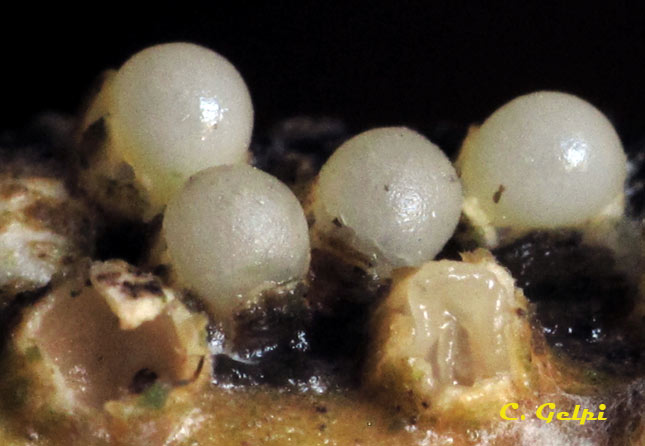
Image credit: [6]
That doesn’t mean my black-colored car was spared. I’m less than concerned about a few extra black spots on a 16-year-old vehicle that has her fair share of dents, scrapes, and rust spots, but Christian’s dream car (in red) attracted some peridioles itself, and while the spore mass does come off with a little effort, its color does not. The key to successful removal is to find them before they dry. I easily scraped one off the window of my car with my thumbnail back when I thought it was tar that had warmed in the sun. According to The Spruce, mechanical removal by scraping (using appropriate caution, depending on the surface) followed by soap and hot water is most effective in the first two weeks or so – but the sooner the better. [7]
Treatment and Prevention
It should be noted that fungicides are not effective and bleach has limited effectiveness, depending on the surface and how long the peridioles have been there. Consequently, those methods are ineffective at best – and more likely harmful to other garden inhabitants (see last week’s post on my difficult decisions around herbicides [8]). Another important point when considering prevention is that peridioles stuck to a house or a car will not grow because they are not in the soil… but if you scrape them off the side of your house without carefully collecting them for disposal (in the garbage, not the compost), you’re creating more work for yourself next year when they start to grow. They are viable for about 12 years and will take advantage of food, moisture, and light they encounter.
This fungus is a nuisance, not a hazard – an important fact to keep in mind when weighing steps to take for removal or prevention. Decaying wood is a preferred food, which means that if you’re using mulch (like I do), you’ll likely see some of it in your yard. According to the state of Connecticut, there has been a growing prevalence in recent years, possibly tied to increased mulch usage. Making sure the mulch you’re using is bark, not wood chips, should help. Some sources suggest cypress and redwood mulch as alternatives that are less hospitable to artillery fungus, but others caution against them because of unsustainable harvesting practices. Some sources suggest stone instead of mulch, which is a great idea for more arid regions in general, but not aligned with what I’m trying to achieve in my yard. [9] (And I’m not even going to start on the suggested rubber or plastic “mulch” suggested by some sources.)

Image credit: [11]
It can be helpful to put down a new layer of mulch every year to block any fungus that has grown from the previous year, but it needs to be done every year, and it should also be relatively thin, as a thick layer of mulch can retain excess moisture and create favorable conditions for fungus and mold. Some sources suggest aerating mulch with a rake periodically to keep it dry, but, again, one of the best things you can do for healthy soil is to leave it alone. (And it took me until Labor Day this year to finish spreading the 8 yards of mulch I had delivered in the spring. I have neither the time nor energy to go back through my garden and aerate it regularly.)
I don’t believe the spore masses we found this year were from the mulch pile that sat in our driveway for four months – I didn’t see any fruiting bodies, but I might have missed some. What is far more likely is that it was already in one of the garden beds, most likely the one that skirts the front porch and driveway, where I have seen multiple types of fungus pop up over the seasons. Covering my mulch pile with a tarp to keep it on the drier side will probably help in future years… as will getting the mulch spread sooner… which may simply require ordering less. As more of my garden beds fill up and and rewild on their own, I am considering (as I mentioned in this year’s garden update [12]) doing more traditional maintenance closer to the house and letting the beds farther away revert to a more natural state. Whatever happens, I’ll be sure to share it here.
~
In the meantime, have you seen any artillery fungus at your house? What did you do to deal with it, or did you just let it go?
Thanks for reading!
[1] https://extension.psu.edu/artillery-fungus-black-spots-on-siding-and-vehicles
[2] https://portal.ct.gov/caes/fact-sheets/plant-pathology/sphaerobolus-stellatus–the-artillery-fungus
[3] https://www.imdb.com/title/tt0078748/
[4] https://en.wikipedia.org/wiki/Sphaerobolus
[5] https://msu-prod.dotcmscloud.com/resources/artillery-fungus-sphaerobolus-stellatus
[6] https://micoex.org/2016/09/17/sphaerobolus-stellatus/
[7] https://www.thespruce.com/artillery-fungus-identification-prevention-5185963
[8] https://radicalmoderate.online/organic-vs-synthetic-herbicides/
[9] https://www.thespruce.com/artillery-fungus-identification-prevention-5185963
[10] https://www.imdb.com/title/tt0108778/
[11] https://br.pinterest.com/pin/418060777900191692/
[12] https://radicalmoderate.online/pollinator-garden-update-2025/
0 Comments