I’ve always hated shopping for clothes. Female stereotype though it may be, it has never been my thing. And ever since I’ve started paying attention to the content and construction of clothing when I do need to purchase new garments, the process has become even less enjoyable. It is no surprise that we live in a consumer society dominated by cheap products designed for short lives – and that is why I do my best to reduce my consumption when possible, taking good care of clothes I already have. When I do purchase new items, I look for good quality and treat them like investments. But that is all easier said than done…
Caveat Emptor
The majority of clothing purchases I’ve made since the beginning of the pandemic have been online. I have neither the time nor the desire to go to a clothing store, look through things I may or may not like and try on things that may or may not fit. (I even gave it my best shot when I was in Milan recently and came home with nothing to show for it.) However, I am clearly a good target for online marketing, where I can buy clothes from the comfort of my couch, particularly when the products involve 100% natural fibers, sustainable environmental practices, and fair, safe working conditions for the people making them.
This May, an online store showed up in my social media feed advertising a 100-day challenge that involved wearing the same wool dress every day and taking a picture in it. The fabric was hailed as sturdy, antibacterial, easy-to-wash, and in need of less-frequent washing than conventional alternatives, hence the ability to wear it for that long. (And successful participants would get a free dress out of the deal.) Long-time readers of this blog will know that I’m a sucker for a gimmicky challenge like that, so I was all-in. Unfortunately, upon closer inspection, I learned that their dresses were not actually 100% wool, so I ultimately didn’t buy a dress for the challenge.

I have been increasingly frustrated by advertising tactics used by many clothing companies to highlight, for example, 100% merino wool or 100% Pima cotton clothing, only to discover something else when looking at the fine print of the product description. Many times I have found that the wool content is 100% merino or the cotton content is 100% Pima, but the fabric itself is only 90-95% the natural fiber advertised, with the additional 5-10% made up with elastane or some other synthetic material to give the fabric a little more stretchiness or sturdiness. (So you’re getting 95% wool fabric where the wool is 100% merino; that’s not 100% merino fabric.)
All or Nothing?
A garment doesn’t need to be made with 100% of a given material in order to gain its beneficial characteristics – fabric starts to demonstrate some of wool’s odor-reducing qualities at 20% wool content when blended with polyester. [1] And more than one person has argued to me that, for example, 90% natural fiber is better than 50% when the other component is plastic, and that doing anything to lessen my consumption of plastic helps. But I disagree – I am still concerned about the fact that these blended fabrics aren’t recyclable (at least not at any scale that is environmentally or economically feasible), [2] result in microplastics whenever they’re worn or washed, and require the extraction of fossil fuels for their production. Yes, I own a lot of plastic clothing, but much of it was purchased before I started paying attention to these things (or purchased second-hand, to help reduce demand for new synthetic garments.)
For those reasons I really do try to look at labels before I buy and support environmentally friendly practices when I do vote with my dollar. I was legitimately excited to buy myself some of this company’s (actual) 100% wool shirts as a birthday present for myself this year, and I have gotten plenty of use out of them in the last six months. As I mentioned in an earlier post, having a lot of black in my wardrobe makes things easy for this style-challenged professional, especially when I lack the emotional energy to think about how I look… or the physical energy to leave the couch. [3]

Image credit: [4]
I did not wear either my short- or long-sleeved black t-shirt for 100 days straight, but I’m certain that I’ve worn each of them more than 50 days in the time I’ve owned them. I’ve worn them to work, to sleep, kayaking, camping, and on long-haul plane rides. The fabric is unlike any wool I’ve ever encountered: it’s comfortable and lightweight like a tech shirt, but unlike a tech shirt, it doesn’t stink after the slightest encounter with perspiration. (Pro-tip: I have had good luck getting “permastink” out of my synthetic tech shirts by soaking the armpits in clear mouthwash before putting them in the laundry.)
A Closer Look
I was intrigued to learn that, contrary to popular belief (including my own), wool isn’t exactly antibacterial, as some purveyors claim. In fact, it appears that bacteria readily grows in wool fabric, [5] but the difference is that it doesn’t retain odor the way oil-based synthetic fabrics do. [6] Consequently, wool garments can stay fresher-smelling for longer, reducing the need for frequent washing, which can break down clothes, particularly poorly constructed clothes. And poor construction is more common in the time of fast fashion… including some very expensive 100% merino wool t-shirts I just purchased.
For as much as I love my shirts, I was shocked to see such mediocre construction, especially given the price point. The fabric itself is of great quality, but the t-shirts were assembled with quick and cheap techniques, no doubt to save time and money. (There are some great resources online that tell you what to look for when shopping for long-lasting garments. [7]) Unfortunately, buying clothing online comes with the risk that you don’t know what you’re getting until it arrives. But since I am comfortable repairing my own clothes, I can’t say that the construction of these shirts would have prevented me from buying them (though it would have made me question the price).
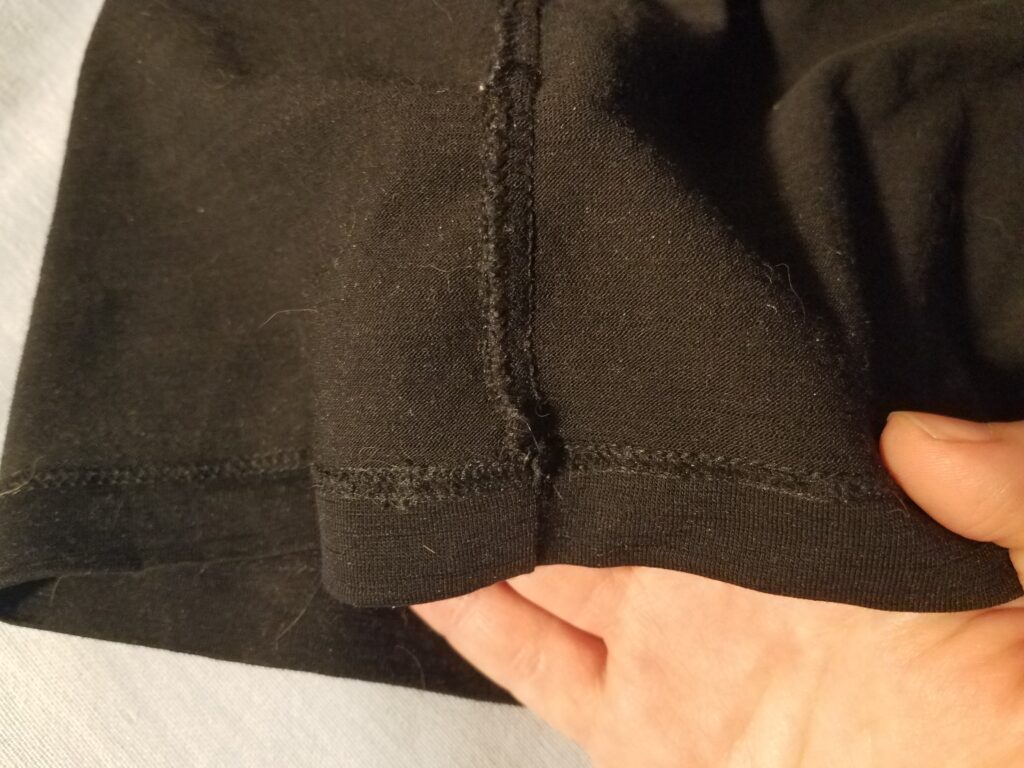
The shirts have held up to a lot of punishment so far, and I do feel like I have been getting my money’s worth, especially given how often I’ve been wearing them. However, it is important to remember that outdoor activities aren’t the only potential risk to these shirts: a colleague who lives in the south told me she can’t keep any wool clothing because of moth damage. Moths are certainly less of a risk in colder climates, but constant vigilance is still important to protect your investments, including regular cleaning of clothes and the drawers or closets where you store them, since moths are attracted to perspiration and body oils. [8]
~
So after all that, it’s not a completely free pass to avoid doing laundry as often as I do, but I certainly will continue adding new 100% natural fiber garments to my wardrobe as I need to. How about you? Have you tried this new style of wool garment to your wardrobe? I’d love to hear about your experiences in the comments below.
Thanks for reading!
[1] https://journals.sagepub.com/doi/abs/10.1177/0040517518801183
[2] https://radicalmoderate.online/clothes-of-dead-white-people-part-3/
[3] https://radicalmoderate.online/paint-it-black/
[4] https://textileengineering.net/wool-fibre-types-characteristics-and-uses/
[5] https://pmc.ncbi.nlm.nih.gov/articles/PMC8950207
[6] https://www.reddit.com/r/Ultralight/comments/kpyk7f/the_science_of_your_smelly_base_layer/
[7] https://www.youtube.com/watch?v=fuVU64m1sbw
[8] https://www.thespruce.com/how-to-stop-moths-from-eating-your-sweaters-11849525
0 Comments