I recently returned from the Middle Ages, specifically a “little” event known as The Pennsic War; or, “camping with 10,000 of your closest friends.” [1] Although this two-week experience that pulls medievalists from all over the globe happens about one hour north of where I live, this year was the first time I stayed on site overnight since 2019 (i.e. pre-pandemic). While some extra vacation time made it possible this year, several of my New Year’s resolutions made it a priority. Those resolutions included goals such as spending time with friends, spending time in nature, and mono-tasking, or intentionally planning activities and being mentally present while doing them. [2]
Being Present
While I’m never great about consistently executing my lengthy list of New Year’s resolutions, I have been better than usual this year. Each Sunday I’ve been writing all six down as priorities for the upcoming week in my planner, [3] and I try to ensure I have at least one example of each by the following Sunday. I don’t have a perfect record for sure, but the first six months of this year may be the longest I’ve ever stuck with a resolution attempt. Monotasking, in particular, is exceptionally difficult to do in our daily lives, and I’m usually only successful at it when I go out to work in the garden for several hours without my phone, but an excursion to a medieval reenactment is more than a little outside the daily norm.
Anyone who has ever been to Pennsic will tell you that there usually isn’t much opportunity for down-time. Unlike a leisurely weekend camping in the woods that doesn’t involve much use of the prefrontal cortex for executive function, [4] there are classes, performances, battles, and formal events, as well as visiting with friends you may only see once a year. However, unlike our daily lives where we have greater access to electronic distractions and the myth of multitasking from a desk, it is far easier to be in the moment when you are physically moving from place to place for different activities and intentionally planning out your day every morning, sometimes having to choose between two or three places you’d like to be at once.
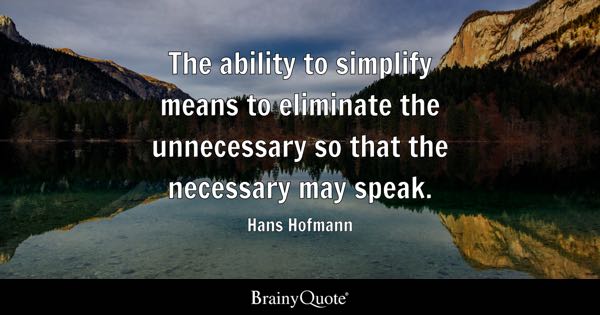
Image credit: [5]

When I was wrapping up at work before leaving town, my coworkers encouraged me to rest and relax. I tried to explain that it wasn’t that kind of vacation, and that people can often leave Pennsic more exhausted than when they arrived. Nevertheless, after spending several days in a more focused, intentional way, I can say that while I’m not feeling more rested, I am feeling more energized. Coming back to work energized and refreshed is certainly a positive in light of the massive to-do list that has continued to mount in my absence, but as I transition back to the office, more screen time, and less physical activity, it will be critical for me to remember that I can’t do it all – and that I shouldn’t try.
Wasting Energy
I like to believe (as I think many of us do) that it is theoretically possible to do everything that needs to get done, if only we can manage our time effectively. Success is tied to productivity, and a lack of productivity indicates some kind of personal failure. The ability to multitask is listed as a necessary trait in the workplace and often worn as a badge of honor, especially among those balancing careers and families. But multitasking is, in fact, an incredibly inefficient use of brain power and has even been described as “the best way to fail at multiple things at once.” [6]
The human brain uses a lot of energy – proportionally much more than other vertebrate brains. In fact, the common saying that we only use about 10% of our brains comes from the fact that we only use about that much at once – it would be inefficient from an energy standpoint to use much more. [7] About 80% of our brain volume is made up of our cerebral cortex, the outermost layer of the brain, which is responsible for functions related to memory, thinking, learning, reasoning, problem-solving, and emotions. [8] We are running all of these functions with a finite amount of energy (which is limited by our calorie intake), meaning that we can only do so much of anything at one time.
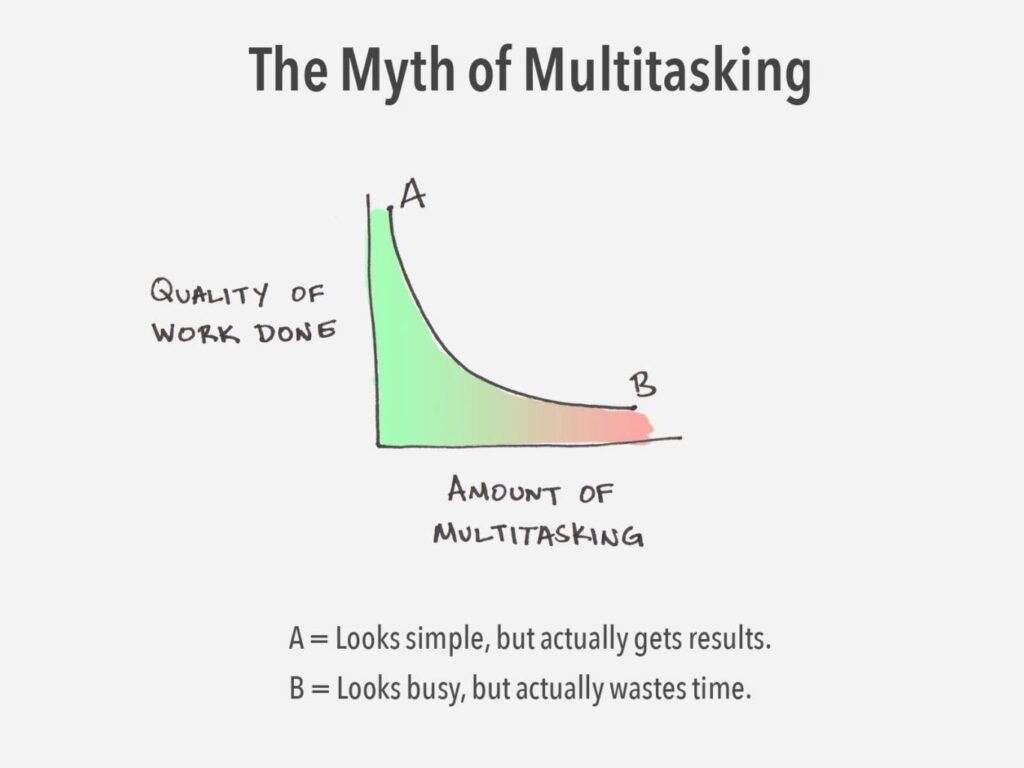
Image credit: [9]
Furthermore, it takes time and energy to switch between tasks, and the more often we switch (even if just briefly, e.g. 15 seconds), the more energy our brains have to use to reorient us into the new task. In short: there is a lot of overhead associated with multitasking that could instead be more efficiently applied to the tasks themselves, if those tasks were done sequentially instead of simultaneously. Interestingly (frustratingly, unsurprisingly), many people who believe they are good at multitasking continue to believe they are good at multitasking, even despite evidence to the contrary. [10]
Simplify, Simplify, Simplify
But it’s not just the risk of inefficient use of brain power – there is evidence demonstrating that with increased multitasking, we are more likely to be distracted by irrelevant information and less likely to be capable of analytical reasoning. [11] Using my brain is how I bring value to my work, how I will leave the world a better place, and how I derive joy from my life. The thought that I might not be using it effectively or that I might be letting certain skills atrophy – simply by trying to do more for more people – is a frightening one. We present-day humans are actively limiting our own capabilities by believing we can continue to do more if we just try harder, instead of acknowledging the finite nature of our own available time and energy.
As I return to modern day and a mile-long to-do list that is already giving me anxiety, it seems that what is necessary right now – for all of us – is a paradigm shift that recognizes the fallacy of our assumptions that 1) we can get it all done through efficiency, and 2) if we don’t, it’s a result of some kind of personal failure on our part. I regularly shame myself for not accomplishing more throughout the day, despite the fact that I spend time every morning identifying priorities, sticking to them as best I can, and reminding myself that not everything will get done. These deeply-ingrained cultural norms are exacerbated by our growing social media addiction, which beckons us to multitask while we’re working, relaxing, or interacting with other human beings face-to-face. (I absolutely did it at Pennsic – texting anecdotes to my husband, who was at home in the air conditioning.)
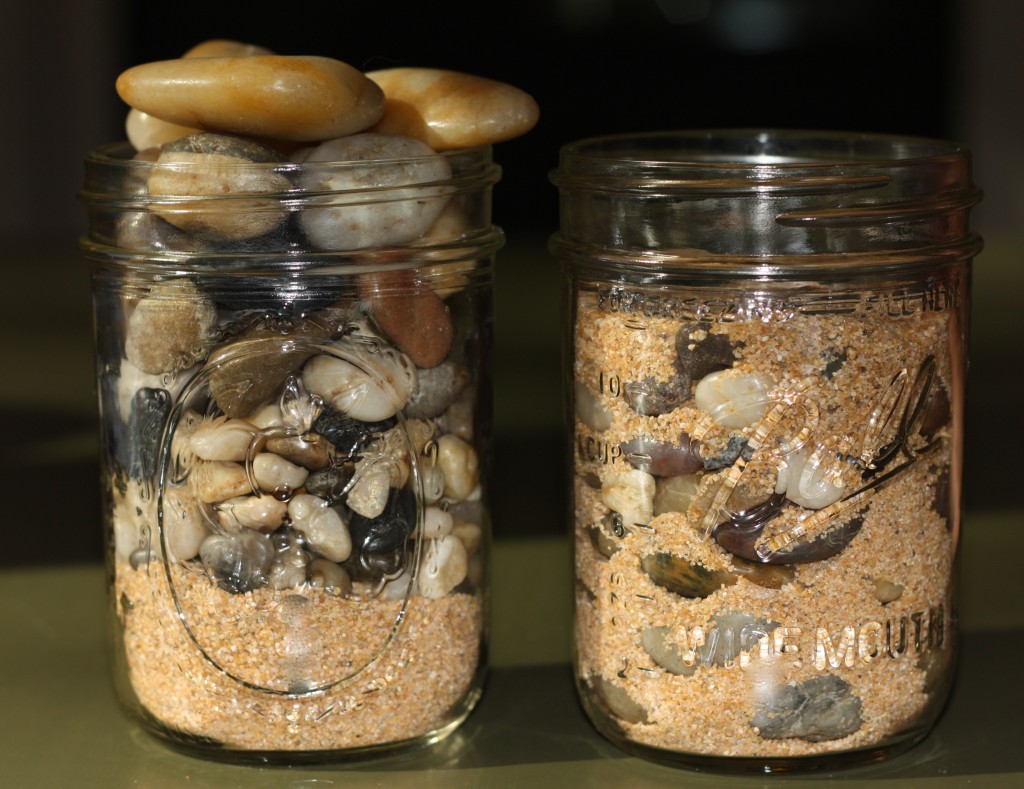
Image credit: [12]
Things I have done to counteract my distractibility over the last few years include meditating (even for just five minutes before work) and blocking off time for monotasking sessions in 30 to 90-minute chunks (of course, the trick is that you have to stick to it and not let yourself get pulled into something else). Certainly, taking time to do those things means that other things won’t get done, which results in a greater desire to multitask and get more accomplished in the time remaining (e.g. reading the news while exercising, listening to podcasts while cooking). And there will always be situations in which multitasking cannot be avoided, such as working in an office, restaurant, classroom, or at home with kids – but finding opportunities for monotasking and ensuring you take advantage of them (I believe, based on my own experience) will help keep us sharper at other times when we are forced to be in more places at once.
A Note on Accountability
Ever since I did my digital detox over two years ago and removed most notification functionality from my phone, I’ve been much happier, but some friends and family have expressed frustration with the fact that I can be difficult to contact at times (especially during the work day, but also if I’m engaged in a project for several hours, such as weeding, cooking, sewing, or writing.) I love interacting with my friends and family, but I think I view my interactions with them as the pebbles or sand that fill in around the rocks in Stephen Covey’s time management analogy. [13] The big rocks are the big to-do list priorities, but sometimes I feel like I can’t get to the pebbles or sand because I’m too busy crushing additional big rocks to fit them in the jar. The moral of the story is that I need fewer (or smaller) rocks… and if I remove one, I shouldn’t replace it with something else.
It’s all well and good for me to dispense unsolicited advice through my blog, but I often do that because I need to hear it too. What the past week has made clear to me is that if balance is the goal, I’m still not achieving it (yet). If I want time with friends, I need to schedule it; if I want time to myself, I need to schedule (and respect) it. But in order to schedule that time, some other things will need to move down (or off) my priority list. There will always be more people and things asking for my attention, but I need to make peace with the fact that I will sometimes have to say no to them. And I need to realize that not everyone will be happy about that… but that eventually I might be.
~
What challenges have you encountered with time management, priority management, or multitasking? I’d love to hear about your experiences (and tips!) below.
Thanks for reading!
[1] https://en.wikipedia.org/wiki/Pennsic_War
[2] https://radicalmoderate.online/do-your-best-do-something/
[3] https://radicalmoderate.online/the-greatest-productivity-hack-part-3/
[4] https://radicalmoderate.online/the-three-day-effect-part-1/
[5] https://www.brainyquote.com/photos_tr/en/h/hanshofmann/107805/hanshofmann1.jpg
[6] https://www.thezenteacher.com/one-thing-at-a-time/
[7] https://thereader.mitpress.mit.edu/how-multitasking-drains-your-brain/
[8] https://my.clevelandclinic.org/health/articles/23073-cerebral-cortex
[9] https://www.anokhilife.com/health-and-wellness-bad-for-the-brain-stop-the-multitasking-madness/
[10] https://thereader.mitpress.mit.edu/how-multitasking-drains-your-brain/
[11] http://www.pbs.org/wgbh/pages/frontline/digitalnation/interviews/nass.html
0 Comments