Part 2 – Out of the Frying Pan
As I covered in last week’s post, [1] I try to do my best when it comes to minimizing my environmental impact. I’d probably be happier in some ways if I just didn’t pay attention to the negative repercussions of nearly everything I do, but I just can’t look away when I feel like I can do better for the planet. As a result, I often wind up in a place of analysis paralysis, unsure what the best course of action is after weighing my options… and then, exhausted and discouraged, I inevitably do something that makes me feel better, even if it’s not what I would consider “sustainable” in a given situation… like eating a piece of cheese… or a lot of cheese.
I recognize that I’m justifying a lot of my behavior in this series, but I have never claimed to be perfect, and I still feel like I try to do what I can inside an imperfect system. I have also never been one of “those” vegetarians who actively lectures others about their dietary choices – because I recognize how complex and, ultimately, personal our food choices are… and that those choices can change over time – mine certainly do as I learn new things, challenge my assumptions, and broaden my perspectives.
Less is More
It’s interesting to observe the evolving research about our food and how we might reduce related impacts through various technological advancements and farming practices. That certainly doesn’t get us off the hook when it comes to eating animal products, but it does make for interesting reading. For instance, studies have indicated that adding seaweed to a cow’s diet reduces how much methane they produce. Researchers at the University of New Hampshire examined various factors including methane reduction, cow health, product quality, and local ecosystem impacts of growing the seaweed, and discovered that “when fed to dairy cows in small amounts (0.5% of their dry food diet), red seaweed (Chondrus crispus) reduced methane emissions by 12% … and did not effect [sic] milk production or quality (amount of milk fat or protein).” [2]
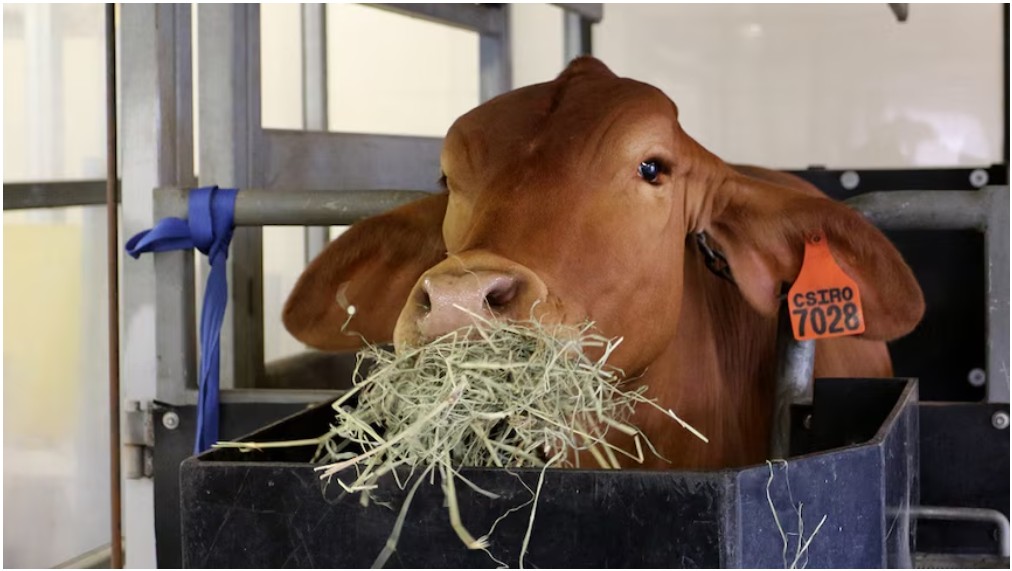
Image credit: [3]
Using numbers I examined several years ago for my Community Supported Agriculture series, a 12% reduction in methane emissions from the cows themselves would bring the full lifecycle carbon footprint of one kg of cheese from 21.2 kg CO2-equivalent to 19.6 kg CO2-e. Some recent studies claim up to 90% methane reduction; in that case, we would be looking at 9.4 kg CO2-e per kg of cow cheese. That is an impressive reduction, and I don’t want to minimize that discovery… but, for reference – and to my point in last week’s post – that would still leave cheese with a higher carbon footprint per unit weight than pork and poultry. [4]
According to Clarity and Leadership for Environmental Awareness and Research (CLEAR) at UC Davis, it sounds like seaweed supplements won’t make enough of a difference to meaningfully impact climate change, especially since most cows on earth don’t eat a managed diet every day. Other less-feasible suggested approaches include securing masks and backpacks to cows to capture the methane, but that sounds even less affordable or cow-friendly. [5] In short, there appears to be no silver bullet solution to the problem… except perhaps the one I’ve mentioned many times before in multiple contexts on this blog: reducing consumption.
I’m the last person on earth who would want to give up cheese, but I have made some efforts to eat less of it over the years. [6] For the record, plans that involve me actively trying to eat less of anything never turn out well because the forbidden item becomes the focus of my attention, and I usually end up eating more of it instead. The best results I’ve had in reducing my dairy intake have actually come from committing to making a certain number of vegan meals every week. In that case, my mind is focused on what I have (not what I don’t), and the vegan food displaces what dairy I might have eaten during a given meal. It’s not perfect, but it’s better.
R-E-S-P-E-C-T
And what better – after a lengthy two-part series focusing on the negative environmental impact of cheese – than trying a recipe that puts my favorite one front and center? Hypocritical, perhaps, but I will say that as I try to reduce my consumption of certain foods, when I do have them, I want to do them justice in the kitchen. I have seen perfectly good ingredients (including meat, for which an animal gave its life) absolutely ruined by someone who doesn’t know what they’re doing, and I have wasted plenty of ingredients myself thanks to my own ignorance. For that reason, if we’re going to cook with cheese, let’s do right by it and prevent disaster through science.
Image credit: [7]
The iconic Roman dish of cacio e pepe is simple, not easy. If you’ve ever tried to make it at home, you may have experienced a certain level of frustration with this “double black diamond” dish parading as a “green circle.” If you don’t have the kitchen experience of an Italian grandmother, you flirt with disaster every time you toss your expensive and patiently-grated pecorino romano with pasta right out of the pot. A recent scientific study (yes, you read that right) examined what factors contribute to a stringy, clumpy cacio e pepe instead of a smooth and creamy one. [8]
The first factor is the difficulty of mixing cheese and water. Starch helps as an emulsifying agent, so starchier pasta water (but not too starchy – we need to consider the taste!) supports this process – and that means having the right ratio of water to pasta in the pot. The second factor is the temperature in the pan. When the heat is too high, it denatures the proteins in the cheese, causing them to stick together. In this case, the temperature needs to be low and slow (something that is far easier to achieve on my new induction cooktop than on our old electric resistance range! [9])
The third factor, unmentioned in the article, but a simple reality from making it at home, is that it takes a lot of upper body strength and patience to make this dish. Grating your own cheese and grinding your own pepper is exhausting and takes seemingly forever, which is another reason I don’t make it often. Yes, you could use pre-grated cheese and pre-ground pepper, but you won’t wind up with as good a final result, as both will impact flavor and sauce consistency. The time and effort required to make it the best dish you possibly can certainly limits how often you may want to attempt it (and the quantity you make!), but I would argue that those factors make it more special, too.
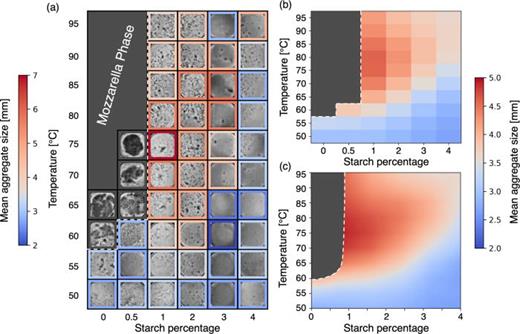
Image credit: [10]
Recipe: Cacio e Pepe
I’ve made cacio e pepe the traditional way with varying results over the last few years, but I simply don’t have enough experience to cook by intuition instead of measurements, and I often wind up with a clumpy, stringy mess that sticks to the pan. For that reason, I was curious about this allegedly foolproof recipe based on chemistry. Although the authors’ departures from certain traditional methods made me bristle, the allure of food science was too strong, and I had to try it. The recipe, published in Physics of Fluids, serves “two hungry people.” [11] (I supplemented the process described in the article with information from a traditional recipe [12] and from our pasta making class in Italy. [13])
Pasta:
- 300g (10.5 oz) pasta (Bronze-cut, please – it has a rougher texture, which allows the pasta to hold more sauce.)
- 2.5 liters (⅔ gallon) water (The ideal ratio we learned in our pasta making class is 1 gallon of water and 1 Tbs of salt for every 1 pound of pasta.)
- 2 tsp salt (Or use more if you want – it’s supposed to be “as salty as the sea.”)
Sauce:
- 200g (7 oz) cheese (Traditional recipes have 100% DOP pecorino romano, but some modern chefs use up to 30% parmigiano reggiano, as we see in the Rome episode of Stanley Tucci’s show [14])
- 5g potato or corn starch dissolved in 50g of water, heated until it thickens and turns from cloudy to nearly clear (It is less traditional but more foolproof to mix it yourself than trying to achieve the correct starch content in the pasta water.)
- 100g cool water
- 2 Tbs freshly ground black pepper, toasted (That is a lot of pepper – fair warning.)
Heat pasta water and add salt once it boils, add pasta and cook to al dente (or 2 minutes less than the package instructions for Americans.) Reserve some of the pasta water before draining and set aside.
Grind peppercorns and toast them briefly in a large pan (you’ll be adding the pasta to this pan later).
Combine corn starch with 50g water and heat until clear and thick. Add 100g water to cool and mix thoroughly. Add cheese and starch mixture to blender; blend until smooth.
After draining the pasta, let it cool for up to a minute (longer for more than 1kg of pasta) in the pan with the pepper, tossing to cool it faster. Toss with the cheese sauce, adding reserved pasta water as needed (probably about 1 c) to achieve the right consistency.
Refrigerate any leftovers and reheat in a pan with pasta water.
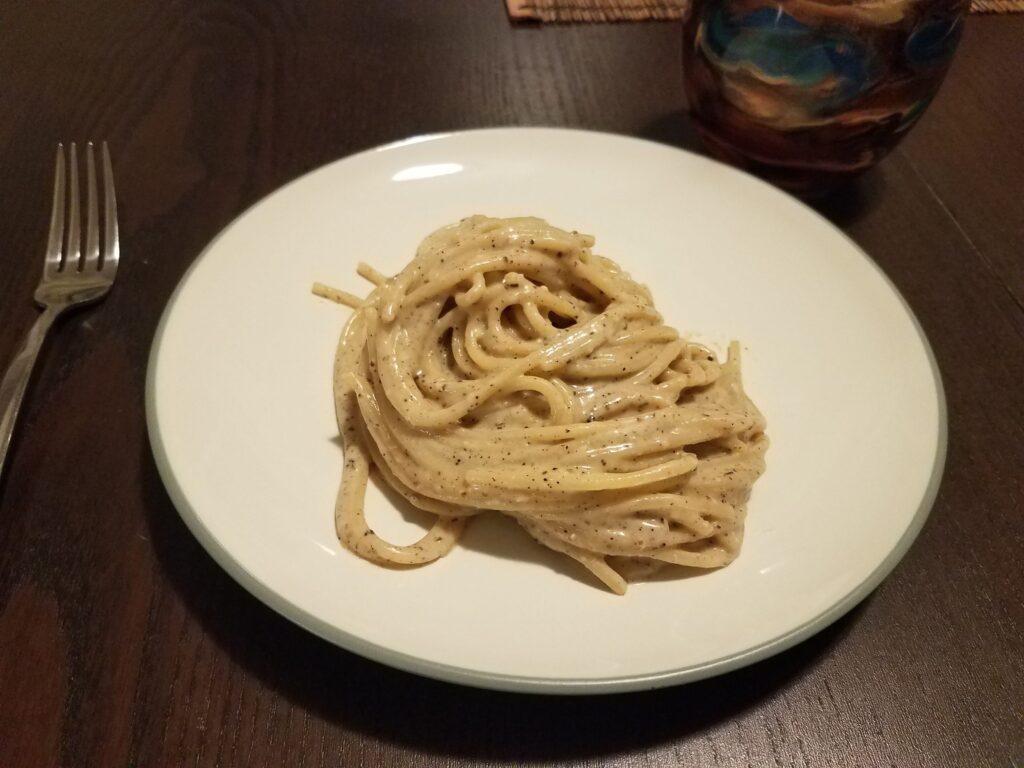
It has been a while since I’ve made cacio e pepe because it has always been a bit of a pain. I will say that this batch was made far easier by grinding the pepper in a coffee grinder instead of by hand and by mixing the cheese in an upright blender instead of grating it all with a microplane. I attempted to use an immersion blender, as was instructed in the journal article, and wound up with chunky sauce both in the pan and around my kitchen; I will definitely use the upright blender in the future.
If you don’t eat it all at once, it will require periodic additions of starchy pasta water to keep the sauce from congealing, but I was very pleased with the sauce’s consistency when it received proper attention. And reheating leftovers in a pan with pasta water the next day worked shockingly well – something that is also not a given for this dish.
The small serving I had was intense – more so than I remembered, including anything I’ve previously made and what I had on my first night in Italy years ago. I might recommend reducing the amount of pepper and/or using a full pound of pasta if you’re trying this recipe for the first time. This version was delicious, but it was so decadent that I can’t possibly imagine eating it on a regular basis, even though I’ve waxed poetic about my love of pecorino in this series and started this post believing that an easier cacio e pepe recipe could make the dish a weeknight staple in our house. No. I’m going to love it from afar and and enjoy it intermittently.
~
So there you have it: a cheese dish to end all cheese dishes for someone who loves cheese but is trying to eat less of it. I’ve never said the words “too much cheese,” but I feel like I’m close to it after that meal.
Maybe next time we’ll explore a vegan recipe. (Aglio e olio, anyone?)
Thanks for reading!
[2] https://colsa.unh.edu/resource/effects-red-seaweed-milk-production-methane-emissions
[4] https://radicalmoderate.online/community-supported-agriculture-part-2/
[5] https://clear.ucdavis.edu/explainers/why-do-cattle-produce-methane-and-what-can-we-do-about-it
[6] https://radicalmoderate.online/vegan-january-part-1/
[7] https://in.pinterest.com/pin/407153622557825283/
[8] https://www.sciencedaily.com/releases/2025/04/250429112831.htm
[9] https://radicalmoderate.online/now-youre-cooking-with-magnets/
[10] https://pubs.aip.org/aip/pof/article/37/4/044122/3345324/Phase-behavior-of-Cacio-e-Pepe-sauce
[11] https://pubs.aip.org/aip/pof/article/37/4/044122/3345324/Phase-behavior-of-Cacio-e-Pepe-sauce
[13] https://radicalmoderate.online/tuscan-agriturismo/
[14] https://www.imdb.com/title/tt13918516/?ref_=ttep_ep_2
0 Comments