Part 1 – Lies, Damn Lies, and Statistics
We know that cows are gassy and contribute to climate change. We also consume a lot of them and their products. (I may or may not be eating cheese while writing this post.) For me, I experience a struggle between trying to make responsible decisions and trying to find little moments of delight in an increasingly un-delightful world. And cheese poses a particular challenge for me as a problematic object of desire.
Chamber of Secrets
Ruminant animals, most notably cows, are prolific methane producers because of how they digest their food. They have chambered stomachs, which allow them to extract maximum nutrition from plant materials with high fiber and low nutrients, such as grasses. In short, they eat, digest, regurgitate, chew, and then redigest, breaking down the material and pulling nutrients and moisture from it at different stages of the process. [1] The first (and largest) stomach chamber is an environment for anaerobic fermentation. And we know that anaerobic decomposition creates methane. (One of the biggest downsides of my backyard compost bin is that I am lazy and don’t turn it enough to maintain aerobic decomposition. [2])
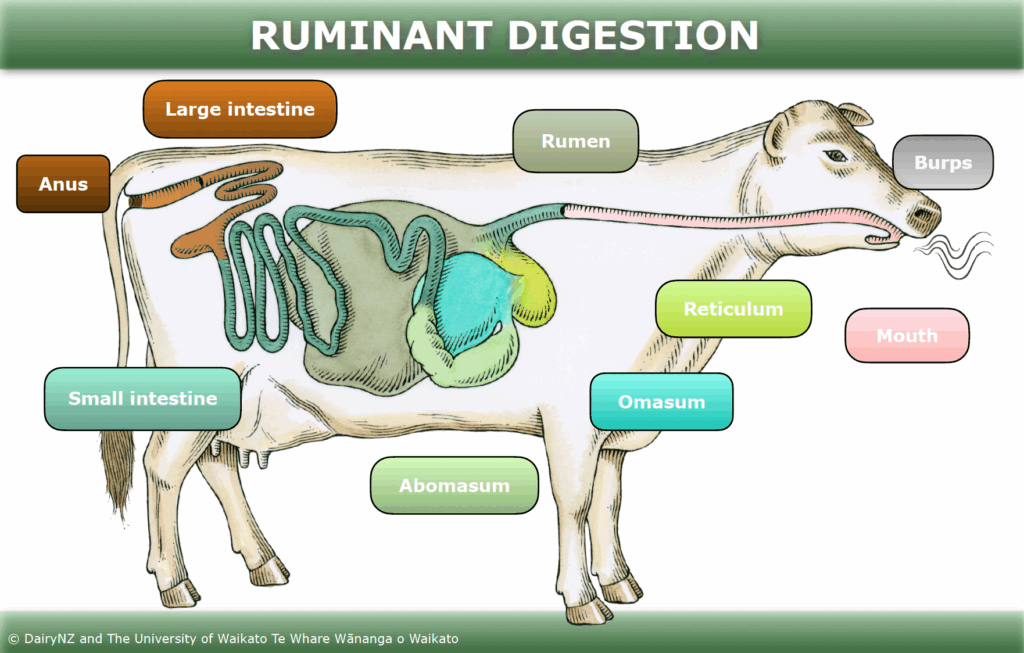
Image credit: [3]
Ruminant livestock can release 250-500L of methane per day, and over the next 50-100 years, methane from ruminants is expected to be responsible for about 2% of climate change. [4] In fact, livestock for food products contributes about 25% of the United States’ methane emissions today. [5] This methane production is a significant component of why meat and cheese produced by ruminant animals represent such high carbon footprints. [6]
For some reason I didn’t think sheep and goats were ruminant animals, like cows. I was wrong: they both are. Years ago when I first looked into the carbon footprints of different foods, I read that non-ruminant cheese was better for the environment but didn’t taste as good, which made no sense to me because pecorino and feta to be amazingly flavorful (and there’s a reason for that: sheep and goats have chambered stomachs.) It turns out that the only non-ruminant cheeses I’ve ever had are buffalo mozzarella (which is notably mild and made from water buffalo – not buffalo – milk) and yak cheese (which was on a four-cheese pizza in Nepal, so I couldn’t actually tell you what it tasted like amid the other, stronger flavors).
That incorrect assumption also led me to erroneously believe that pecorino romano was better for the environment than parmigiano reggiano. [7] Again, I was wrong, but for a time it was a wonderful justification for using what could be considered excessive amounts of pecorino since we got back from Italy three years ago. It is wonderfully sharp and salty, and it adds more flavor than parmigiano – to the point that we’ve pretty much stopped using the latter. (Discovering bags of pre-grated pecorino at Sam’s Club has only made matters worse.)
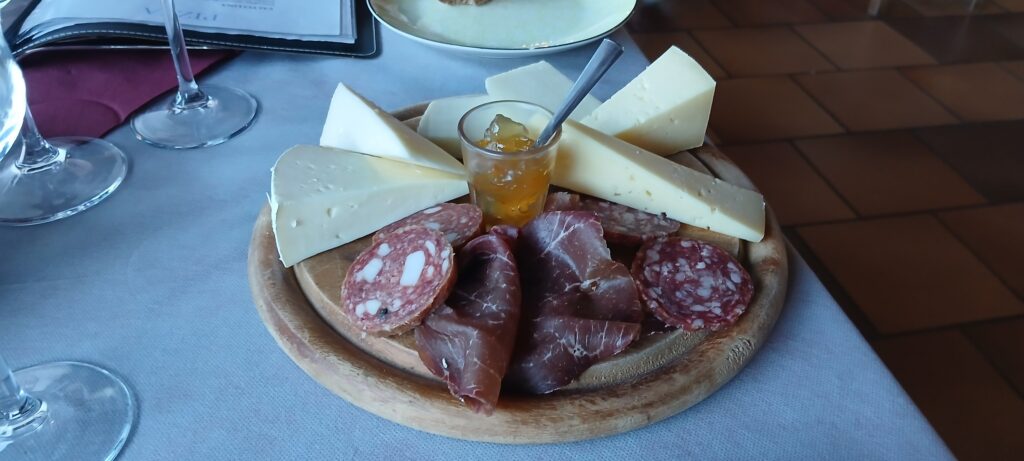
Photo credit: Christian Korey
One food critic on Epicurious complained about the overuse of pecorino with the following description: “I felt pecorino’s knife-like bite, its musky punch, stab me in my tongue, my cheeks, the delicate roof of my mouth. It was a sharpness that was akin to being screamed at. Man up! pecorino seemed to be screaming. The pain is where the flavor is!” [8] I don’t need that kind of culinary edgelord negativity in my life; I need pecorino.
#TeamPecorino?
It is a fact that sheep produce less methane overall than cows. Dairy cows averaged just under 200L of methane emissions per day in one experiment, while sheep averaged about 25L of methane. It would be reasonable to assume, then, that sheep have less of an impact on the environment than cows. Indeed, beef production contributes 60kg of CO2-equivalent greenhouse gases to the atmosphere per kilogram of meat, while lamb or mutton contributes about 24kg CO2-e per kilogram of meat. The major difference between the two is from the more intense changes to land use for cattle farming and more sizable methane production associated with cattle digesting their food. [9]

Because of those facts, I think it was a reasonable assumption to believe that cow cheese has a higher carbon footprint than sheep cheese. However, here’s the catch: sheep emit almost twice as much methane as cows per liter of milk produced – cows are just more efficient in their digestive process. [10] But, it also takes more milk from a cow (9.5 liters or 2.5 gallons) to make 1 kg (or 2.2 lbs) of cheese, compared to how much milk is needed from a sheep (5.7 liters or 1.5 gallons) to produce 1kg of cheese. [11] All in all, it appears that cow’s cheese and sheep’s cheese come out about the same, or at least close enough to make no significant difference (according to research from MTT Agrifood Research Finland that is referenced in a Slate article but otherwise unfindable in a brief internet search). [12]
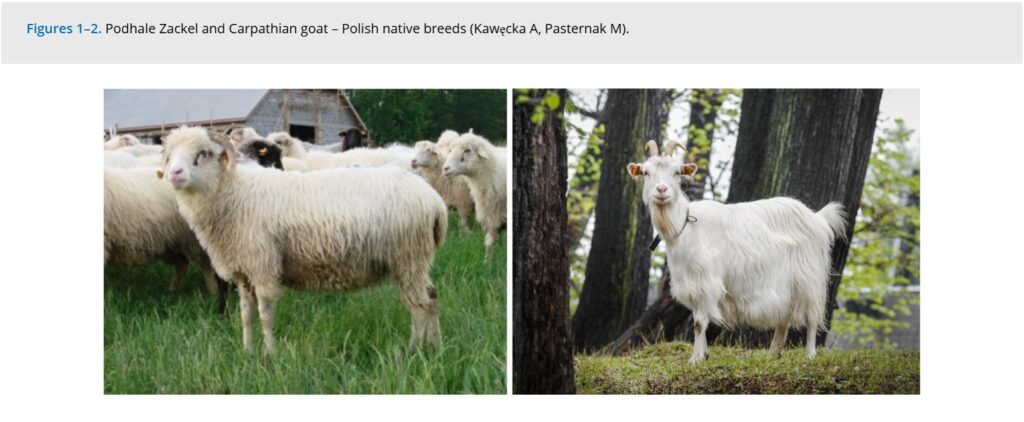
Image credit: [13]
In other words, both cow and sheep cheeses are bad from a carbon footprint standpoint to start with, but the amount of milk needed to make 1kg of cheese increases for harder cheeses, which have lower and lower moisture content the longer they age. Furthermore, storing hard cheeses while they age (sometimes for multiple years) also increases their environmental impact because of the energy required to keep them at the ideal temperature.
Personal Decisions
I’ve known it for years (since I wrote my blog series on Community Supported Agriculture) that cheese is worse for the environment (per unit weight) than some meats, including pork, poultry, and fish. The key to putting those numbers in context is consumption: some might argue that one could eat a half pound of chicken but not a half pound of cheese. (My response to that would be that they’ve never seen me eat cheese… especially in Italy.)
But, ultimately, if someone’s reason for becoming vegetarian is reducing their carbon footprint, that argument really only holds up when it comes to eliminating beef, possibly sheep. If environmental impact is the argument, then veganism is a much more meaningful step than cutting out all meat and keeping the cheese. The numbers get a lot fuzzier when comparing cheese and lower-impact meats (plus factoring in how much someone might be eating of each), and one could easily argue that it would be more beneficial from a greenhouse gas standpoint to stop eating cow and sheep products (meats and cheeses), while still consuming poultry and fish.

Image credit: [14]

For the record, this tangent is not a thinly-veiled effort on my part to justify eating meat again. In fact, I have really never liked the taste of meat, and I didn’t miss it when I stopped eating it. My reasons for being vegetarian are many, including animal welfare considerations, but it was interesting (and saddening) to learn that, with the clear exception of beef, the environmental angle for vegetarianism (as compared to veganism) simply isn’t as solid as I originally believed.
The “animal welfare” angle is on legitimately shaky ground too, when you consider 1) farming and milking practices at large factory farms and 2) any cheese that contains rennet, a substance found in the fourth chamber of a ruminant stomach rich in enzymes that coagulates milk in the cheesemaking process. [15] I have known about rennet for several years , but didn’t have the courage to research it in any great detail. I was not surprised to learn that the animal has to be dead for the rennet to be harvested, but I think it’s important to note that the animals are slaughtered for meat, and the rennet would be discarded as a waste product if there wasn’t a demand for it. [16] (Consequently, my argument for eating rennet is similar to my argument for wearing leather. [17])
~
We’ll leave it there for now, but there is more important food-science content to come next week, including possible methods for reducing cheese-related methane at the source and showing proper respect to the pecorino in your kitchen.
Until then, how do you feel about cheese, and would you give it up, reduce your consumption, or change what kind you buy for environmental reasons? I’d love to hear your thoughts below.
Thanks for reading!
[1] https://en.wikipedia.org/wiki/Ruminant
[2] https://radicalmoderate.online/real-vs-plastic-christmas-trees-part-3/
[3] https://www.sciencelearn.org.nz/resources/3023-ruminant-digestion
[4] https://pubmed.ncbi.nlm.nih.gov/8567486/
[5] https://colsa.unh.edu/resource/effects-red-seaweed-milk-production-methane-emissions
[6] https://radicalmoderate.online/community-supported-agriculture-part-2/
[7] https://radicalmoderate.online/may-feast/
[8] https://www.epicurious.com/ingredients/why-parmesan-is-better-than-pecorino-cheese-article
[10] https://slate.com/technology/2009/12/what-s-the-environmental-impact-of-cheese.html
[11] https://cheeseorigin.com/how-much-milk-for-cheesemaking/
[12] https://slate.com/technology/2009/12/what-s-the-environmental-impact-of-cheese.html
[13] https://www.tandfonline.com/doi/full/10.1080/09712119.2021.2020125#d1e280
[14] https://media1.tenor.com/m/wy67pl5ZWg8AAAAd/blessed-are-the-cheesemakers-life-of-brian.gif
[15] https://ingredients.saccosystem.com/en/rennet-lets-find-out-together-what-it-is/
[16] https://ingredients.saccosystem.com/en/rennet-lets-find-out-together-what-it-is/
[17] https://radicalmoderate.online/leather-a-good-or-bad-choice/
1 Comment
Ian · October 28, 2025 at 4:30 am
I would give up cheese for environmental reasons, but not ice cream. I would, in fact, go ovo-pescatarian with no cheese.