Part 2 – Around the World in 21 Days
This post contains spoilers for The Ministry for the Future, by Kim Stanley Robinson.
The world we live in is different today than it was even six years ago… Christian and I spent a month in Japan in early 2020 while I was in between jobs, and I interviewed for my current job on my cell phone using a virtual meeting platform I had never heard of before: Zoom. The COVID-19 pandemic spurred remote working technology to evolve so quickly that six weeks after my interview, I was leading my organization’s efforts exclusively from my guest bedroom at home – and would be for the next 15 months.
Technological advances that limit the necessity for work travel have been a boon for those of us with already-packed schedules and concerns about our carbon footprint. In the nearly six years I’ve been in my role, I don’t think I’ve traveled farther than a four-hour drive from Pittsburgh, and there is still one team member I haven’t actually met in person. But work travel still happens across many different industries because there are some things you just need to see and do in person… and such is the case with personal travel as well.
Planes, Trains, and Automobiles
As I said in last week’s post, [1] airplane trips are most likely the biggest component of my carbon footprint. I try to minimize it when possible (opting for road trips or ferries instead of short-haul flights), but it is practically necessary for someone who wants to travel the world. I’ve written before about offsetting my carbon footprint with donations to carbon reduction programs, [2] but there really is no substitute for just not using that energy in the first place. In that vein, I do know people who have simply decided not to travel (or to travel significantly less) in order to reduce their impacts on the planet, and I respect the shit out of those people.
Christian and I have really made the road trip our preferred approach to vacations, seeing multiple states, [3] regions, [4] or countries [5] in one longer-format trip instead of several shorter ones, which might necessitate more flights. But, again, if my calculations in last week’s post are anywhere near accurate, my airline travel is way above the average American’s and represents about 20% of the energy I use. Unfortunately, practical, climate-friendly alternatives don’t really exist, unless you can and want to take two weeks for a one-way Atlantic crossing in a racing yacht, as Greta Thunberg has done. [6]
Now, in Kim Stanley Robinson’s book The Ministry for the Future, [7] the people of planet Earth don’t have much of a choice. The airplane industry is brought to an end at the hands of eco-terrorists who take down fossil fuel powered aircraft (and their passengers) mid-flight, while sparing low- and zero-emission crafts, such as airships. Subsequently, the airship industry grows and partially fills the gap left by airplanes, but this imposed shift results in a more systemic change as to how and when we humans travel, rather than a one-for-one substitution. The book’s main character Mary Murphy even starts dating an airship captain by the end of the story, a man whom she gets to know during a long, low-emission, tourist voyage to observe wildlife across remote areas.
The Once and Future Tech
Airships as a form of transport experienced their heyday about a century ago, after restrictions on German construction (put in place by the Treaty of Versailles) were lifted in 1926. The resulting large-scale zeppelins designed for long-haul luxury travel saw roughly a decade of prominence, carrying passengers around the world at speeds greater than travel by ocean liner. Graf Zeppelin (the most famous airship of its time) could make a transatlantic trip in 2-3 days, at a top speed of 80 miles per hour. Twenty passengers rode in Graf Zeppelin’s 98’ x 20’ gondola on the bottom of the ship during the journey, spending their time in a lounge / dining area or in private sitting / sleeping berths. The cost of a one-way ticket was about $400 in the 1930s, roughly the cost of a new car at the time, or about $8,000 today, adjusted for inflation. (Based on a quick internet search, that seems to be about twice the current cost of a first-class airplane ticket from New York to London; travel time approximately 7 hours.)

At 775 feet long, Graf Zeppelin stayed aloft thanks to 3.7 million cubic feet of hydrogen contained in bags inside its rigid metal structure, making it about three times the size of a modern commercial blimp. It moved forward along its path through the use of five 550-horsepower gas engines attached to the outside of the structure. In a 1929 demonstration of its capabilities, Graf Zeppelin circumnavigated the globe in 21 days, with stops in Tokyo, Los Angeles, Lakehurst, NJ, and its home of Friedrichshafen, Germany. [8]
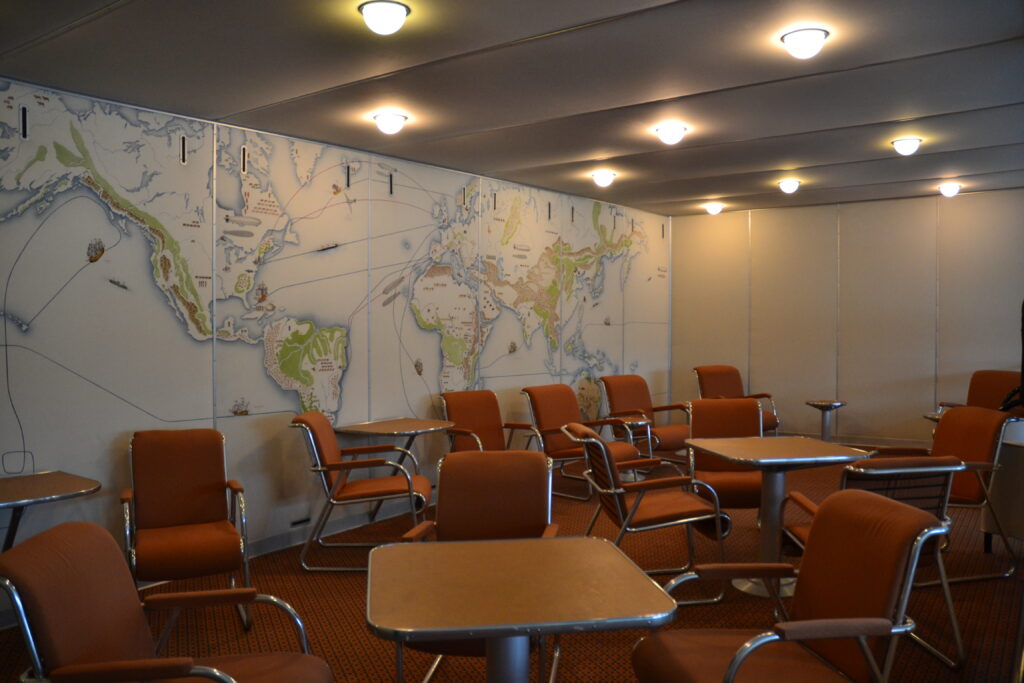
Once we knew we would be visiting friends near Friedrichshafen on our five-country road trip last fall, I excitedly booked us for a sightseeing tour on a zeppelin. [9] I had been warned that the flights were not cheap (on the order of $800 per ticket for a one-hour tour), and that about one third of them do not even launch due to unfavorable weather conditions. Nevertheless, I figured we wouldn’t get another chance, and I imagined myself traveling like the well-heeled elite of a century ago and/or like the eco-conscious heroes of a popular “cli-fi” book set just a few decades in the future. On the morning of our flight, the weather was bad, so we didn’t get to sightsee around Lake Constance from above. We instead spent that time at Friedrichshafen’s excellent zeppelin museum, [10] where we toured a replica of Hindenburg’s gondola. Given the fate of the world’s most infamous airship, I was not going to complain about a grounded zeppelin (even if ours was filled with helium).
Everything Looks Perfect from Far Away
The disaster of the Hindenburg in May 1937 effectively brought a swift end to the era of airship travel. Although Graf Zeppelin II was intended to stay aloft with helium, the US government did not want to supply the gas to Germany due to concerns that Germany would use the craft for military purposes – a legitimate concern. With so many advancements to airplane technology during World War II, they quickly became the preferred mode of air transport moving forward. With that shift, the value for travelers started to shift as well: the mode of travel was no longer part of the experience but a method of conveyance whose time should be minimized so the vacation at the destination could begin as quickly as possible.

Image credit: [11]
In The Ministry for the Future, Mary Murphy doesn’t have a choice of vehicle when she has to travel from Switzerland to California for work: airplanes are no longer an option, but work culture has shifted to accommodate the new realities of the world. She spends several days working remotely from a WiFi-enabled airship until she gets to her destination and the meetings she has to attend there. I, for one, think I would enjoy that approach to travel, though I absolutely recognize the privilege that comes with being able to choose a slower form of transport and “just work remotely” during that time. Not everyone can do that… or afford what would probably still be exorbitantly expensive tickets.
With that said, there are companies developing helium-filled airships for short-haul travel. England basically exited the airship stage after a devastating crash in 1930 that killed many of the country’s top engineers, [12] but Hybrid Air Vehicles, based in the UK is rethinking air travel with their Airlander, a type of aircraft that blends technologies for airplanes and airships, with low-emission travel. [13] Proponents of airships have touted them as low-carbon alternatives to planes, especially for cargo that doesn’t need to move quickly (e.g. freight) or must go to places that lack airport infrastructure (e.g. aid deliveries). Some companies, such as Airlander, are even looking at passenger transport for shorter distances (i.e. those that wouldn’t require sleeping quarters).
The current claim is that airships could operate with one tenth of the impact of an airplane traveling the same distance, which is an exciting concept, especially for anyone who can spare the time. However, it is incredibly important to remember that carbon footprint doesn’t just come from the operation of the vehicle but in its construction as well – and getting enough helium to put an airship in the sky is a costly endeavor. Helium is most commonly acquired by chilling fossil gas (a.k.a. natural gas) and separating out the helium as other gases turn to liquid. I was unable to find estimates on how much energy is required to isolate helium through cryogenic distillation other than the very unhelpful “a lot.” But I will once again remind readers that there is always a cost, and it appears that – at least given current technology – the cost of helium-based airships includes a continued dependence on the oil and gas industry. [14]
~
It is not my intent to burst any bubbles here – just to raise awareness and encourage us all to consider where there may be a gap between the bigger-picture view and what we’re told. If we understand the true cost of our choices, I believe we will make those choices more responsibly… or at least more intentionally. But either way, for now, we’re stuck with airplanes for long trips – and that’s where we’ll pick up next week: with a fascinating piece of tech that has made transcontinental travel just a little bit easier on this traveler.
Thanks for reading!
[1] https://radicalmoderate.online/ministry-for-the-future-part-1/
[2] https://radicalmoderate.online/the-real-cost-of-travel/
[3] https://radicalmoderate.online/the-30-year-nostalgia-cycle/
[4] https://radicalmoderate.online/truffle-hog/
[5] https://radicalmoderate.online/krampus-and-kipferln-german-traditions-at-christmas-part-1/
[6] https://en.wikipedia.org/wiki/Transatlantic_voyages_of_Greta_Thunberg
[7] https://www.goodreads.com/book/show/50998056-the-ministry-for-the-future
[8] https://www.worldhistory.org/article/2752/the-transatlantic-zeppelins/
[9] https://zeppelinflug.de/en/zeppelin-flights
[10] https://www.zeppelin-museum.de/
[12] https://www.worldhistory.org/article/2752/the-transatlantic-zeppelins/
0 Comments