It’s because of “Pulp Fiction”: any time I travel to a new country, I go to McDonald’s. My husband (who rolls his eyes every single time) can just go ahead and blame Quentin Tarantino. The opening scene of Tarantino’s 1994 tale of crime involves two hitmen discussing the French name for McDonald’s quarter-pounder with cheese: the “Royale with cheese” … so-named because of Europe’s use of the metric system. [1] Alternately, my husband can blame my high school friend Mike, who dragged a bunch of us to McDonald’s during an orchestra trip in Puerto Rico to see if there was a “Royal con queso.”
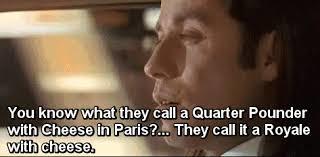
Image credit: [2]
Spoiler alert: Puerto Rico is part of the United States, so imperial units are not a foreign concept, as they are in many parts of Europe – and, as such, their McDonald’s locations did not require a rebrand of one of their signature menu items. But, nevertheless, that quirky pilgrimage was in the books and would eventually become a tradition once I did more traveling on my own in later years. As far as my memory serves, I have visited a McDonald’s in nearly every country I’ve ever been to. It’s no longer a nod to Tarantino’s best movie but rather because of my fascination with the interplay of business and culture.
Trust is Built with Consistency
For the record, I don’t eat a lot of fast food in America, and I am not one of “those” tourists who goes abroad only to eat from familiar chain restaurants. I still, however, often contend with looks of bewilderment and disgust whenever I tell anyone that McDonald’s is a must on my travel itinerary. My reasons are as follows: as someone who has studied anthropology and business, I am always excited to see how the menu of one of the planet’s most prolific and consistent brands changes by country, as a nod to varying cuisines, palates, and even religions in its host countries.
McDonald’s trades on its consistency. Years ago I heard Michael Pollan speak about his book The Omnivore’s Dilemma (which is now 20 years old!) [3] In part of his talk, he described how McDonald’s only used one type of potato – the Russet Burbank – for its fries in order to create the exact product it wanted: long, crispy fries with high starch and low moisture content. He warned about the extent to which McDonald’s was dominating the potato market, buying something like 7% of potatoes in the US and demanding that specific variety, which is also prone to several diseases (including late blight, [4] cause of the Irish Potato Famine. [5]) Obviously Pollan is not a fan of monocultures caused by the need for uniform products across large food chains.
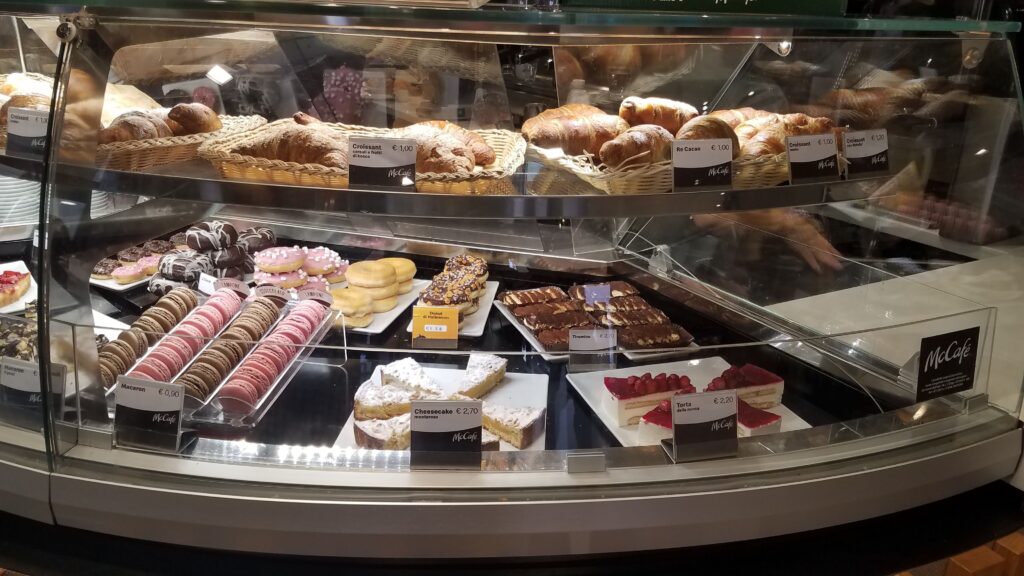
But like it or not, McDonald’s global success is due in part to such strict control over its products and supply chains – and maintaining consistency across 68 million orders in 119 countries every day is no small feat. [6] The company works with thousands of suppliers [7] and maintains strict control over quality standards for each food component, which they are able to do through vertical integration of their supply chain. [8] Food prep and portioning take place at centralized distribution hubs, [9] making use of industrial standard ISO 9001:2015, which oversees processes to ensure consistency in meeting consumer, regulatory, and organizational requirements. [10] From a business standpoint, the global machine created by this one company is fascinating.
Variety is the Spice of Life
Unfortunately, it’s not possible to meet these requirements everywhere: Iceland had three McDonald’s locations, but they closed in 2009 after it became prohibitively expensive to import the specific ingredients and meet the exacting standards for the menu items in the wake of the 2008 financial crisis. [11] (I was in Iceland for grad school in 2011 and sadly missed my chance.) But when it works, it works: when I lived in Japan and got homesick, I would drive half an hour to the closest McDonald’s (or “maku-do”) and order myself a cheeseburger (without meat), fries, and a Coke – and it tasted just like it did back home. I can – and have – done the same thing in several countries, amazed each time by the similarities in taste. But I don’t eat at McDonald’s abroad to see how similar it is to home; I go to see what is different.
In catering to local culinary traditions, food preferences, and even religious observations, McDonald’s creates signature menu items in different countries around the world – and I love getting to see what entices the locals into an American chain that many Americans disdain. In the course of my travels, some of the more interesting menu items I’ve encountered have included…
- a veggie burger (my first fast food veggie burger) in Germany when I was in grad school – it was nothing special by today’s standards, but just its existence was literally something to write home about
- a spicy paneer wrap in India
- bubble tea in South Korea
- a literal cup of corn kernels at the Olympic Village in Beijing
- stuffed olives (well, Christian had those because they contained meat), as well as pastries and espresso in Italy
- a concerningly realistic vegetarian “fried chicken” sandwich in Liechtenstein, which we didn’t find in any neighboring countries during our Fall 2025 road trip (…nor can I find any evidence of it online – I swear I’m not making it up: I have photos!)
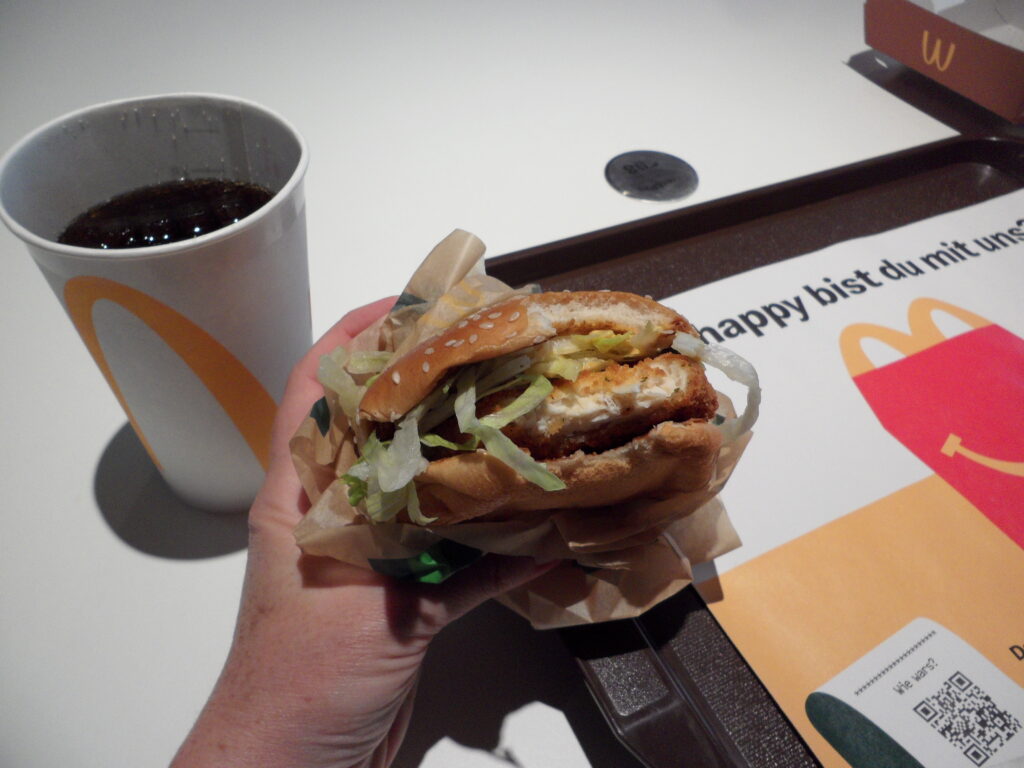
Going into a European McDonald’s simply feels like an elevated experience compared to the United States. Christian was predictably appalled when I suggested that we eat our one meal in Liechtenstein (during an afternoon jaunt across the border from Switzerland) at the one McDonald’s in the country. But the internet reviews (mostly written by Americans) praise its cleanliness and the quality of its food, noting fresh, local ingredients. [12] It’s clearly not seen as a low-class venue by locals, either: when we pulled into the parking lot, we stowed our shitty little Seat Arona across from a $250k Mercedes-Maybach and already knew we were in a different world.
You Are What You Eat
McDonald’s has its own standards for food quality, but Europe’s are far more stringent. You’ll know it’s McDonald’s when you eat it, but it just tastes better… and I’m not the only one who claims to feel better after eating it, compared to after eating the American analog. We visited multiple expat friends while in Germany and heard multiple times how much better their bodies deal with food in Europe in general, even when eating foods that were problematic for them back home. They largely credit the European Union’s stricter regulatory environment regarding food.
The EU frequently makes use of the Precautionary Principle, an approach for harm reduction that emphasizes caution with substances that have unclear or possibly harmful impacts on the human body. [13] While the EU often bans substances with questionable safety records, we take more of an “innocent until proven guilty” approach in the US, with information about health harms sometimes coming to light and leading to regulatory changes only after those harms have been observed in the consumer population. For example, the EU bans certain preservatives that the US does not and has stricter limits on pesticides and growth hormones than we do here. [14]
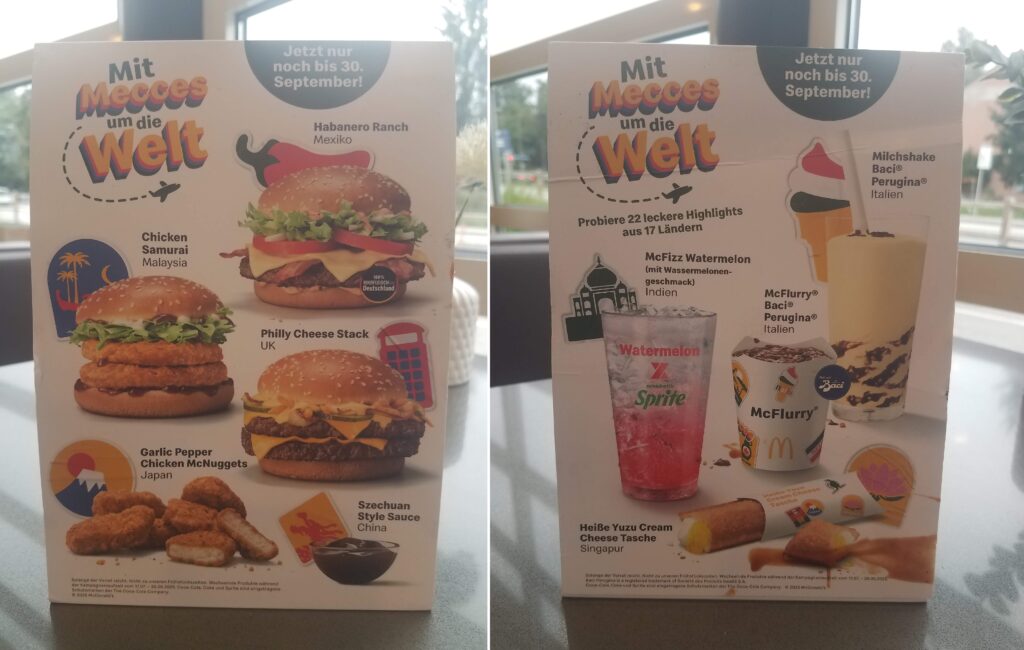
The EU also emphasizes fresh, whole ingredients, smaller portion sizes, and lower sugar content in foods, which is about all there is in common with the recent dietary guidelines released by the US Departments of Agriculture and Health and Human Services. [15] Those facts alone make it ironic that some of the healthiest places to get iconic American food… are outside America. But for those in America (specifically near Chicago) looking for some international flair on your golden arches, there is one McDonald’s location that offers a rotating global menu, highlighting foods from around the world. [16] And I’ll definitely be dragging Christian there the next time we’re in Chicago.
~
McDonald’s: love it or hate it? Have you tried it abroad? If so, what did you get and what did you think? I’d love to hear about it below.
Thanks for reading!
[1] https://www.imdb.com/title/tt0110912/
[2] https://knowyourmeme.com/photos/2045322-pulp-fiction
[3] https://www.goodreads.com/book/show/3109.The_Omnivore_s_Dilemma
[4] https://inspection.canada.ca/en/plant-health/potatoes/potato-varieties/russet-burbank
[5] https://en.wikipedia.org/wiki/Great_Famine_(Ireland)
[6] https://en.wikipedia.org/wiki/International_availability_of_McDonald’s_products
[7] https://www.food-safety.com/articles/4639-mcdonalds-usa-a-golden-arch-of-supply-chain-food-safety
[8] https://www.flytotheworld.org/blog/z7dw6g7ngxn2jmkxble2g2y8skhxxz
[9] https://www.joneselitelogistics.com/blog/how-mcdonalds-ensures-freshness-across-millions-of-orders/
[10] https://stratmatters.wordpress.com/2019/11/26/quality-management-of-mcdonalds/
[11] http://news.bbc.co.uk/2/hi/8327185.stm
[13] https://en.wikipedia.org/wiki/Precautionary_principle
[14] https://choosenow.eu/en/2025/03/05/comparison-of-eu-and-us-food-quality-control/
[15] https://hsph.harvard.edu/news/understanding-the-new-dietary-guidelines-for-americans/
[16] https://www.foodandwine.com/mcdonalds-global-menu-restaurant-chicago-8728683
0 Comments