It’s the time of year when holiday greens come down, [1] candles burn to remind us of light returning to the world, [2] and animals give clues as to whether we’re nearing the end of winter. [3] Following medieval superstition (and a desire to keep my marriage intact), our Christmas tree is now out of the house, along with any other greenery… but I was not about to wade through a foot of snow to and brave a 5-degree windchill to dig out the garlands on our porch railing and lamppost. (We may get goblins in them, but at least they’re outside. In any case, I’m sure those goblins need shelter in this weather, too.)
The paired holidays of Imbolc and Candlemas mark the halfway point between the winter solstice and the spring equinox, and it’s the time when we start to notice changes in the light. The body’s clock is very sensitive to light levels, with some people more sensitive than others (me especially [4]). Whether it’s a change in the seasons or a change in time zones, our bodies do react. I used to laugh at people who talked about getting jet lag from crossing one or two time zones, but there is evidence that even shifting one hour to or from Daylight Savings Time has an impact, with more traffic accidents and workplace injuries occurring after that shift than other days of the year. [5]
Jet Lag
While the shift between seasons is more gradual (aside from the jarring one-hour adjustment two nights/year), changing time zones can be particularly rough. When I lived in Japan (almost 20 years ago) and flew back and forth more frequently, I would stay up all night before my flight (packing, because I’d left it until the last minute) to exhaust myself enough that I could sleep on the plane and get a jump start on switching my sleep cycle for a 13- or 14-hour time change. Basically, if I took off from Newark around 2 in the afternoon on a Friday, I’d land in Tokyo around 2 in the afternoon on a Saturday, after a 12-hour flight. (That was disorienting enough, but flying in the other direction, I might take off at 2 in the afternoon on a Friday and land at noon the same day.)

Of course, my approach of pre-flight sleep deprivation didn’t always work, and it would still take several days to adjust, despite the fact that I was significantly younger and had comparably more energy. These days I make use of my SAD lamp [6] and a bottle of melatonin to accelerate the adjustment. (Other tips include staying hydrated, limiting alcohol and caffeine consumption, and getting physical activity during and after the flight. [7]) But there’s another new piece of technology to support a shift in circadian rhythm that was as unexpected as it was welcome on two recent trips: for both our trip to Europe this past fall and Japan the year before [8], Christian and I flew on the Boeing 787 Dreamliner, which has lighting and window design to help ease you into sleep on the flight. [9]
I can’t say we were exactly clamoring to fly on a Boeing, given their recent record, [10] but flying is still statistically the safest form of travel, with 0.003 deaths per 100 million passenger miles (though, those numbers are prior to the Trump administration taking steps to undermine safety oversight in the airline industry. [11]) Boeing’s issues are systemic and can be tracked across decades; [12] they are not new, though may be exacerbated by the Trump administration’s rollback of regulations – and that made me uncharacteristically nervous to be in the air whenever we were in a Boeing. With that said, we had safe, smooth, and quiet rides each time. (FYI, after some of the recent Boeing incidents, some booking sites started allowing customers to de-select certain types of aircraft when buying airline tickets. I have absolutely used that feature.)
A Tangent on “Efficiency”
I would be remiss if I wrote a post on this blog about air travel and didn’t mention the massive carbon footprint it represents. [13] It is also an unfortunate truth that we as consumers are led to believe that we can get ourselves out of the climate crisis by substituting more efficient products, rather than fundamentally changing our behavior. I haven’t looked into much detail about the plane’s construction (this post is supposed to be about circadian rhythm, after all), but it feels like some of their most basic claims don’t hold up under light questioning.
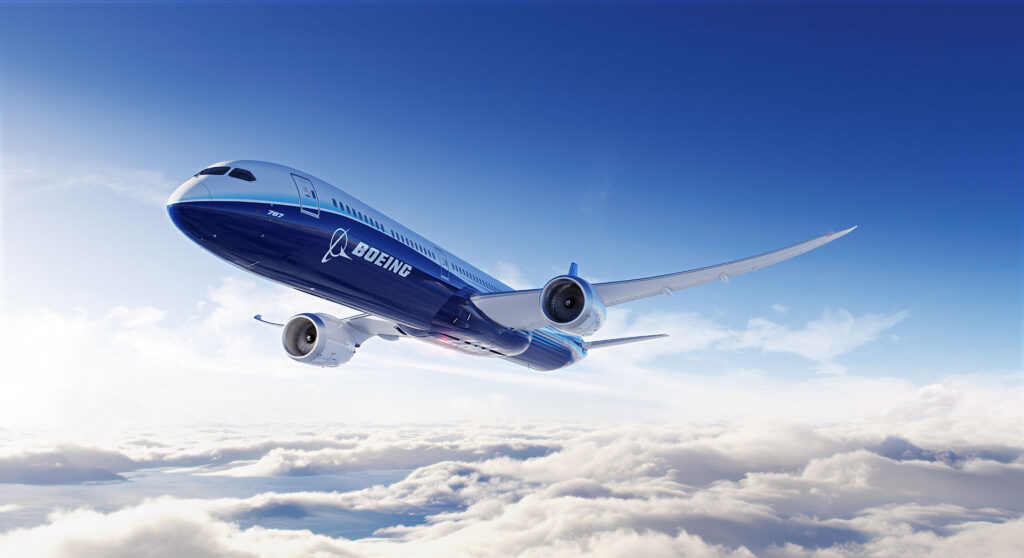
Image credit: [14]
The Dreamliner incorporates a lot of components that are purported to make the plane lighter, more flexible and durable, and more aerodynamic (improving fuel efficiency). Their website says their planes are made up of 50% composites by weight, making them lighter than traditional metal airplanes, which saves fuel. I’d love to know more about the life cycle of these products, because I would imagine that the process of creating the composites in the first place is pretty energy intensive, and their end-of-life options are limited outside of landfilling.
I will note that some companies talk about thermal and chemical “recycling” options for carbon fiber composites, [15] but those appear to be similar to energy-intensive processes involving high temperatures and/or toxic solvents that still haven’t been made safe or scalable for recycling plastic consumer products, let alone airplane components. Furthermore, these technologies often don’t represent closed-loop recycling, but rather a depolymerization of plastic that produces oil that can then be burned for fuel instead of making new plastic. [16]) It would be fascinating to see where the balance point is in these “more efficient” planes given the energy used to make the product vs. the energy saved while using it. (Is there, indeed, a net benefit? Someone should get on that!)
Lights Out
But looking specifically at passenger experience, the Dreamliner includes smart tech to identify and counteract gusts of wind to reduce noise and turbulence, allowing passengers to largely forget where they are. I will say that all four of the flights we took in a Dreamliner were relatively smooth, and it wasn’t until reading about the gust alleviation system for this blog post that it even occurred to me how smooth an experience we’d had because I hadn’t thought of it at the time. (I find I’m more likely to notice turbulence than the absence of it.) And some of the other things that made this ride better as a passenger were also things that were difficult to notice at the time.
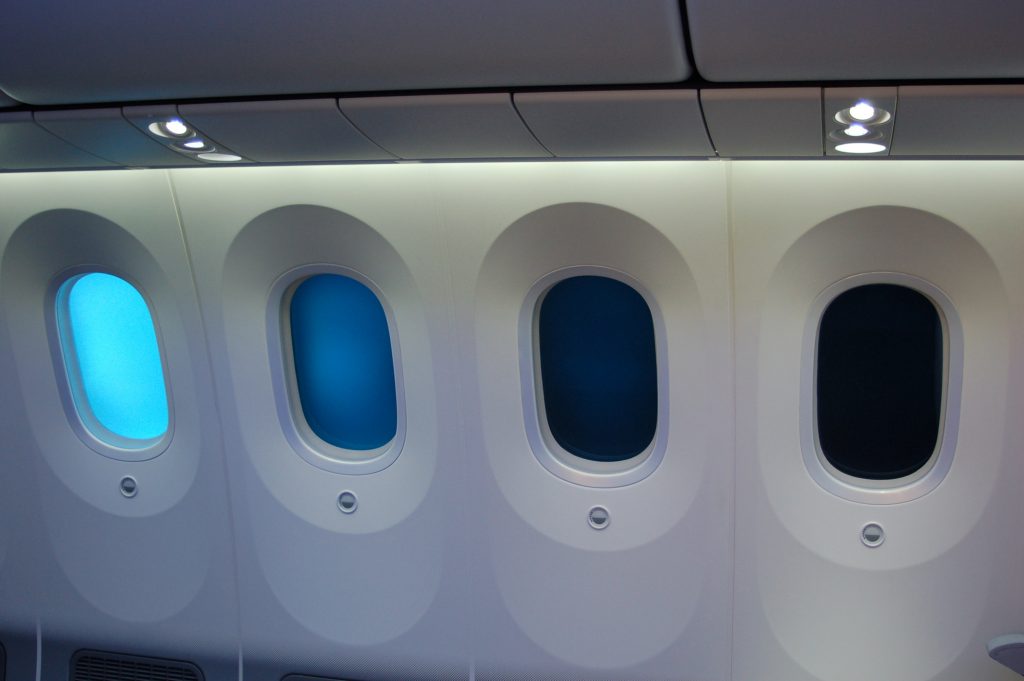
Image credit: [17]
The cabin pressure is set to feel like you’re sitting at a lower altitude (6,000 ft instead of the more common 8,000 ft), and the humidity is higher – both of those things increase comfort and reduce fatigue. Cabin lighting slowly shifts brightness and color temperature when going from light to dark and vice versa, simulating sunset and sunrise, respectively. As someone with a sunrise alarm clock, [18] I can attest to the fact that subtle light signals can be a much more welcome introduction to the day.
The thing I didn’t notice until long into our first flight on this plane was that all the windows were black, as though it was night out, even though we were chasing the sun to Japan and wouldn’t see night at any point during the flight. Making use of an electrochromic gel that undergoes a chemical reaction when voltage is applied, [19] all of the cabin windows slowly become more opaque as the whole plane shifts its lighting to “nighttime.” The reverse happens on approach to the destination. And that trick to make my brain think it was night worked on me like I was a baby bird. I barely saw any of the three Christopher Nolan movies I cycled through on that flight.
It’s a shorter trip across the Atlantic, but I still got to experience several hours of shut-eye, aided by this circadian tech this past fall when flying to and from Italy. It was enough to make me grateful that someone has recognized how sensitive the human body is to light and other stimuli. And those thoughts come to me today as I feel excitement for light coming back to the world at the halfway point of winter, when we already have 10 hours of light a day in Pittsburgh and are just five weeks away from Daylight Savings Time.
~
Have you flown on a Dreamliner? Do you have any tried-and-true jet lag (or seasonal depression) tricks? I’d love to hear about them below.
Thanks for reading!
[1] https://www.english-heritage.org.uk/christmas/leaving-up-christmas-decorations/
[4] https://radicalmoderate.online/fighting-sad-with-blt/
[6] https://www.usa.philips.com/c-p/HF3332_60/golite-blu-energy-light
[7] https://piningforrome.com/how-to-prevent-jet-lag
[8] https://radicalmoderate.online/climate-lab-japan-in-the-classroom/
[9] https://www.boeing.com/commercial/787/by-design
[10] https://www.cnn.com/2024/01/30/business/boeing-history-of-problems
[11] https://theaircurrent.com/aviation-safety/trump-dca-disaster-news-analysis-icao-annex-13/
[13] https://radicalmoderate.online/the-real-cost-of-travel/
[14] https://www.boeing.com/commercial/787/by-design
[15] https://www.fairmat.tech/blog/is-carbon-fiber-recyclable/
[16] https://radicalmoderate.online/plastic-free-july-2024-misnomers-and-monomers/
[18] https://www.usa.philips.com/c-p/HF3650_60/smartsleep-sleep-and-wake-up-light
[19] https://gizmodo.com/how-the-magical-windows-in-boeings-787-dreamliner-work-5829395
0 Comments