Do your best… fail… learn… do better (when you can). That concept feels like it’s following me around – and, speaking as a recovering perfectionist, maybe it’s what I’m here on this planet to practice. (It certainly is at the core of Sustainability…)
Longtime readers of this blog know that I am very much opposed to the boring, unrealistic perfection of the lawn – a chemically maintained monoculture that is the largest and most useless “crop” in America. [1] As a result, I’ve been trying to reduce the size and grass content of our lawn for several years. Unfortunately, while I thought I was doing the right thing, I’m not entirely sure after some recent research. (Of course, as with anything in Sustainability, the “right” thing is dependent upon a lot of competing factors.)
Organic Island
Our yard is surrounded by turf lawns that get maintained by companies that come in and spray some kind of chemical solution aimed at creating a “perfect” lawn. I don’t know the content of what is being sprayed, but I am certain that it is wafting across property lines. As such, I am notorious for standing outside, watching, and (as politely as possible) requesting that the mix of weed killer and fertilizer coming out of the hose get nowhere near the retaining wall separating our property from our neighbor’s. They’ve said it’s “safe,” and my only response is that I’ve heard that before about plenty of things that aren’t (see last week’s post on chemical treatments for termites [2]).
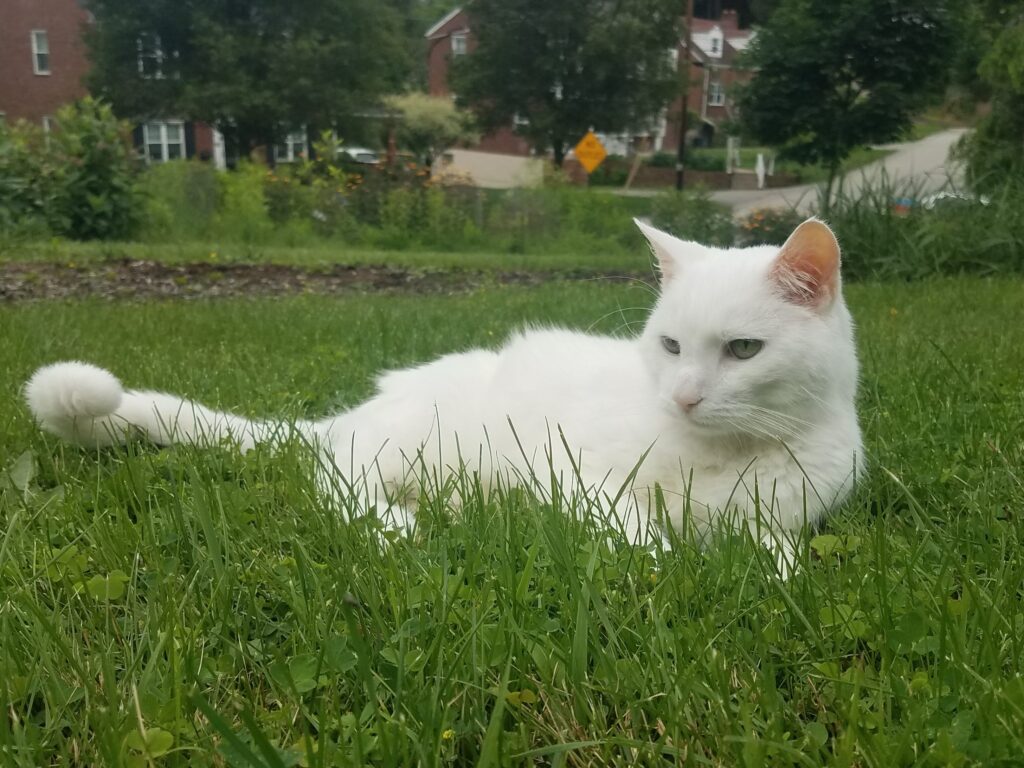
In fact, just this weekend my neighbor was complaining to me about all the weeds in her yard, and how spraying three times over the course of the summer isn’t doing the trick. I tried to politely and cheerfully explain that what she was worried about was clover, which is good for the soil, but she kept insisting “It’s a weed!” It occurred to me later that I could have told her I’m actively sowing it in my yard, but that may have turned into some kind of assumption on her part that my clover was somehow migrating across our retaining wall to her yard.
Indeed, I’ve been sowing clover in my yard for years in hopes of slowly crowding out our turf lawn. And for almost as long, I’ve been lauding its benefits: it’s low-growing, it provides food for pollinators, it improves soil quality by putting nitrogen from the air into the ground, and it doesn’t require a lot of maintenance (e.g. mowing, water, fertilizer, or herbicides). [3] Ideally, I’d love to have an entire lawn made of clover (and/or other low-profile flowering plants) with no grass at all. It is possible, but based on my own experience thus far and some recent research, I believe it would also take a lot of work to rip up the grass and plant something in its place.
Reassessing Clover
Every year I hope my newly germinated clover will simply crowd out the grass in my lawn, I can’t even keep grass out of my garden beds, where I actively remove it, so I’m not exactly holding my breath there. While the grass doesn’t seem to be going away any time soon, I’ve at least got a good mix going between multiple types of clover, creeping charlie, violets, wild strawberries, and some other random plants I don’t know. The most beautiful time to see them all come up is in the spring, before Christian mows the lawn for the first time. On more than one occasion I’ve asked him to wait until I can run outside and get some pictures.
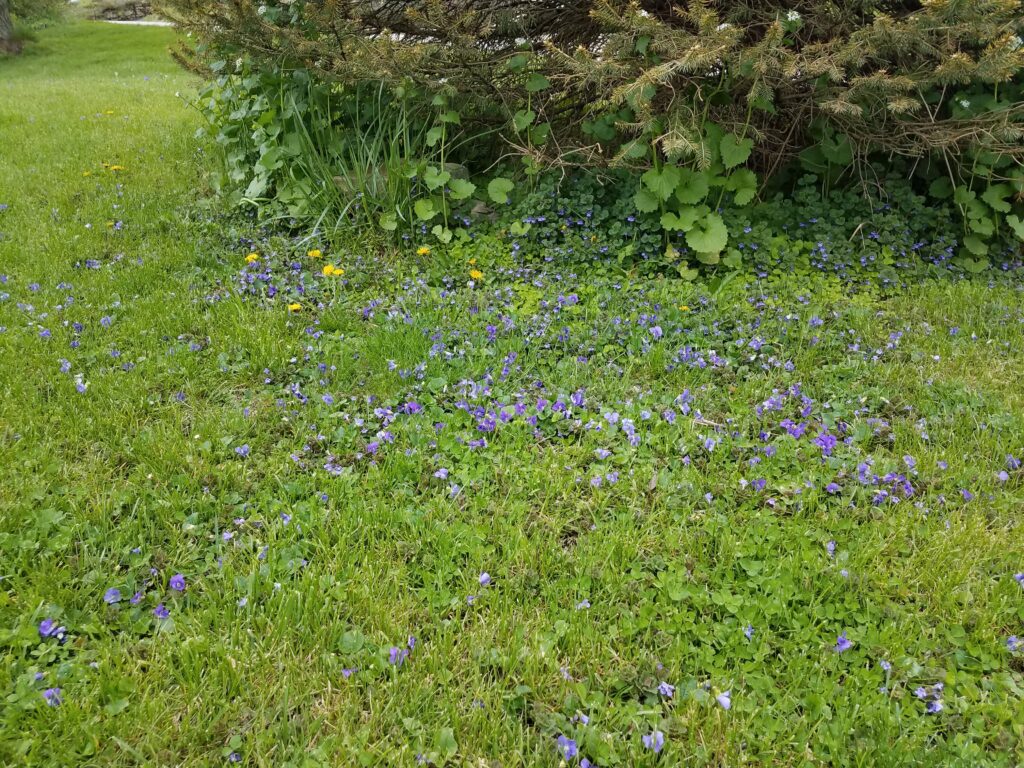
After multiple years of simply scattering seeds and hoping nature would take care of the rest, I finally decided to try following instructions on the clover, which means dethatching the lawn and ensuring the ideal temperature and moisture for four to six weeks. While the weather was even more unpredictable than usual this year, it seems I timed it nicely with the spring rain (which also doubled as the watering I had to do for the nematodes – again, see last week’s post). This year I actually had some success, and we now have clover coming up in places it didn’t before! Unfortunately, my thrill of victory was short-lived once I made a realization that will probably mean that this year is the last time I will be sowing clover in my yard.
Clover isn’t native to North America, which I somehow didn’t realize until I was buying Dutch White Clover seeds this spring. [4] Yes, non-native plants can do a good job at supporting pollinators, but native plants do a better job of that. And yes, honeybees are European, as is clover, so clover is good at supporting honeybees, but there are plenty more native bees that are often ignored in “save the bees” efforts. [5] And for that reason, I started looking into options for native groundcover that can serve as an alternative to turf.
Livin’ on the Sedge
The most common recommendation I saw was some kind of sedge, a cousin of grass in the genus Carex, which requires extremely little maintenance (sometimes as little as one mow a year). [6] There are enough varieties that there seems to be one for every kind of lawn need (sunny, shady, dry, wet), and there are several varieties native to my neck of the woods. In fact, I vaguely remember an account of a couple that was required by their homeowners association to have some lawn (instead of just a pollinator garden), so they planted Pennsylvania sedge instead of a turf grass. There have been many of those fights, and it wasn’t one of the ones I highlighted previously on my blog, [7] so I couldn’t go back and look at the details, but still, the option took root in the back of my head.
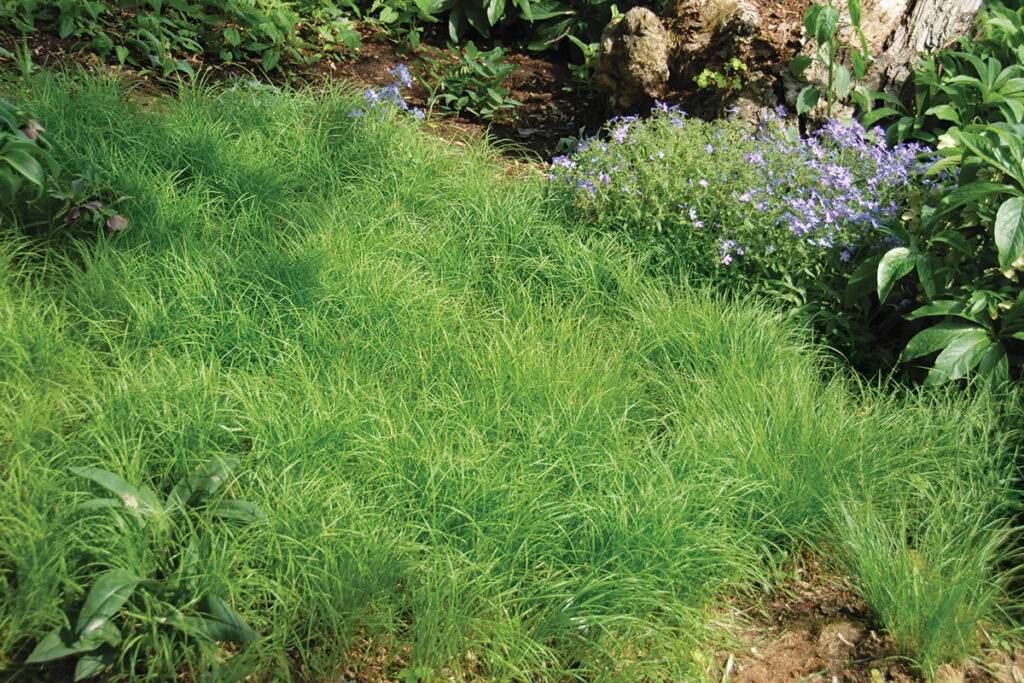
Image credit: [8]
However, from my initial research, it does appear that the only way to transition to a sedge “lawn” is to pull up the old one in its entirety and make sure it is truly dead. One blogger detailing her experience advocated for glyphosate to ensure you get everything, and I bristled. [9] She felt it was well worth the use of glyphosate once or twice to get the longer-term benefit of converting to sedge, but I can’t imagine spraying glyphosate in my yard for any reason, knowing what we know about its impacts on animal life, from humans to bees. [10] I would also worry about disrupting the insects that overwinter in the grass, even if I pulled everything out manually. [11]
I also don’t know if I can justify the massive amount of work that would be required to get rid of our lawn, pulling up thousands of square feet of grass and keeping it gone when I can’t even stay on top of the weeds in my garden. It would probably require taking several months off of work to make it happen, meaning that it probably won’t. While I am intrigued by the concept and the process of converting to a native lawn, sedge will (for now at least) have to remain a “someday” project. Unfortunately, that makes our turf-and-clover lawn a necessary evil, meaning that Christian will have to continue mowing every week, unless he wants to start digging up grass.
Do you have (or have you seen) a sedge lawn or other turf alternative? What did you think? I’d love to hear about it below.
Thanks for reading!
[1] https://grist.org/article/lawns-are-the-no-1-agricultural-crop-in-america-they-need-to-die/
[2] https://radicalmoderate.online/terminator-2/
[3] https://www.americanmeadows.com/content/clover-grass/inspiration/9-reasons-clover-lawn
[4] https://www.americanmeadows.com/category/grass-and-groundcover-seeds/on-sale
[5] https://www.xerces.org/blog/want-to-save-bees-focus-on-habitat-not-honey-bees
[6] https://www.bbg.org/article/sedge_lawns
[7] https://radicalmoderate.online/for-the-birds/
[8] https://www.finegardening.com/article/2-native-sedges-to-replace-your-grass-lawn
[9] https://www.penick.net/digging/?p=23006
[10] https://radicalmoderate.online/roundup-and-glyphosate-part-1/
[11] https://radicalmoderate.online/firefly-festivities/
0 Comments