Part 2 – Looking Forward
On our recent road trip through the Alps, I was surprised to find touches of home in the art and architecture of Switzerland and Austria, even though my family is ostensibly German. It was clear, though, that cultures readily bleed across borders, especially political borders, which are far more fluid than physical borders (such as huge mountain ranges). In last week’s post on the curious Italian province of South Tyrol, [1] I looked at dialects spoken throughout the region, many of them with roots in Romance and Germanic languages, but some of them still distinct to specific valleys in between alpine mountain ranges. [2] It should be no surprise, then, that cuisine has experienced a similar evolution.
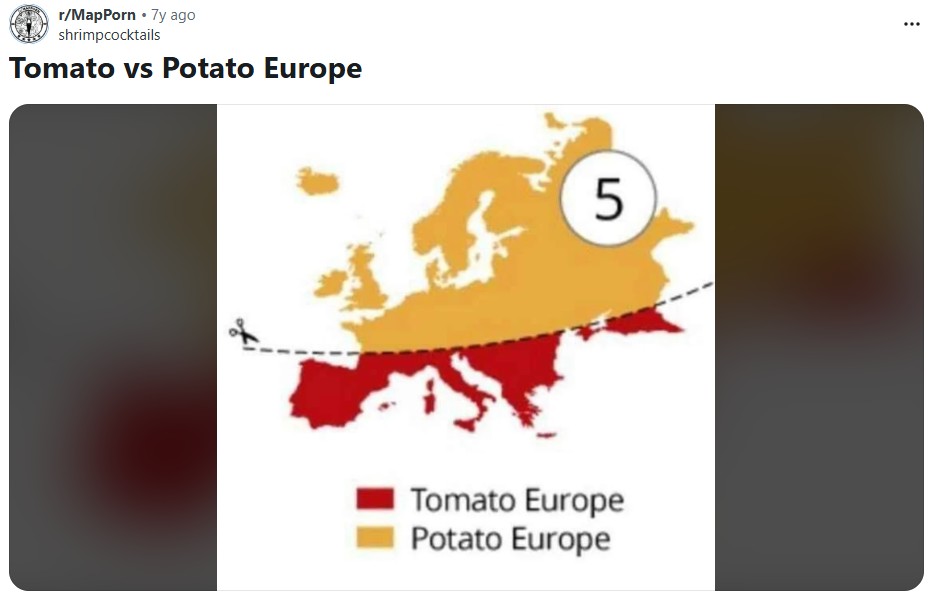
Image credit: [3]
Christian vastly preferred the food south of the Alps in “Tomato Europe,” home to his ancestors. I love Italian food, but there is something about the butter and baked goods of “Potato Europe” that call to me on a cellular level. (For the record, we tried to get Italian food north of the Alps and were disappointed every time – it became quickly apparent that the key to amazing food in Europe is eating locally and using ingredients that thrive nearby.) The changes in weather as we traveled north across the San Bernardino Pass in Switzerland and south across the Brenner Pass from Austria into Italy were stark and uncanny. It was clear how the colder, darker climate makes a real impact on food availability and, thus, a need for cold-hardy ingredients that can be stored for long periods of time.
Buttery Crescent
A friend of mine from high school and her German husband hosted us for a few days in Munich and were gracious enough to cook some authentic food for us, too. Since they both know their way around the kitchen, I was curious to hear what kinds of goodies they liked to bake at Christmas. He started listing several kinds of traditional cookies, and my ears perked up when he said “vanillekipferl,” which is one we make every year in my family. I was genuinely thrilled at that connection across generations and continents, especially since no one in the United States ever seems to know what they are when I talk about them. (Usually people think I’m talking about Hungarian kiffels, which are completely different.)
Once we got home and started heading into baking season, I looked up what I could about the history of this cookie, which had always been described to me as Austrian. A noted – but debunked – origin story for this cookie is that it was developed by bakers in Vienna to celebrate the thwarted invasion of Turks tunneling under the walls of the city during the siege in 1683. The crescent shape was meant to evoke the crescent moon on the Turkish flag. [4] In fact, the term “kipferl” describes the shape, not the contents, of the baked good, [5] and there is evidence of the “kipferl” in Austria dating back to the 13th century. However, although the “kipferl” itself predates the Siege of Vienna [6] it is not a cookie. Descriptions make it sound more like a dense croissant, sometimes filled with nuts (and that sounds like a kiffel.) [7]
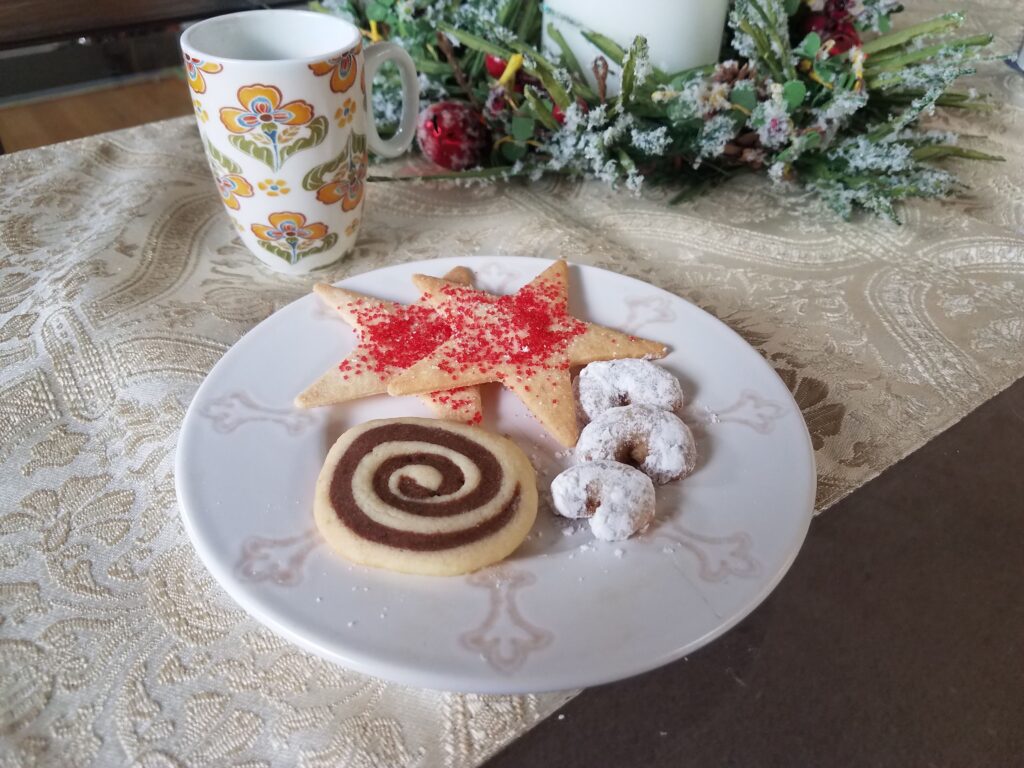
As far as I can tell, only the cookie version is designated by the name “vanillekipferl,” and it is a small, crumbly, butter cookie made with nuts and dusted with powdered sugar. Some southern Germans claim it is originally from southern Germany, [8] but Austria and the Czech Republic claim it as their own as well. My mom told me the cookie was Austrian, which always confused me because she also said we were German. I know now how readily recipes cross borders, but I have a growing suspicion that my own genetic information probably contains bits of Swiss and Austrian blood, and our family simply used “German” as shorthand – but who’s to say? (I could probably get a clearer sense with some genetic testing, but that’s a whole other can of worms I’m not interested in opening right now.)
Ghost of Christmas Past
I have thought a lot about my heritage in recent years. Being the only member of my generation in my family, having decided not to have kids myself, and now having lost my mom (who really was the keeper of our family traditions), I’m starting to grapple with the concept of mortality. When I say that, I’m not really thinking about my own mortality (though I am around the age for a certain type of crisis), but that of my family as a concept. As the last of my line, I’ll be the last to know and appreciate all of the stories, inside jokes, routines, and family lore if I don’t share them. I’m not self-absorbed enough to think that everyone else should stop what they’re doing and justify my family’s experiences, but I do hate the idea of all of these beloved things being lost to time.
The readiness with which a local used book store was prepared to simply throw away a stack of my mom’s old cookbooks really laid bare the impermanence of knowledge stored in physical form, to say nothing of words in a cloud-based blog (among all the other internet ramblings I’ll never read). As the years tick by, it’s not my death that frightens me but the concept of not having left something positive for the world that will outlast me. (Dark concept for a Christmas blog post, perhaps, but also very Dickensian in spirit.) And, no, I don’t think that sharing some family recipes online will address that sense of mortality, but I do think that sharing them is absolutely a symptom of what I’m feeling right now.
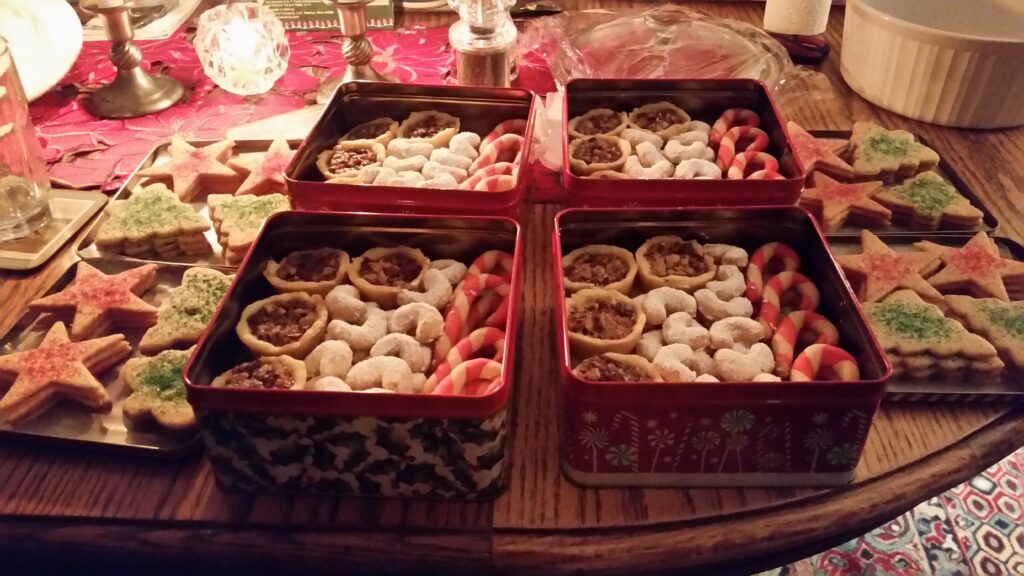
My mom would be the first to share a popular recipe that was already public (i.e. published in a magazine), but she guarded our family recipes closely, lest someone else bring the same thing to a party. Now that I’ve encountered someone else who makes vanillekipferln (not “something like them,” but a version of those cookies specifically) and encountered numerous recipes for them online (paired with fond tidbits from the author’s family history and/or dubious culinary history), I figured there would be no harm in sharing our recipe… and maybe some good. They are, after all, the reported favorite among friends who get my Christmas cookies, and they were wildly popular when I made them for my office party last week.
Recipe: Vanilla Kipferln
The recipe below is what my mom emailed me upon request the first year I lived in Japan and made our Christmas cookies on my own. The instructions are simple enough to be frustrating because she didn’t actually provide things I would consider to be critical details, such as the type of butter, the type of nuts, or the time and temperature for baking. For some reason I never wrote down what she told me whenever I called her (every year) for clarification, but she was never really sure either.
What I did this year was use unsalted butter (which gives the cookies a “more European flavor,” according to my aunt), use roasted but unsalted almonds (which gives the cookies a more toasty flavor), and bake them at 350 F for 10-12 minutes (keeping an eye on them until they’re golden brown). We also make them significantly smaller than other recipes online seem to indicate – about the size of giant cashews, with approximately 100 fitting on a cookie sheet… bite size and guilt free.
10-12 oz. flour
10 1/2 oz. butter
5 oz. almonds, finely chopped
3 1/2 oz. sugar
1 tsp. vanilla
Shape into tiny crescents. When baked, sprinkle with confectioners sugar. Stuff your face.
~
Do you have a similar cookie in your family? What’s in it, and where is it from? I loved hearing those personal tidbits from coworkers at our recent holiday party as they described their family’s equivalent. It helped me feel more connected, recognizing that there are different “culinary dialects” across cultures that maybe aren’t as separated as we think.
Thank you for reading!
[1] https://radicalmoderate.online/krampus-and-kipferln-german-traditions-at-christmas-part-1/
[2] https://en.wikipedia.org/wiki/Ladin_language
[3] https://www.reddit.com/r/MapPorn/comments/awr62k/tomato_vs_potato_europe/
[4] https://www.daringgourmet.com/vanillekipferl-austrian-vanilla-crescent-cookies/
[5] https://ansonmills.com/recipes/610
[6] https://blog.bakewithzing.com/kipferl-to-croissant-history/
[7] https://shunculture.com/article/do-croissants-come-from-austria
[8] https://www.meikepeters.com/blog/vanilla-kipferl-take-over-my-kitchen
0 Comments