Part 1 – Looking Back
The German-speaking world may not have a monopoly on Christmas, but it certainly has a controlling interest. From the Christmas tree, to advent wreaths, to Christmas markets, many modern practices for people who celebrate the holiday (religiously or commercially) can be traced back to Germany. [1] And for people with German heritage, the connection to Christmas can be particularly strong.
I am at least a quarter German (possibly closer to half, if crowd-sourced research on Ancestry.com is to be believed), and there could be bits of Swiss and Austrian in there too, but at this point, who knows? Some of my German ancestors lived in Pennsylvania before it was even a state, and parts of PA are still strong with German roots. (The term “Pennsylvania Dutch,” by the way, has nothing to do with the Netherlands – it was a persistent mispronunciation / misinterpretation of the word “Deutsch,” or German.) My hometown of Bethlehem was founded by German settlers on Christmas Eve in 1741 and is called “The Christmas City.” [2] Every year when I was growing up, my town became a magical place of candlelight concerts, tree lightings, and Christmas markets. Christmas is in my blood as much as my German DNA.
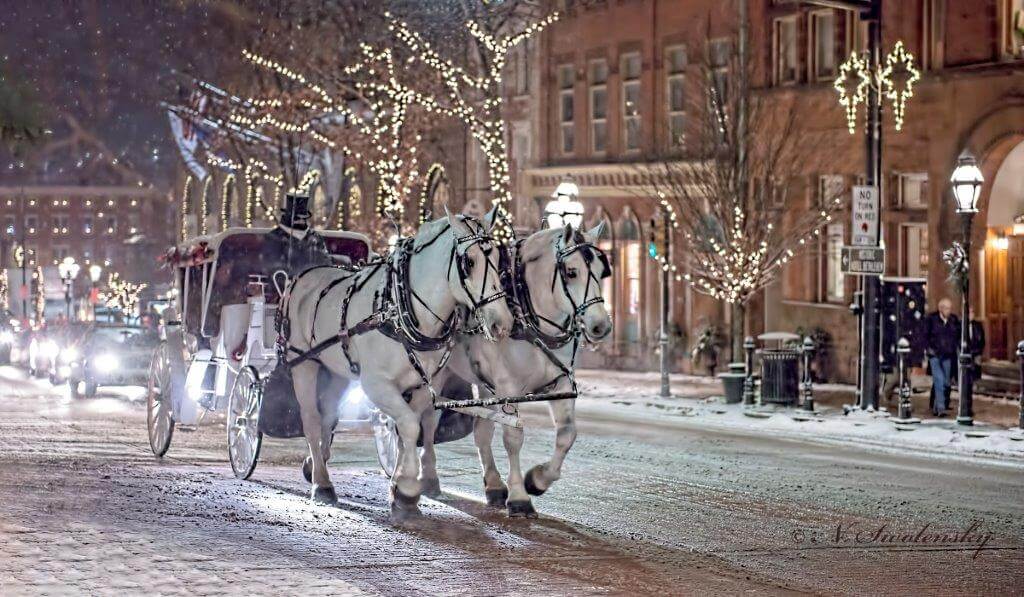
Image credit: [3]
To further celebrate my heritage, Christian and I visited five German-speaking countries in Europe this fall as part of a regional road trip I conceived to explore the cultural similarities across geopolitical borders. And (even though we weren’t there at Christmas) I absolutely felt a connection to the places – through the architecture, the art, the food, and the language. Even outside Germany, it was amazing to me how much little farming towns in Switzerland and Austria felt like Pennsylvania Dutch country. And now that it is officially Christmastime in our house, my heart is being called back to the places we visited three months ago.
What I Didn’t Learn in History Class
For the second time, one of our Italian vacation destinations was inspired by a beloved TV host. It’s no secret that Stanley Tucci’s episode on the Amalfi Coast was the catalyst for our first trip to Italy in 2022, [4] but James May’s “Our Man in Italy” was the reason I wanted to go north – way north, to a part of Italy where German is the primary language: the northernmost province of South Tyrol, which feels far more like Austria than Italy. [5] As I said, this two-week road trip was intended to be an exploration of how cultures bleed across man-made lines, illustrating how arbitrary political boundaries can actually be. And this intersection point of Christian’s heritage and mine seemed like a wonderful place for us to explore together.
Maybe it’s an American perspective that national borders are firm and unchanging. After all, our country is very young, very large, and physically removed from most of the other countries with which we interact. Europe, on the other hand, is very old, is packed with different countries speaking different languages, and has seen countless political borders change during countless wars on its soil. As an American, every time I go to Europe, I am astonished by the number of people who were born in a different country from where they currently live and who speak multiple languages. It’s really Europe, not the United States, that feels like a true melting pot to me. (Granted, that feeling may be more pronounced since the birth of the European Union in 1993 – I’d love to know if you have a pre-EU perspective to share.)

South Tyrol is an excellent example of the permeability and impermanence of political boundaries (and regimes), if the reason is less idyllic than a peaceful, neighborly sharing of cultures. Over the centuries, the area was invaded by Romans (15 BC), Goths (493 AD), Franks (534), Bavarians (553), and Lombards (568). [6] It was bequeathed to the Habsburgs in 1363 and would remain associated with their empire through its future iterations – Austrian (1804-1867) and Austro-Hungarian (1867-1918) – except for a brief period during which South Tyrol was ceded to Bavaria (1805-1814). [7] When the monarchy collapsed at the end of World War I, the region became part of the Kingdom of Italy and was later subject to forced Italianization under fascism. (Rick Steves describes it in a much lighter tone than it probably deserves. [8]) German language teaching and newspapers were banned, and a forced relocation of German-speaking families was planned (but never carried out due to the start of World War II). [9]
May in December
Today, however, history’s bloody battles aren’t apparent, at least not to a tourist (even a well-researched one). The region feels more like a cultural curiosity, even if it is a result of people who are “Italian In Name Only,” clinging to five-plus centuries of Austrian roots. We learned while we were there that rural areas are more conservative and more likely to speak German (or Germanic dialects), and that the cities are more liberal and more likely to speak Italian (or Romance dialects). It was at this point in the trip that I continued with my German (at its peak after a week’s worth of practice) and Christian was finally able to break out his Italian again (though most of the hotel and restaurant staff we encountered spoke fabulous English).
I won’t lie: we landed in the town of Kastelruth for two nights because James May was there in his show, and it looked amazing. (The fact that it’s a Rick Steves favorite as well simply reinforced my decision.) James May happened to be there on the eve of the Feast of St. Nicholas, also known as Krampusnacht. The origins of Santa Claus come from the tradition St. Nicholas bringing presents to good children on his feast day (December 6), not Jesus’ birthday (allegedly December 25). And he travels with a companion who, conversely, provides some kind of punishment for bad behavior.
In northern Germany, St. Nick’s companion is Knecht Ruprecht, a tall, dark man wearing long robes and a pointy hat who doles out coal and switches… but in Bavaria (and points south), he is Krampus, a nightmarish half-goat, half-demon who actively beats and kidnaps bad children. It is widely believed that Krampus’ origin is tied to pre-Christian pagan traditions, and he was absorbed into Christmas mythology when the Church was unsuccessful at banning him entirely. [10] (Not to be too heavy-handed, but I thought that was an interesting parallel to the earlier comments regarding forced culture changes.)
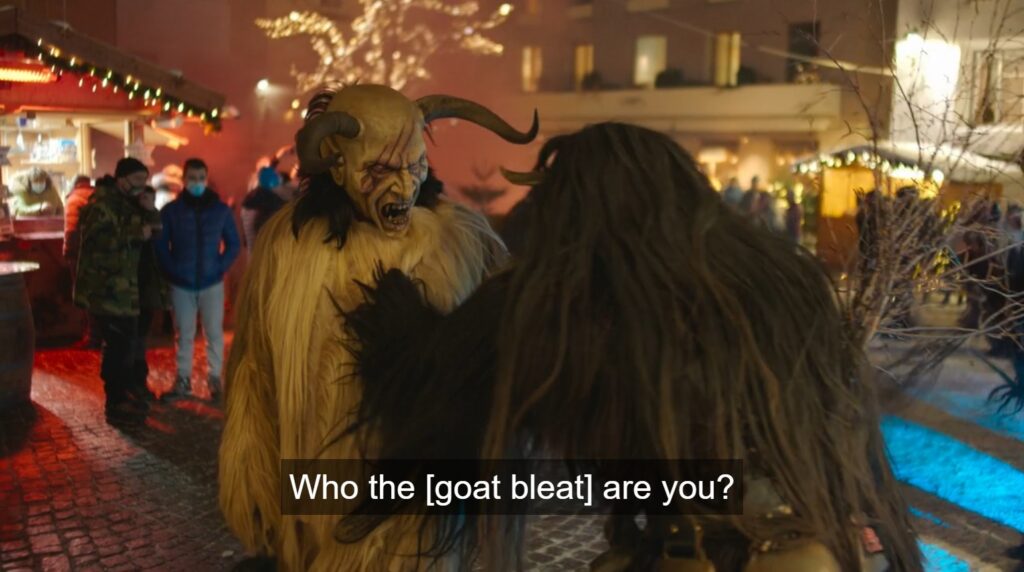
Image credit: [11]
I grew up with these stories, but they’ve become more mainstream since the release of the 2015 Krampus movie (which I have not seen). [12] Pittsburgh has hosted its own Krampusnacht since at least 2017 (the first year I attended), and it now has dueling events, one that involves a bar crawl through a Christmas market downtown, and one at a brewery featuring the release of their St. Nikolas Bock and a performance by Christmas metal band “Sleigher.” With Krampusnacht happening this past week, I wanted to rewatch James May’s Kastelruth episode with Christian. We shouted enthusiastically at each other, pointing out our hotel, [13] our favorite restaurant, [14] and the medieval town square that is normally host to a much-beloved and overactive bell tower, but on this particular night (probably in 2021, based on the show’s release date) also host to a host of Krampusse (plural of Krampus). [15]
Although we weren’t in Kastelruth to see any Krampusse – or any local festivals, for that matter – the place felt particularly magical on a random weekday in the fall: a medieval Austrian town with an Italian address and a rich history influenced by multiple cultures in multiple ways, nestled among some of the most beautiful mountains I’ve ever seen. It made me want to go back at Christmas. And now that it is Christmas, I’m glad I can at least enjoy recent memories of the part of the world that does Christmas best… and feel a little more connected to my own heritage.
~
Have you been to South Tyrol? Have you been to Germany (or its neighbors) during Christmas? I’d love to hear about your experience in the comments.
Thanks for reading!
[1] https://germanfoods.org/german-food-facts/german-christmas-traditions/
[2] http://bdhp.moravian.edu/bethlehem/bethlehem.html
[3] https://www.historicbethlehem.org/christmas/
[4] https://radicalmoderate.online/when-life-hands-you-amalfi-lemons/
[5] https://www.imdb.com/title/tt21065592/?ref_=ttep_ep_6
[6] https://en.wikipedia.org/wiki/History_of_South_Tyrol
[7] https://habsburg-dynasty.com/timeline/
[8] https://www.youtube.com/watch?v=9BZk6eVMa00
[9] https://en.wikipedia.org/wiki/South_Tyrol
[10] https://www.britannica.com/topic/Krampus
[11] https://www.amazon.com/James-May-Our-Man-Italy/dp/B09X6ZJ444
[12] https://www.imdb.com/title/tt3850590/
[13] https://www.cavallino.it/en/home.html
[14] https://www.nomad-restaurant.it/
[15] https://www.reddit.com/r/German/comments/3vmgji/was_ist_die_pluralform_von_krampus/
0 Comments