This post was unintentionally but appropriately timed: this week will see a rare conjunction of Eid al-Fitr (the end of Ramadan for Muslims) and Nowruz (Persian New Year). These celebrations will involve special foods for breaking fasts and marking renewal, respectively (and I truly hope that anyone celebrating either can do so with as much peace and safety as possible, though that is probably a tall order these days.) Given the celebratory nature of the holidays taking place this week and the religion highlighted in this particular post, the series title “Fast Food” may seem oddly irrelevant. However, there are plenty of intricacies and philosophies to be explored when it comes to dietary guidelines in what is considered to be the world’s oldest monotheistic religion: Zoroastrianism.
Also Sprach Zarathustra
Today there are approximately 120,000 to 200,000 Zoroastrians around the globe, but at the height of the Persian Empire, it was the largest religion in the world. [1] It evolved from an ancient polytheistic religion in which Ahura Mazda, the Lord of Wisdom, was the greatest of the gods. Sometime between 1500 and 1000 BC, a priest named Zoroaster (a.k.a. Zarathustra) had a vision from Ahura Mazda saying, among other things, that he was the only god and that all he required of humans was ethical behavior. Zoroaster began to share this revelation, but these radical thoughts were not popular – he was threatened, persecuted, and even imprisoned for a time because of them.
The religion itself was passed down orally, with no formal texts until sometime during the 4th century AD. Consequently, timelines and details vary, as do interpretations of guidance. Nevertheless, as the religion grew, so did its influence, which we can still see today in the Abrahamic faiths that followed (i.e. Judaism, Christianity, and Islam) through the concepts of “individual responsibility for salvation, judgment after death, a messiah, an end-time, and a heaven and hell.” Even some of its origin stories sound strikingly familiar: the first humans (Mashya and Mashynag) were created by Ahura Mazda and lived in peace and harmony until they were tricked by the leader of the dark forces (Angra Mainyu) and were consequently expelled from paradise. [2]
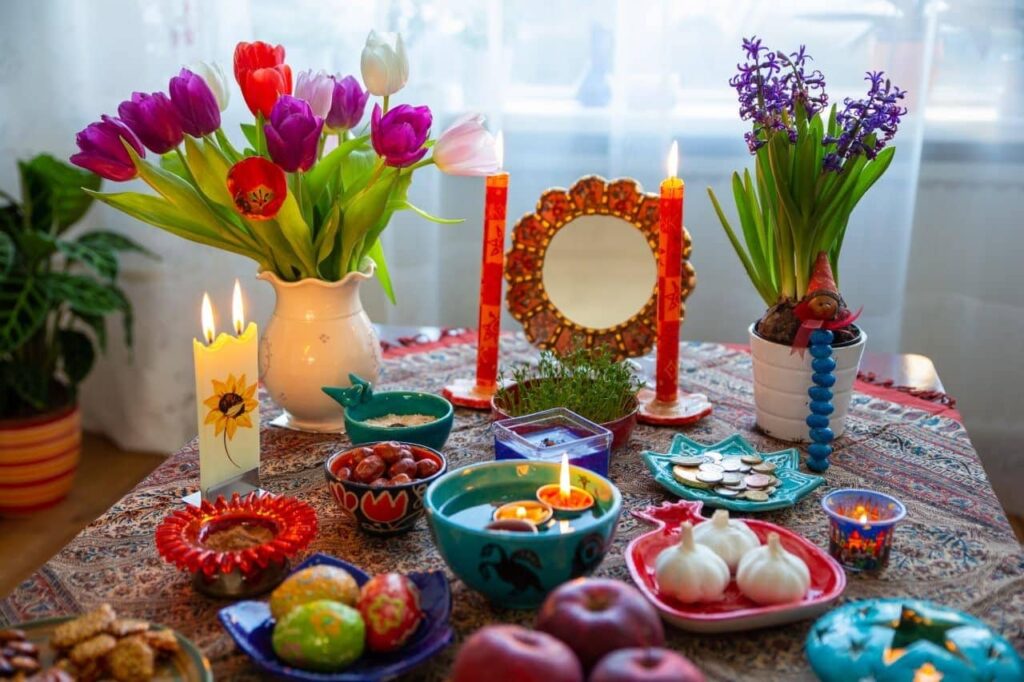
Image credit: [4]
While the mythology is complex, the religious practices are incredibly straightforward. Individuals have free will to choose between good and evil, and goodness is apparent through good thoughts, good words, and good deeds. Examples of this goodness include telling the truth at all times (especially keeping promises), practicing charity to all (especially those less fortunate), showing love for others (even when they do not return the sentiment), and moderation in all things (especially in diet). [5] And the moderation piece is fascinating because, unlike the Abrahamic faiths that would follow in its footsteps, Zoroastrianism specifically forbids fasting (notably the extremes of gluttony and deficiency) because it is believed to weaken people who need to stay vigilant for the fight against evil. [6]
Location, Location, Location
It is interesting (though maybe unsurprising) to see the lack of religious fasting coincide with a place and time of abundant agricultural output. The Persian Empire had advanced agricultural techniques, including irrigation, fertilization, and crop rotation, making good use of its arable land, not only to feed its people but to serve as the foundation for its economy. Major crops included cereals (wheat and barley), legumes, and fruits, [7] which all make sense when looking at any traditional Persian recipes. Note: among Persia’s prominent fruits were grapes, and alcohol is not only allowed, but encouraged in Zoroastrianism, especially when it’s wine. [8]
The strong agricultural history makes a great foundation for a plant-based diet, and Persian food is known today to be vegetarian friendly, with many recipes that have easy adaptations for vegans. [9] However, animal products are certainly present in the cuisine, and opinions vary widely on religious guidance when it comes to eating meat. The age of the religion, its long oral tradition, and forced relocation of many practitioners from their homeland have likely all played roles in these variations – variations not unlike the spectrum of orthodox to progressive practitioners in Judaism. [10] For example, there are some sources that say there are no strict food prohibitions under Zoroastrianism, [11] while others are adamant that religious texts could not be clearer about what is and isn’t allowed. [12]
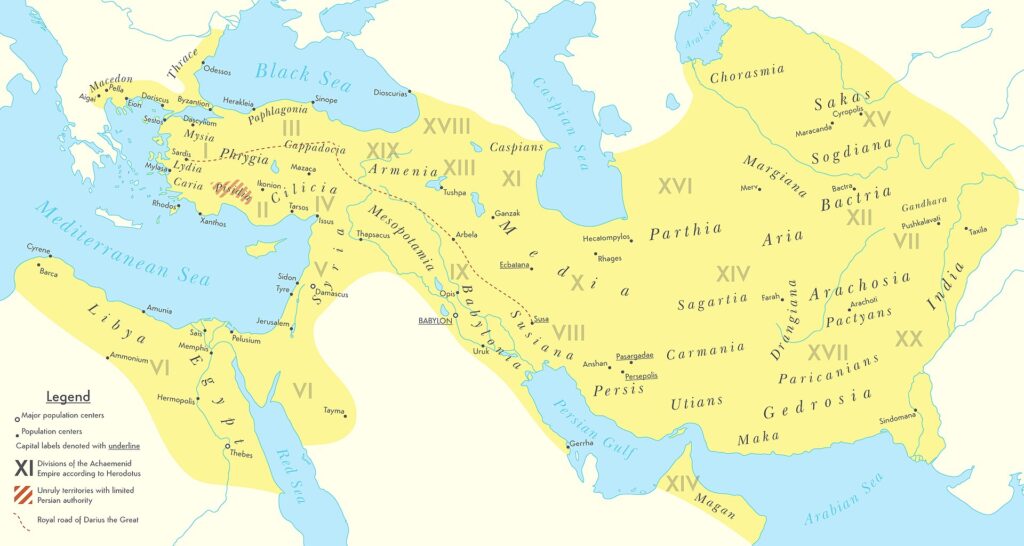
Image credit: [13]

Somewhere in the middle is this idea of “everything in moderation,” with all food being considered sacred, animals having souls, and waste being unacceptable. Decisions should be guided by a reverence for creation and a desire to minimize harm and suffering, [14] which I personally think is a nice idea. With that said, there are definitely instances where vegetarianism is encouraged, if not specifically observed, such as during Bahman, the 11th month of the Persian calendar (typically January 21 to February 19), [15] and for three days after the death of a family member. [16] Consumption of dairy products is generally encouraged, as long as the animal is treated well, and the food is not being taken from her young. [17]
Zoroastrianism spread over time, it is believed, more through observation of virtuous behavior than through overt conversion efforts. Religious tolerance was a hallmark of Zoroastrianism and of the Persian Empire, from the sixth century BC through to when Zoroastrians had to contend with religious intolerance from others, notably Christians (fourth century AD) and Muslims (seventh century AD). [18] After the persecution of practitioners and destruction of religious sites, many fled to other countries. The largest number of Zoroastrians in the world is now in India, at about 61,000 – where, ironically, their ethnic group eats a lot of meat. While these descendants of refugees have been described as “incorrigible carnivores,” they still tend to avoid beef out of respect for the country that took them in. [19]
Recipe: Ash Reshteh
As for me, I was eating Persian food before I can remember. My nanny used to make me dishes from home and teach me songs and dances. I credit her with laying some very important groundwork for my lifelong love of learning about other cultures. And with Nowruz coming up this week, I wanted to try my hand at a traditional New Year’s dish, which I cobbled together from a few different good-sounding recipes online. [20], [21], [22] But there was a small snag: the dish I picked traditionally contains kashk, a fermented dairy product. Since this blog series is about vegan recipes (and since I’m trying to eat more vegan food myself), I could either leave it out entirely, substitute with a splash of vinegar (as some do), or substitute with a homemade vegan version of kashk. [23]
Under normal circumstances, I would have just gone with kashk (or yogurt, which is a fine substitute) since it’s adding flavor and texture to the dish (and not serving as the primary ingredient), since Zoroastrianism has an “everything in moderation” philosophy, and since (after a recent trip abroad) I am currently trying to rebuild my microbiome, which calls for yogurt, kombucha, and other sources of friendly bacteria. But, for the purposes of this blog series, I tried a vegan substitute – I don’t know what kashk is supposed to taste like, but what came out of my blender was creamy, salty, and tangy, which is how the genuine article is described.
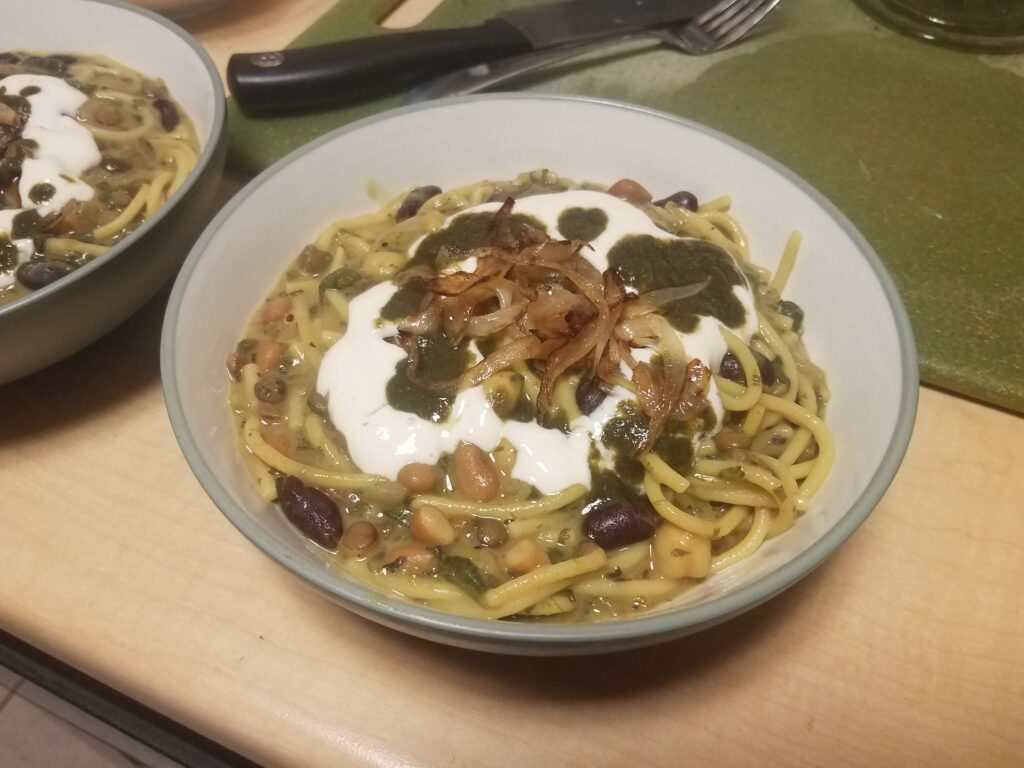
Ingredients for Stew
- 2 Tbs olive oil
- 1 yellow onion, diced
- ½ bulb garlic
- 1 Tbs dried mint
- 1 tsp turmeric
- 4 c veggie stock (don’t be like me – remember to thaw it before you start cooking)
- 1 15 oz can pinto beans
- 1 15 oz can kidney beans
- 1 15 oz can garbanzo beans
- ½ c dried green lentils (I might have used more, but Christian hates them)
- 1 c chopped cilantro (I hate it, but I honestly couldn’t taste it with everything else going on in the pot)
- 1 c chopped parsley
- ½ c chopped dill
- 6 scallions, sliced
- 2 c spinach, chopped
- 1 c kashk (or yogurt, or vegan substitute – see below)
- 8 oz reshteh noodles (or spaghetti, broken in thirds)
- Juice of ½ lemon
- Salt & pepper to taste
- 1-2 c water, as needed
2 hours before: start soaking lentils in a bowl of water and take your veggie stock out of the freezer (if you’re using frozen).
Heat a large pot over medium heat, add 1 T olive oil, when hot add onions and stir until golden. Add garlic, mint, turmeric, and 1 T olive oil; stir for 5 minutes. Add vegetable stock and season with salt and pepper; bring to boil; drain lentils and add to pot; reduce to simmer, cover, and cook for 15 minutes, stirring occasionally.
Chop all of the greens, discarding stems when necessary. Add greens and drained canned beans to the pot, stir, cover, and cook for 30 minutes, stirring occasionally. Break the noodles into thirds and add to the pot for the cooking time; add water as needed if the stew is too thick.
Stir in the kashk (or substitute) and lemon juice, season with salt and pepper to taste. Let sit for 10 minutes so the flavors can set up.
Ingredients for Toppings
- 6 Tbs olive oil
- 1 yellow onion, thinly sliced lengthwise
- ½ bulb garlic, thinly sliced
- 2 Tbs dried mint
- ¼ c kashk (or yogurt, or vegan substitute – see below)
Saute onion in 1 Tbs olive oil until crispy and golden brown(15 min); set aside. Saute garlic in 2 Tbs olive oil until crispy and golden brown (1 minute); set aside. Saute dried mint in 3 Tbs olive oil (30 seconds); set aside.
Vegan kashk
- 1 10 oz package silken tofu
- 1 clove garlic, minced
- 2 tsp salt
- 2 tsp apple cider vinegar
Blend all ingredients in a blender; add water in very small amounts if too thick.
To serve, top a bowl of stew with fried onions and garlic, drizzle with kashk and mint topping.
As a New Year’s dish, there is a lot of symbolism in every bite. The noodles represent the twists and turns of life – and having lived in Eastern Asia, where they represent longevity, I was still hesitant to break them for this dish. The greens represent new beginnings, and the lentils represent prosperity (too bad Christian doesn’t like them).
But speaking of lentils and ancient religions, in next week’s post, we’ll pick up with the country that provided asylum for many Zoroastrians centuries ago: India.
Thanks for reading!
[1] https://escholarship.org/uc/item/8t2507mw
[2] https://www.worldhistory.org/zoroastrianism/
[4] https://surfiran.com/mag/nowruz-persian-new-year/
[5] https://www.worldhistory.org/zoroastrianism/
[7] https://ancientcivs.blog/farming-in-ancient-persia/
[9] https://www.tastingtable.com/1200844/cuisines-that-are-notably-vegan-friendly/
[10] https://en.wikipedia.org/wiki/Judaism#Jewish_religious_movements
[11] https://multifaiths.com/pdf/Zoros.pdf
[13] https://en.wikipedia.org/wiki/Achaemenid_Empire#/media/File:Achaemenid_Empire_500_BCE.jpg
[14] https://noblechatter.com/faq/6085/zoroastrianism/what-dietary-laws-or-customs-do-zoroastrians-follow
[16] https://parsi-times.com/2023/04/your-religious-queries-answered-2/
[18] https://www.worldhistory.org/zoroastrianism/
[19] https://www.nytimes.com/2019/05/08/t-magazine/parsi-food.html
[20] https://cookingwithayeh.com/ash-reshteh-persian-noodle-and-herb-soup/
[21] https://www.thespruceeats.com/aash-reshteh-recipe-5219123
[22] https://www.hamisharafi.com/free-recipes/aashe-reshteh
[23] https://www.reddit.com/r/persianfood/comments/182qhse/a_substitute_for_kashk/
0 Comments