This week’s topic is meant to focus on the intersection of food and religion, as are the other posts in this series, but no subject is ever isolated completely. I had the broad strokes of this series (religions, locations, and recipes) outlined well before the recent joint US-Israel airstrike on Iran and Iran’s subsequent retaliation throughout the Middle East. As this post goes live, there have been significant casualties in some of the countries I will mention below, and I don’t want it to seem in any way that I am glossing over the suffering and loss of life taking place there. If anything, I hope that visiting bits of the history, religion, and cuisine of some of these areas can help to humanize those who are shouldering the heavy burden of decisions that were not made by them.
Wars are nothing new in the Levant (a region made up of Syria, Lebanon, Jordan, Israel, and Palestine). This term is often used to connote a region of shared culture and history while avoiding specific political names and boundaries, any number of which can be inflammatory and shut down conversations. Given its geographic location at the intersection of Western Asia, Northern Africa, and the Arabian Peninsula, it was historically a strategically valuable location along trade routes and wound up along the border of multiple warring empires for nearly three thousand years (at least as far back as I researched.)
It is also the cradle of major world religions, holding sacred sites for Christianity, Islam, and Judaism, which we’ll be looking at more closely in this week’s post. And while I have multiple friends and colleagues who are Jewish, I definitely needed a refresher on the basics, which turned into a deep dive on regional military conflicts and systematic persecution of Jewish people across multiple millennia, which is an entirely different can of worms and deserves a dissertation rather than a quick mention in a blog post. [1], [2] So here’s this week’s disclaimer: I do not claim to be an expert on any of what I’ll be sharing below, so please, if you have corrections or context to share, I welcome you to do so in the comments because I am definitely still learning.
Judaism 101
Judaism is one of the world’s oldest monotheistic religions and subsequently influenced both Christianity and Islam, which recognize Jewish religious texts and figures as part of their own teachings. Abraham (who probably lived sometime between 2100 and 1900 BC) is considered to have made a compact with God, which is seen as the foundation for Judaism as a religion, while he himself is the father of the Jewish people (i.e. his descendants). Because of the (relatively) common ancestry that Jewish people share, Judaism is not simply a religion but an ethnoreligious group, which includes common religious, ethnic, and (sometimes) historical backgrounds. In general, a person can be considered Jewish if born to a Jewish mother (or if that person converts to Judaism). [3]
The number of followers worldwide is difficult to calculate precisely, as the definition can range from strict practitioners, to non-practitioners who are still considered Jewish because of heritage, and everyone in between. A 2025 count placed the total number somewhere below 15 million with a growth rate of practically 0%. Almost half (46%) of the world’s Jewish people live in Israel, with a large percentage in the United States as well, but persecution and forced relocation over the centuries have contributed to significant geographic dispersion around the globe. [4]

Data generation credit: [5]
Image generation credit: [6]
Because of Judaism’s old age, there has been a lot of time for the religion to evolve. There are movements that prioritize different things, such as the literal translation of religious texts, the continuation of specific traditions across generations, or the ethical aspects of the religion over ceremonial ones. (These differences sound reminiscent of some of the varying aspects of Christian beliefs I described earlier in this series. [7]) While it seems there aren’t fixed core tenets of Jewish faith, general ethics include “justice, truth, peace, loving-kindness, compassion, humility, and self-respect,” while specific practices embodying these values include “charity and refraining from negative speech.” [8]
Kosher + Historic Cuisine
As with Islam, which we covered in last week’s post, [9] there are some general food restrictions in Judaism that always apply. Most notable is the prohibition on pig products, but also included on that list are horses, camels, rabbits, birds of prey, shellfish, insects, vermin, and grape products made by people who aren’t Jewish. There are also restrictions on mixing meat and milk categories in the same meal, growing different species of food plants together, and using non-kosher additives in food preparation. There are six holidays throughout the year that involve a fast with no food at all, [10] and Passover, which lasts one week and allows consumption of only unleavened bread and specially prepared foods. [11]
From where I sit, it looks like the general rules would have more of an influence on day-to-day cultural cuisine than would any of the holidays, but strict adherence to Kosher law still doesn’t get us to “veganism.” I know plenty of Jewish people who have easily kept Kosher by eating a vegetarian diet, thus eliminating many of the prohibited animals and combinations, but the added step toward veganism doesn’t seem to provide any added value from the standpoint of religious practice. Nevertheless, Israel has among the highest number of vegans per capita in the world. [12] Again, as with Islam, it seems as though the connection between highly Jewish areas (i.e. Israel) and vegan-friendly cuisine has more to do with the ingredients that are readily available than with religious practice. Similar to Northern Africa, the Levant has an ideal climate for producing cereals and grains, legumes and pulses, vegetables and fruits, and olive oil… with the added bonus of one of my favorites: tahini. [13]
The climate lends itself to raising sheep, chicken, and cows, but again, not pigs. Pigs are highly sensitive to extreme temperatures (they thrive in 65-75 F), need high-fat diets, access to water, and clean bedding. It has been pointed out that religious restrictions on eating pigs may have been grounded (in part) in food safety concerns, [14] but I think the fact that they are so resource-intensive may have had something to do with it too, at least creating an implicit bias if nothing else. Though not explicitly mentioned in any religious texts I’ve seen, pigs simply were not practical to raise in a Mediterranean climate and would have diverted resources from other more efficient food sources. And even through the 1960s, researchers noted that eating trends throughout the Levant were “primarily local, seasonal, and plant-based, with moderate to low animal product intake.” [15] With that said, we’ll wrap up with a look at one of my favorite regional dishes…
Recipe: Mejadra / Mujaddara / Mdardara
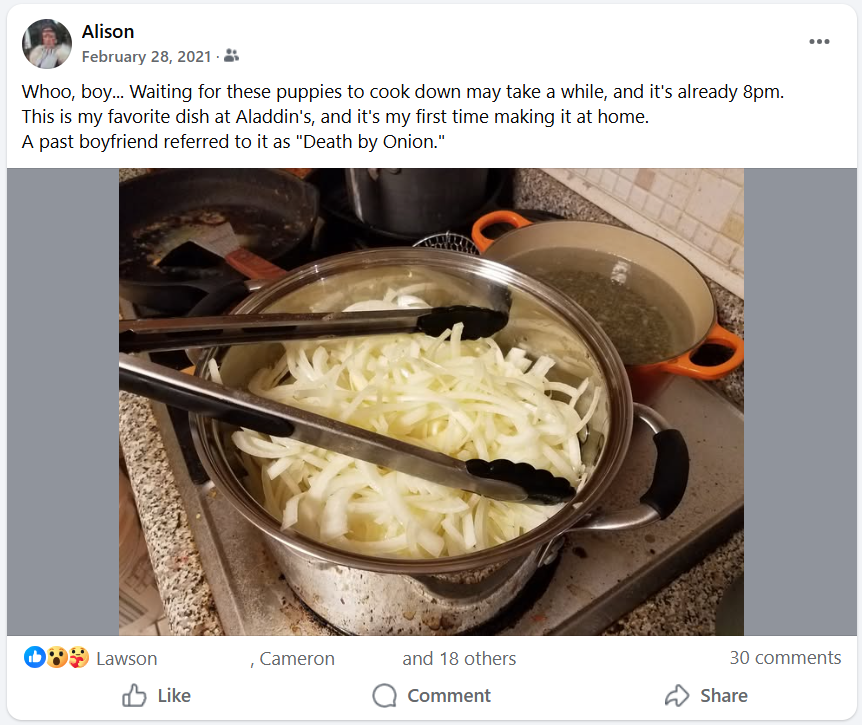
Variations of this onion, lentil, and rice dish can be found across the Levant and beyond. It is my go-to order at a Pittsburgh-area Middle Eastern restaurant chain, [16] but it’s also one of the Lebanese dishes my mother-in-law makes. I have a tried-and-true recipe that I use from the Bad Manners (formerly Thug Kitchen) cookbook, [17] but given this week’s focus on Judaism, I decided to go with a recipe from the cookbook Jerusalem, [18] reprinted with permission (and notes) at Serious Eats. [19]
Ingredients
- 1 1/4 cups (250 g) green or brown lentils
- 4 medium onions (700 g), thinly sliced
- 3 Tbs all-purpose flour
- 1 cup (250 ml) sunflower oil
- 2 tsp cumin seeds
- 1 1/2 Tbs coriander seeds
- 1 cup (200 g) basmati rice
- 2 Tbs olive oil
- 1/2 tsp ground turmeric
- 1 1/2 tsp ground allspice
- 1 1/2 tsp ground cinnamon
- 1 tsp sugar (I generally skip any added sugar in savory dishes, as a rule)
- 1 1/2 cups (350 ml) water
- Salt and pepper
Rinse and pick through lentils, cover with water in a saucepan, bring to boil, and simmer for 12-15 minutes until al dente. Drain and set aside.
Slice the onions thinly, sprinkle with flour and 1 tsp salt, toss thoroughly. Heat a large saucepan or pot to medium-high heat, add sunflower oil. Fry onions in batches to ensure they crisp up (and don’t sweat), stir each batch occasionally for 5-7 minutes until they are golden brown. Transfer to a paper towel and sprinkle with salt. Add more oil as needed.
Toast cumin and coriander seeds in a large pot (can be the same one) over medium heat for 1-2 minutes. Add rice, olive oil, turmeric, allspice, cinnamon, sugar (if you’re using it), ½ tsp salt and pepper. Stir to coat. Add cooked lentils and 1 ½ cups water. Bring to a boil, cover and simmer over low heat for 15 minutes.
Take the pan off the heat, remove lid, cover with a clean tea towel, and put the lid back on. Let sit for 10 minutes. Add half of the fried onions to the dish and stir gently. When serving, add extra onions on top.
~
Next week we’ll continue east – to an area with its own wealth of religious history, cultural diversity, and delicious food. For now, I’d love to hear your thoughts in the comments below.
Thanks for reading!
[2] https://medium.com/@mattsamberg/a-brief-history-of-israel-and-palestine-d417f9d7e838
[3] https://en.wikipedia.org/wiki/Ethnoreligious_group
[4] https://en.wikipedia.org/wiki/Judaism
[7] https://radicalmoderate.online/fast-food-part-2-eastern-orthodoxy-and-georgia/
[8] https://en.wikipedia.org/wiki/Judaism
[9] https://radicalmoderate.online/fast-food-part-3-islam-and-morocco/
[10] https://www.chabad.org/library/article_cdo/aid/609607/jewish/Jewish-Fast-Days.htm
[11] https://en.wikipedia.org/wiki/Kashrut
[12] https://worldpopulationreview.com/country-rankings/veganism-by-country
[13] https://www.fas.usda.gov/data/production
[15] https://pmc.ncbi.nlm.nih.gov/articles/PMC12023382
[16] https://aladdins.com/locations/
[17] https://www.goodreads.com/book/show/28694618
[18] https://www.sami-tamimi.com/cookbooks/project-two-llrgk-wx4wf
0 Comments