As we open this third part in a series on the interplay between food and religion, Lent is in full swing for all Christians, as is Ramadan for Muslims, and the Hindu festival of Holi (celebrating colors, love, and Spring) will be taking place in the coming week. But more on Hinduism later. This post will focus on the world’s second-most populous religion. Christianity represents about one third of the global population at 2.6 billion followers (about half of whom are Catholic); next in line with about 2 billion followers around the world is Islam. [1] And while I have multiple friends and colleagues who practice this religion, I needed a refresher on the basics before writing this post. (Please, if you have corrections or context to share, I welcome you to do so below!)
Islam 101
Islam is one of the three major Abrahamic religions, including Judaism and Christianity. (If you’ve seen the movie “Heretic,” [2] you’re probably hearing Hugh Grant’s voice in your head saying “I call ‘em, ‘The Big Three.’” … or is that just me?). It is the newest of the three, originating in the seventh century, when the prophet Muhammad had his revelations. While the religion recognizes previous prophets (including Adam, Noah, Abraham, Moses, and Jesus) as well as previous religious texts (including the Torah, Psalms, and Gospels), Muhammad is considered the final prophet, and the Qur’an (revealed to him by God through the archangel Gabriel) the most literal scripture. [3]
Muhammad is roughly 600 years younger than Christ, who is roughly 1800 years younger than Abraham, the spiritual and ancestral founder of Judaism. While Islam is the youngest of these three, there are similarities to be found with the others, such as the presence of one all-powerful god who is the source of moral law and divine revelation. [4] Similar to Christians, Muslims believe in an afterlife of reward or punishment that will be based on deeds during life. Muslim values include justice, compassion, peace, and equality. Since Islam was established as a religion, it spread (relatively) rapidly throughout the Middle East, North Africa, Persia, India, and Southeast Asia via military conquest, economic influence along trade routes, and missionary activities. [5]
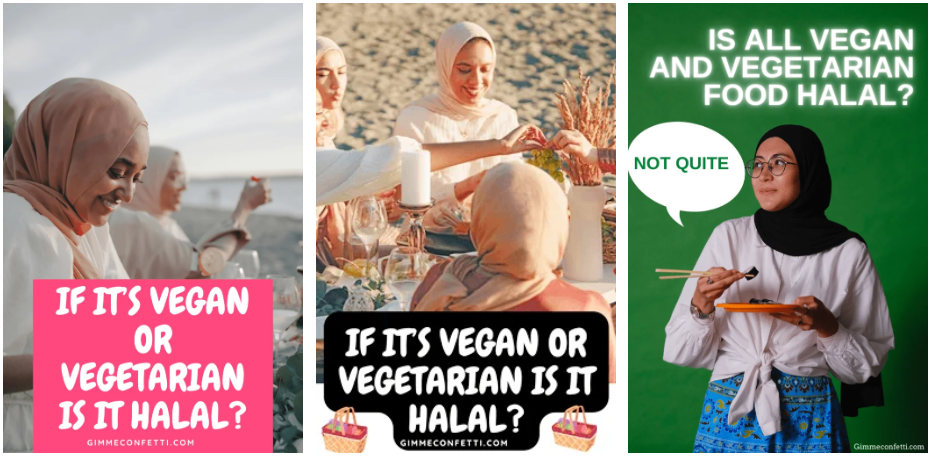
Image credit: [8]
There are some distinct differences between Christianity and Islam (the most notable probably being views on Jesus Christ’s role in each religion), but the one I’ll be focusing on here is food, which shouldn’t be a surprise at this point. I will note that the initial focus (and even title) of this blog series was a nod toward how global cuisines were influenced by religious practices (specifically fasting), but the fast associated with Islam, Ramadan, involves no food or drink whatsoever from dawn to dusk for the span of one month. Consequently, we’ll need to look to other aspects of Islam, such as general prohibitions on food as a matter of daily life.
Contrary to Christianity, which does not have any permanent, universal prohibitions on food, there are several restrictions for Muslims: probably the most notable is the prohibition on pork and pork products, but also included are blood and blood-based products, animals not slaughtered according to Islamic law (i.e. by a Muslim who invokes the name of God, with a swift cut to the throat to ensure minimal suffering and rapid blood drainage), carnivorous animals and birds of prey, reptiles and insects, seafood (in some schools, but not all), food containing prohibited ingredients, food sacrificed to idols or other deities, and alcohol and other intoxicants (including for flavoring, such as vanilla extract). [9] As a result, it makes sense to me that observation of a strict fast (i.e. Ramadan) would not have impacted the cuisine of a highly Muslim region so much as the daily practice of eating halal (“lawful”) foods.
Halal + Historic Cuisine
With all that said, it’s worth noting that, although there are not strict limitations around all meat in Islam, there is evidence indicating that Muhammad’s diet was primarily plant-based, meaning that could have been the norm at the time. [10] Additionally, prior to Islam’s arrival in North Africa in the seventh century, Christianity was dominant there (starting in the second century). Lent in the early Christian church was not as strictly codified as it eventually became, but it was often observed as a “black fast” (consuming nothing all day), [11] broken with a vegan meal at sunset, which is not unlike Ramadan, particularly a modern vegan variant of it, which is growing in popularity: “Veganadan.” [12]
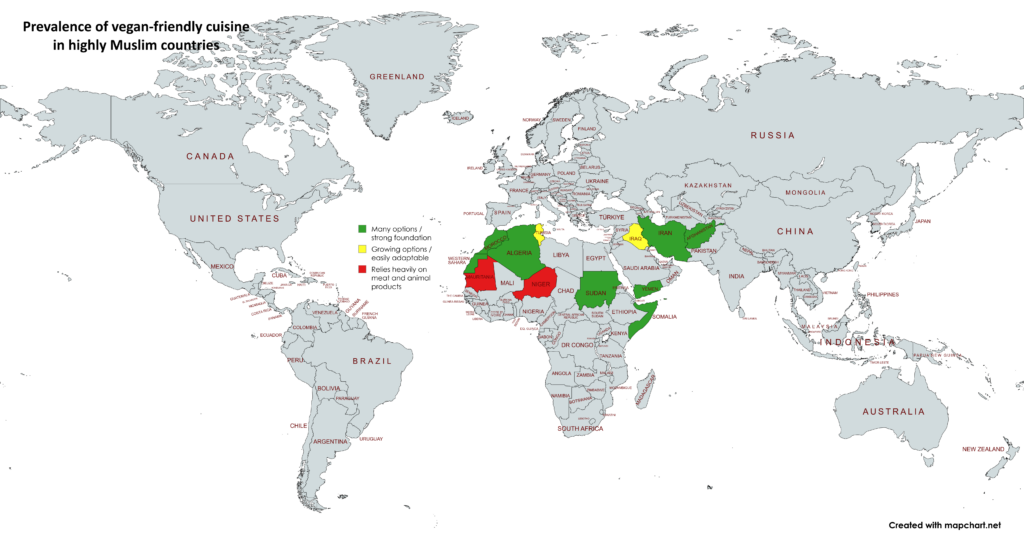
Data generation credit: [13]
Image generation credit: [14]
Prior to Christianity’s arrival, the indigenous peoples of the region were known as the Berbers, with their history going back 10,000 years. I know even less about the varied, amalgamated religious practices of this broad group, but it appears that there were aspects of ancestor worship, celestial worship, and animal sacrifices, [15] while also having some prohibitions on eating certain animals, such as cows (connected with Egyptian goddess Isis) and pigs (connected with Egyptian god Set), [16] among other taboo animals and animal body parts. [17]
Given the relatively recent spread of Islam across the world, it is fascinating to see the practices around halal foods blend in different ways with the historic cuisine traditions, while questioning how much of it is correlation vs. causation. It was incredibly difficult to choose just one African country and one dish from it to highlight in this post, since there are so many different flavors I love across the expansive northern and eastern regions of the continent. When it comes to my affinity for those cuisines, it’s probably no coincidence that the climate in many of those countries lends itself to more plant-based dishes to start with (not unlike what I wrote about Italy in the first installment of this series [18]). And consequently, adopting religious food guidelines that are focused largely on restricting certain types of meat makes for an easy adjustment.
There are certain food products that thrive in the hot, dry climates of North African countries, such as cereals (i.e. grains derived from grasses, such as wheat and barley, which are full of starches, carbohydrates, vitamins, and minerals), [19] pulses (e.g. lentils, chickpeas, beans, and peas, which are loaded with protein and nutrients), [20] olives (which have numerous health benefits), [21] vegetables and tomatoes, and citrus and other fruits (especially dates!), together representing a variety of nutritious and flavorful ingredients. [22]
North African foods are naturally vegan friendly, but there is meat available in these cuisines as well: typically, smaller ruminants (e.g. sheep and goats) are kept because they require less water and are resilient to harsher conditions; [23] similarly, camels provide milk, meat, and transportation, while also being efficient with water use. Cows are less common, and I found no mention of pigs, which are highly sensitive to extreme temperatures. (I find it interesting to see prohibitions on the meat of animals that already don’t thrive in the given climate – but more on that next time.)
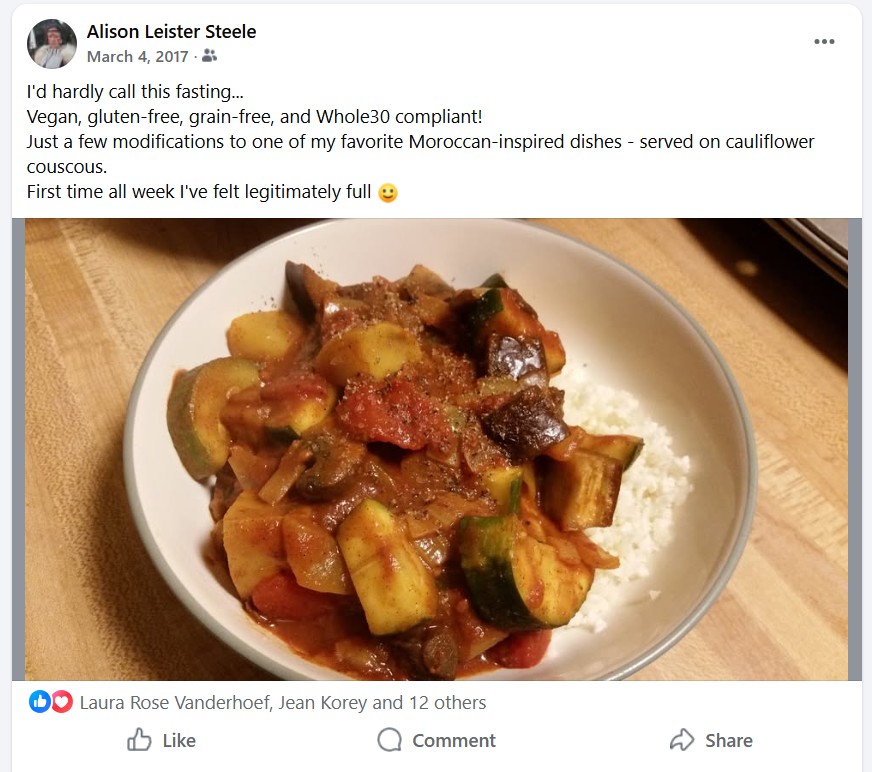
Recipe: Eggplant and Chickpea Tagine
For now, I will wrap up with one of my favorite recipes from North Africa, specifically Morocco. I have no source for it, as its provenance is probably buried somewhere in ancient, unused email accounts. This text below was sent back and forth between my mom and me for years, copy-pasted and forwarded with annotations by one of us whenever the other couldn’t find the recipe. It is by no means the most accurate version of this dish, but it is the one closest to my heart, and one I’m excited to revisit this Lent.
Ingredients:
- Qty 1 small eggplant cut into 1/2″ dice
- 2 zucchini, thickly sliced
- 4 T. olive oil
- 1 large onion, sliced
- 2 garlic cloves, chopped
- 2 c. brown cap mushrooms, halved
- 1 T. ground coriander (I used 2 tsp.)
- 2 tsp. cumin seeds (I used ground)
- 2 tsp. ground turmeric
- 1 T. cinnamon (gracious – that seemed like a lot … I used 1 or 1 1/2 tsp. or to taste
- 8 oz. new potatoes quartered (I used more, but then I love potatoes)
- 2 1/2 c. passata (tomato sauce)
- 1 T. tomato paste
- 1 T. chili sauce
- 1/3 c. ready-to-eat unsulfured dried apricots ( I skipped this)
- 3 c. canned chickpeas, drained and rinsed (I used 2 cans, I think)
- salt and freshly round black pepper
- 1 T. chopped cilantro to garnish (yuck .. I never use this stuff .. I hate it ..)
Sprinkle salt over the eggplant and zucchini and leave for 30 min. Rinse and pat dry with a dish towel (this is supposed to make it less bitter) ..Heat the broiler to high. Arrange the zucchini and eggplant on a baking sheet and toss in 2 T of the olive oil. Broil for 20 min., turning occasionally, until tender and golden .. (I think you can just cook this is a skillet/pan etc.)
Meanwhile, heat the remaining oil in a large heavy-based saucepan and cook the onion and garlic for 5 min until softened, stirring occasionally. Add the mushrooms and saute for 3 min. until tender. Add the spices and cook for 1 min. more, stirring to allow the flavors to mingle.
Add the potatoes and cook for 3 min., stirring . Pour in the passata, tomato paste, and 2/3 c. of water, cover, and cook for 10 minutes or until sauce begins to thicken.
Add the eggplant, zucchini, chili sauce, apricots, and chickpeas. Season and cook, partially covered, for 10-15 min. until the potatoes are tender. Add a little extra water if the tagine becomes too dry. Sprinkle with chopped cilantro to serve. (not me!)
Tasted even better the next day!
~
Next week we’ll continue with a different area that touches the Mediterranean, infamous for its blend of “The Big Three” religions: an area known as The Levant. In the meantime, I’d love to hear any thoughts you have about the cuisines or religions mentioned here.
Thanks for reading!
[1] https://omsc.ptsem.edu/world-christianity-its-annual-statistical-table-time/
[2] https://www.imdb.com/title/tt28015403/
[3] https://en.wikipedia.org/wiki/Islam
[4] https://www.davidpublisher.com/Public/uploads/Contribute/68c3bed0cb346.pdf
[5] https://hub.edubirdie.com/examples/why-did-islam-spread-so-quickly-argumentative-essay/
[6] https://aboutislam.net/counseling/ask-the-scholar/food-slaughter/can-muslims-consume-vegan-products/
[7] https://halalwatch.us/the-halal-vegan-muslim/
[8] https://gimmeconfetti.com/is-all-vegan-and-vegetarian-food-halal/
[9] https://en.wikipedia.org/wiki/Islamic_dietary_laws
[10] https://www.veganislam.org/
[11] https://en.wikipedia.org/wiki/Black_Fast
[13] https://search.brave.com/
[15] https://ohmyfacts.com/religion-history/34-facts-about-berber-religion/
[16] https://religion.fandom.com/wiki/Traditional_Berber_religion
[17] https://www.encyclopedia.com/environment/encyclopedias-almanacs-transcripts-and-maps/berber-religion
[18] https://radicalmoderate.online/fast-food-part-1-catholicism-and-italy/
[19] https://www.organicfacts.net/health-benefits/cereal
[21] https://health.clevelandclinic.org/are-olives-good-for-you
0 Comments