When this post goes live, Catholics across the world will already be observing Lent, and adherents of Eastern Orthodox religions will be just about to start. I never really had a firm grasp on the difference between Catholic and Orthodox when I was growing up, but I was exposed to many different cultures and beliefs throughout my hometown. (Bethlehem, PA has a strong history of immigration and industry, making it a significant melting pot – from its original Moravian founders, to Irish and Eastern European steelworkers during the industrial revolution, followed by Puerto Rican and Latin American laborers for the coke works and garment industries in the mid-twentieth century.) [1],[2]
My exposure to Orthodoxy as a child was limited to eating fantastic food at church festivals and knowing that some of my friends celebrated Christmas and Easter about a week later than I did. In reality, my knowledge of the split between the “East” (Orthodox) and “West” (Catholic) Churches is still superficial, despite taking some religion and medieval history classes in college. Eastern Orthodox Christianity still feels like a bit of a mystery to me, but one I’m interested to learn more about, even if only through research for this blog (for now).
Note: again, I have never practiced any of the religions discussed here, and I am not a theology scholar, so please feel free to leave corrections and context in the comments below!
East-West Schism
The split between these churches wasn’t instantaneous, though the formal break is cited as happening in 1054. [3] Over several centuries, differences in official church teachings and practices widened: to name a few, whether the Holy Spirit proceeds from both God the Father and the Son (Catholic) or God the Father alone (Orthodox); whether parish priests should be celibate or not; whether the Eucharist should be unleavened or leavened bread; whether the Pope has universal jurisdiction as the supreme spiritual leader of one universal Church or if there is, instead, a “first among equal” bishops (the “Ecumenical Patriarch” in the Orthodox church); etc. Political differences and military campaigns also played heavily into the schism, but that is a topic for a very large library section, not this blog post. [4]
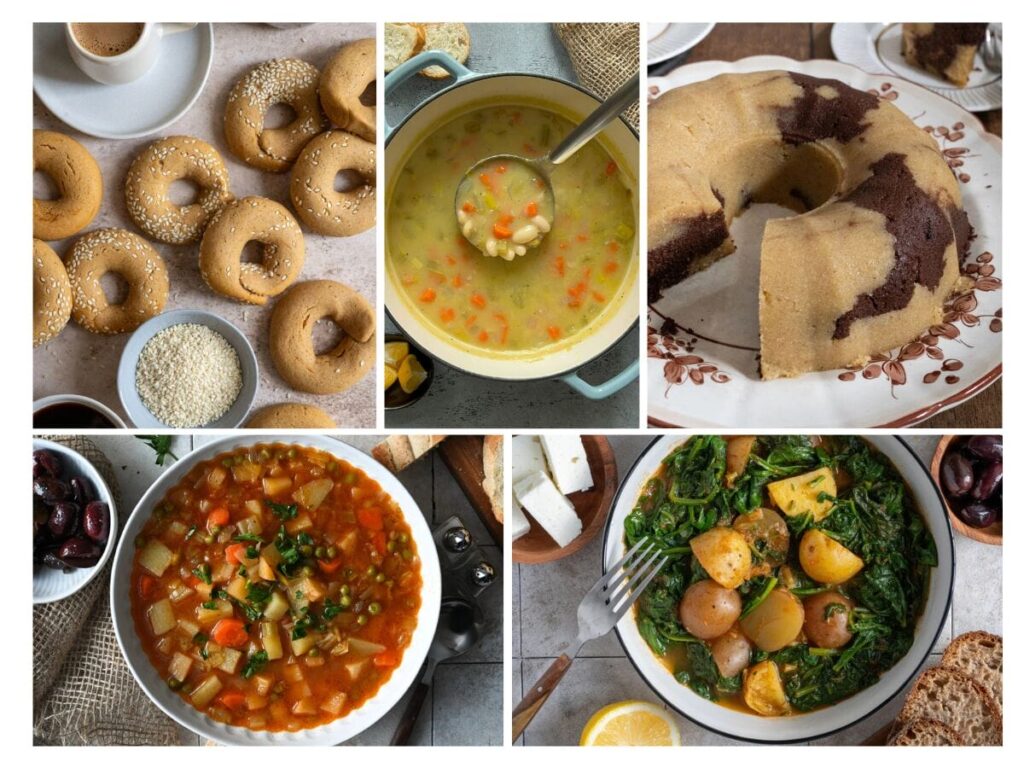
Image credit: [5]
The most notable difference I remember from college is the distinction between “orthodoxy” (“correct belief”) and “orthopraxy” (“correct action”). [6] Of course, the terminology is counterintuitive here, but at the time of the split, the Catholic emphasis was on the concept of correct belief (“orthodoxy”), meaning getting the doctrine right and ensuring that all believers adhered to it (i.e. establishing one formalized, correct set of beliefs, which were enforced through a centralized, hierarchical Church authority). Meanwhile, the Eastern Orthodox emphasis was on the concept of correct action (“orthopraxy”), meaning that ethical conduct and prescribed rituals were a means for encountering God. [7] Today, both branches recognize the roles of both belief and action in the practice of faith, but the historic emphasis on action in the Eastern church provides a lot of context for where we’re going next.
The Eastern Orthodox liturgical calendar still follows the Julian calendar (established by Julius Caesar in 45 BC), while the Catholic Church follows the Gregorian calendar (established by Pope Gregory XIII in 1582). The Gregorian calendar is more accurately aligned with lunar cycles used to determine when holidays fall (and the reason we have Leap Years on certain years and not on others). As a result, there is currently a 13-day difference between the two, which will continue to grow over time. [8] In addition to adhering to the older calendar, the approximately 300 million practitioners of Eastern Orthodox religions have stuck with more restrictive fasting guidelines over the years than their approximately 1.2 billion Roman Catholic counterparts. [9]
Orthodox Fasting
There are several fasting periods throughout the year for the Orthodox, not just Lent (the 40 days before Easter). The Nativity Fast (40 days before Christmas) is the other big one, along with one after Pentecost and one before the Assumption, as well as every Wednesday and Friday throughout the year. For those keeping count, that total comes to somewhere between 180 and 200 days, or more than half of the year. The dietary restrictions themselves are more stringent than the Catholic equivalent, as well: there are some variations between holidays and churches, but prohibitions generally cover meat, dairy, fish (only with backbones – shellfish is allowed), alcohol, and olive oil. [10] I will note that the restrictions laid out here do not represent a fully vegan diet – it’s more light pescatarian, but 50% of the year or more made up of these fast days would absolutely influence a vegan or vegan-friendly menu. It seems, compared to last week’s post on Catholicism and Italy, [11] the food associated with this smaller branch of Christianity is more heavily influenced by religious practice and has adopted less flexibility over time when it comes to ingredient availability.
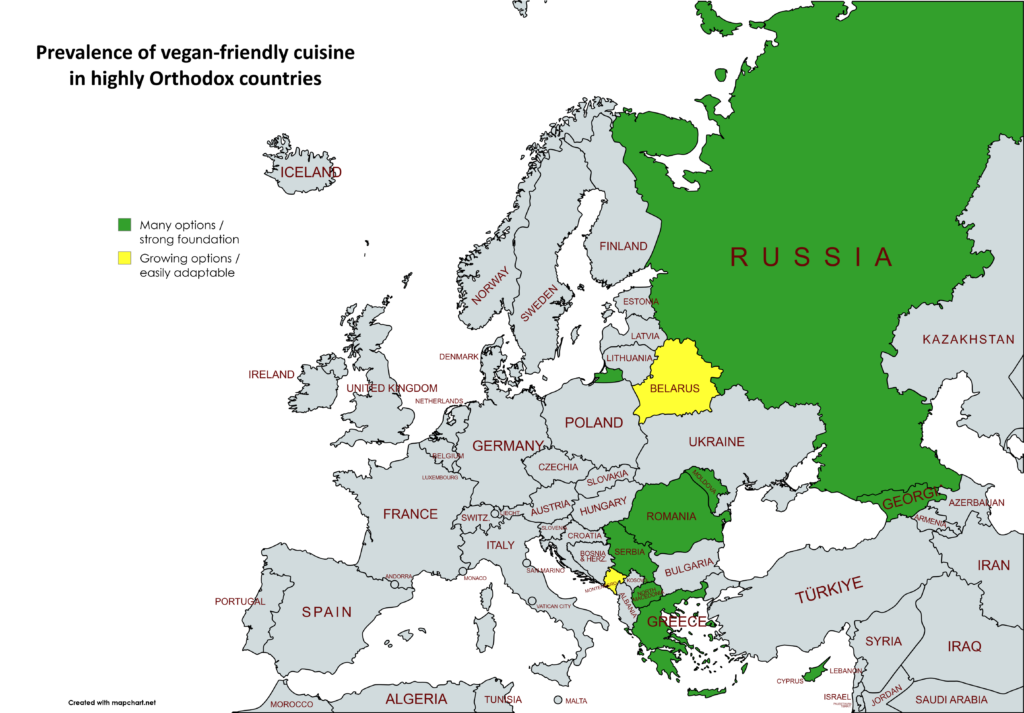
Data generation credit: [12]
Image generation credit: [13]
Vegan-friendly cuisines from countries with large Orthodox populations came to my attention while watching more of Stanley Tucci’s adventures in Italy, which are now continuing under the name “Tucci in Italy,” thanks to National Geographic. [14] He dined with a diverse immigrant community that shared each other’s cultures and cuisines in his episode on Trentino-Alto Adige (a melting pot I’ve covered before, under its other name of “South Tyrol”). [15] Although that segment highlighted Ethiopian food, and although Ethiopian food was right at the top of the first list I looked at for vegan-friendly cuisines, [16] we’ll be heading to Africa in post #3. And although the Ecumenical Patriarch of the Eastern Orthodox church has to be a Turkish citizen, [17] today Türkiye is almost exclusively Muslim (and we’ll be heading to the Middle East in post #4).
Consequently, for the purposes of this post, we’ll be looking at food from Türkiye’s neighbor Georgia, which is in the top five predominantly Eastern Orthodox countries in the world, with 83% of its people identifying as such. Georgia is considered Eastern European, a category of cuisine I always believed to be heavy in animal products (and it is). While that is the case, there are also many vegan, vegan-friendly, or vegan-adaptable options for fasting, plus a healthy familiarity with a range of spices, given its location between Eastern Europe and Western Asia. Georgian cuisine features vegetable patties, nut-stuffed eggplant, bean stews, and mushroom dumplings, all of which sounded delicious to me. [18] Sadly, there aren’t many options for restaurants around Pittsburgh, but I found a few in Philly to try out on a future trip back east. For the time being, however, I have the internet and my kitchen.
Recipe: Badrijani Nigvzit [19]
I had no idea what to expect from this recipe. Aside from liking all of the main ingredients in this rolled, stuffed eggplant dish, I couldn’t imagine what they would all taste like together. I was highly disappointed that I couldn’t find any pomegranates out of season because I think a few seeds for garnish would have brightened it up just a bit, but it was still delicious, and I will absolutely be making it again.
As for whether this dish adheres to Orthodox fasting restrictions, the letter of the law is no olive oil. I used vegetable oil (and as little of it as possible), but it does seem that the spirit of the law is nothing excessive or indulgent when using other oils. Still, that’s easier said than done when frying eggplant, which can soak up a lot of oil if you let it. And I needed a lot to keep the eggplant planks soft enough to roll after cooking.
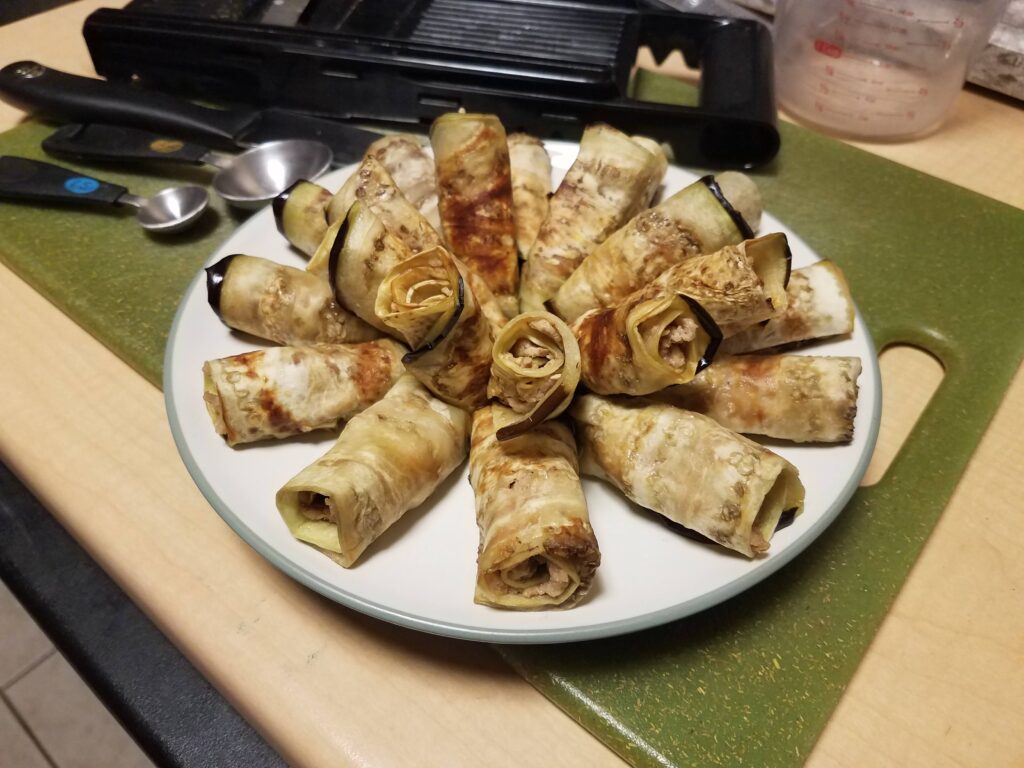
Ingredients:
- 2 small-medium eggplant (long and thin are preferable if you can find them)
- Salt
- Vegetable oil
- 2 cups walnuts
- 4 cloves garlic (you don’t really need more than that – I only used 5)
- 1 Tbs white wine vinegar
- 1 tsp blue fenugreek (sub ½ tsp regular fenugreek if you can’t find blue)
- 1 tsp ground coriander (I used half because coriander tastes like soap to me)
- ¼ tsp cayenne (I doubled that)
- ¼ c water
- Pomegranate seeds (unfortunately they were out of season, and I couldn’t find them anywhere)
Slice eggplants lengthwise, about ¼ inch thick – it’s easiest to do this step with a mandoline slicer in order to achieve consistency. (Do invest in a protective glove to wear when using your mandoline – trust me, it’s worth it!) Place slices on a paper towel-lined baking sheet and sprinkle salt over both sides. Wait approximately 30 minutes for the eggplant to give up its moisture, then pat dry.
While the eggplant is sitting, pulse walnuts in a food processor until they are a fine consistency. Transfer to a bowl and grate garlic into the mixture with a microplane. Add vinegar, fenugreek, coriander, cayenne, and water. Mix thoroughly into a paste, adding water as needed to achieve a hummus-like consistency.
Fry eggplant slices in a pan with just enough oil to ensure browning on each side (3-5 minutes over medium heat). Transfer to a cooling rack lined with paper towels. Once each piece is cool, spread a tablespoon of filling on each piece (photos and videos indicate a lot more than one tablespoon) and roll up. Garnish with pomegranate seeds, assuming they’re in season.
~
My original plan was to swing by a Georgian restaurant in Philly this weekend while I was out that way visiting family, but the snow brought me home early. Trying the genuine article will have to wait, but I will definitely be exploring more of this cuisine, [20] and will be making badrijani nigvzit again – even Christian unexpectedly enjoyed it (and requested more cayenne “next time.”)
Speaking of “next time,” this culinary and religious journey will continue, as promised, in Africa. But for now, can you share some expertise or perspective about Eastern Orthodox and/or Eastern European cuisine? I’d love to hear about it below.
Thanks for reading!
[1] https://www.achp.gov/preserve-america/community/bethlehem-pennsylvania
[2] https://thebethlehemgadfly.com/2019/09/04/bethlehem-moment-latinos-come-to-bethlehem/
[3] https://www.bbc.co.uk/religion/religions/christianity/subdivisions/easternorthodox_1.shtml
[4] https://en.wikipedia.org/wiki/East%E2%80%93West_Schism
[5] https://miakouppa.com/2025-great-lent-meal-plan/
[6] https://www.learnreligions.com/orthopraxy-vs-orthodoxy-95857
[7] https://en.wikipedia.org/wiki/Orthopraxy
[8] https://aleteia.org/2025/02/05/why-is-orthodox-easter-on-a-different-date-than-catholic-easter/
[9] https://theothertour.com/catholic-and-orthodox-church/
[10] https://www.crkvenikalendar.com/post/post-rules.php
[11] https://radicalmoderate.online/fast-food-part-1-catholicism-and-italy/
[12] https://search.brave.com/
[14] https://www.imdb.com/title/tt30443317/
[15] https://radicalmoderate.online/krampus-and-kipferln-german-traditions-at-christmas-part-1/
[16] https://www.tastingtable.com/1200844/cuisines-that-are-notably-vegan-friendly/
[17] https://en.wikipedia.org/wiki/Ecumenical_Patriarchate_of_Constantinople
[18] https://www.tastingtable.com/1200844/cuisines-that-are-notably-vegan-friendly/
0 Comments