The first in this eight(?)-part series on the interplay between religion and cuisine is kicking off just ahead of two concurrent religious periods of fasting. Blessed Lent and Ramadan Mubarak to those of you who observe.
This past fall I finally stopped procrastinating and looked (again) at the carbon footprint of cheese, something I had been meaning to do for some time. [1] It was something I didn’t want to know, but it was something I needed to know if I was going to keep declaring that I was a vegetarian in part to lower my carbon footprint. The bad news is that cheese has a higher carbon footprint per unit weight than most meat (except for beef, lamb/mutton, and farmed prawns). [2] To those who are so ready to point out that a serving of cheese (1.5 oz) is half the weight of a serving of meat (3 oz), I will say that you’ve never seen me eat cheese. (I’ll also point out that the ranking of those foods is similar when you look at carbon footprint per gram of protein, so at least I’m getting some good nutrition for my environmental impact. [3])
Displacement, Not Deprivation
Does this revelation/reminder mean that I’m going to stop eating cheese altogether? Absolutely not. Does it mean that I’m going to stop citing climate change as one of the reasons I don’t eat meat? Most likely. If reducing my carbon footprint were my only reason for being vegetarian, I’d do a better job if I gave up cow products entirely and kept eating poultry and seafood. But that’s not going to happen since I don’t particularly care for the taste of meat (or asking animals to die for me). As a result, I am trying to eat more vegan meals – in fact, one of my New Year’s resolutions was to cook one vegan meal every week (categorized under “physical health,” because that’s a good reason too). [4]
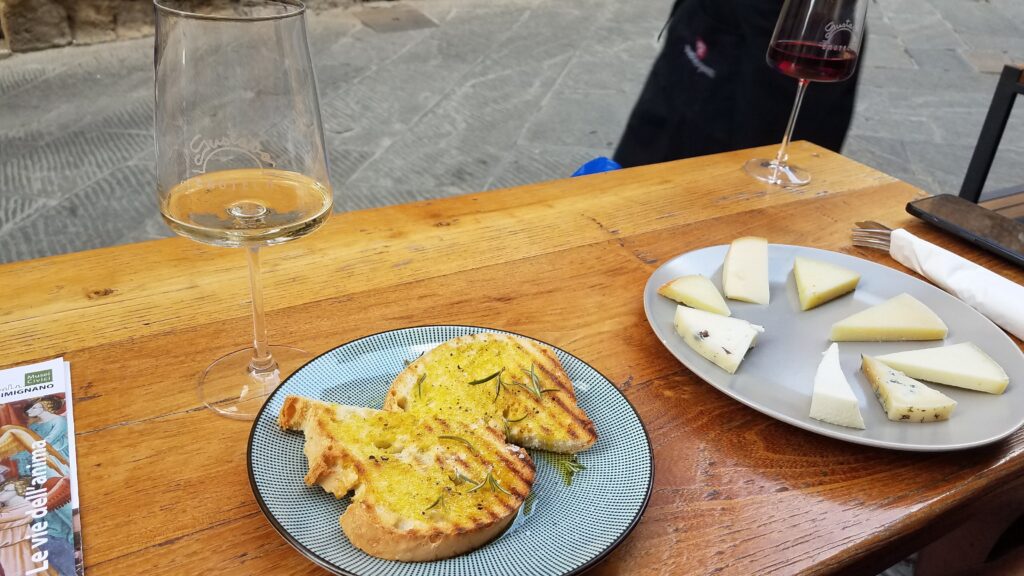
On the occasions when I have tried veganism in the past, my efforts have met with limited success. What I learned during my whole month of veganism four years ago [5] was that making dishes that were naturally vegan didn’t feel like deprivation. That lesson was similar to when I did the Whole30 Program [6] nine years ago. In that highly restrictive elimination diet, substitutions (e.g. almond flour instead of wheat flour) were not allowed because you would be more likely to think of genuine article, miss it, and cheat. As a result, the goal in that program was to cook dishes that met the requirements of the diet (in the spirit of the law, not just the letter of the law) and appreciate them on their own merits.
So now that I’m trying to reduce animal products in my meals, I simply try to cook more dishes that don’t include them in the first place, instead of trying to apologize for their absence. One of the easiest and most accessible cuisines for meeting that goal is Italian food. When Christian and I first went to Italy in 2022, my mind was blown by how delicious some of the very simple dishes were, particularly in Tuscany and points south. We came home, and I was a changed woman: for the first time in my life I was able to cook by feel, not by recipe. Sauteing fresh veggies in a pan with Italian herbs and mixing them with pasta became a weeknight staple – easy to adjust based on seasonal ingredients and easy enough to make vegan (if I could forgo the sprinkle of pecorino on top).
Fasting for Catholics
I assumed that the prevalence of naturally vegan dishes in Italian cuisine was in part due to the land and weather conditions (“Tomato Europe” being south of the Alps), [7] in part due to the necessity for affordable ingredients (we ate a lot of what was referred to as “peasant food”), [8] and in part due to the fact that the country has been strongly Catholic since the religion was legalized in 313 and adopted as the state religion of the Roman Empire in 380. [9] I am not now nor have I ever been Catholic, but I can pass. Between that and being a student of medieval history, I am aware that there are (or at least used to be) many fast days throughout the year, which put restrictions on consuming certain foods.
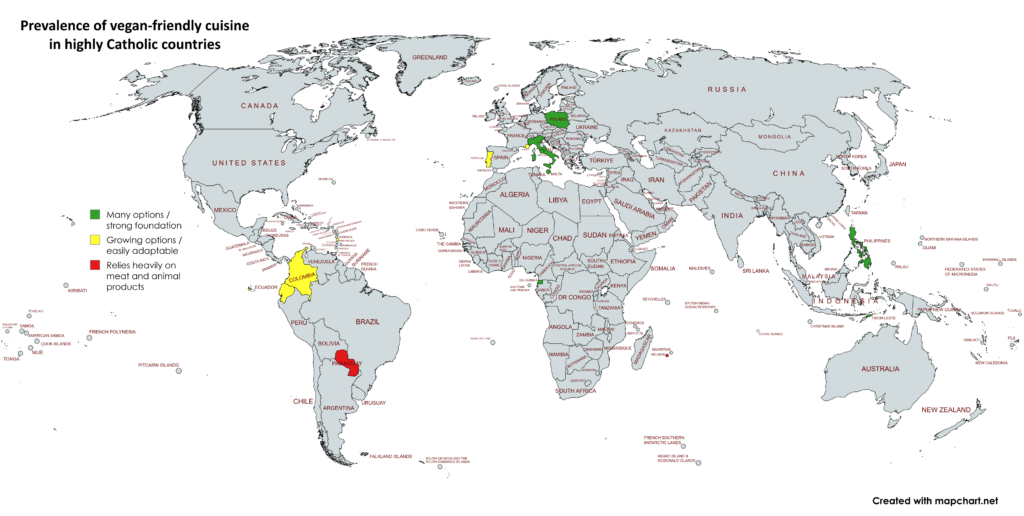
Data generation credit: [10]
Image generation credit: [11]
The most notable Catholic fast that remains on today’s liturgical calendar is Lent, representing the 40 days leading up to Easter. Common modern practice is refraining from eating meat on Fridays in Lent (fish and seafood are still fair game), but fasting used to be much more common and restrictive. For instance, fasting took place throughout the year on every Wednesday, Friday, and Saturday, on the eves of major feasts, and during three-day seasonal fasting periods, in addition to the big one (Lent). Fast days made up about half the year and prohibited all animal meats and fats (i.e. lard), eggs, and dairy products. [12] My research indicates that fish and seafood were always allowed, based on interpretation of scripture, [13] not because of the oft-retold urban legend of Portuguese fishermen lobbying Rome for economic reasons. [14]
The prohibition on eggs gives some context to something that happened during that first trip to Italy, when we learned during a pasta-making class that eggs laid during Lent were kept in storage until Easter. [15] Although the modern Catholic church does not prohibit eggs during Lent, it’s possible that certain traditions in certain regions during certain times of the year have been continued through multiple generations, especially if they don’t represent an undue hardship. Again, though, Italy’s climate is better suited to support plant-based cuisine than other parts of Europe are. There are historic records of English cooks exercising some outside-the-box thinking when it came to what counted as “fish” [16] and German bishops selling dispensations for eating dairy (my people understood the need for cow products!) [17]
Every major world religion has some form of restrictions on food in one way or another, and my guess is that those restrictions evolve (slightly) when different climates and geographic features dictate different ingredient availability. I’d be happy sticking with the elegant simplicity of the cucina povera we ate while driving around the Italian countryside, but this question has kindled a curiosity about what other world religions and climates lend themselves to vegan cooking. We’ll be doing a survey of them in the weeks to come (overlapping with Lent, as it happens), but for now let’s start off with one of the most satisfying vegan Italian meals I’ve made recently…
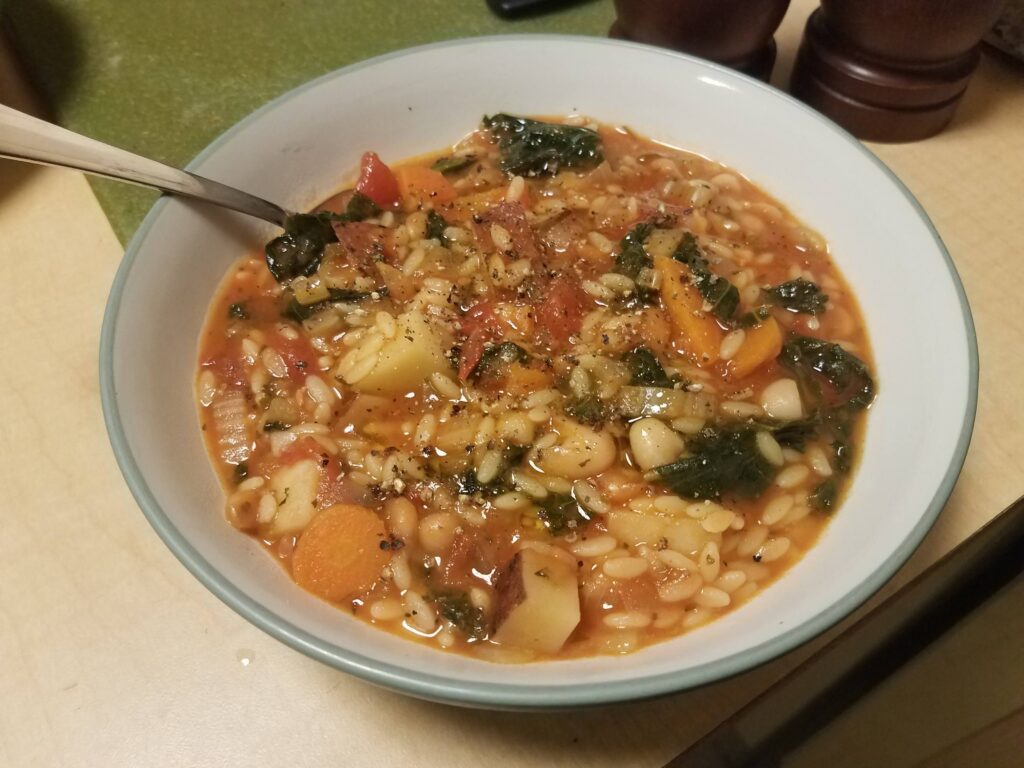
Recipe: Minestrone
I’ve cooked a lot of minestrone during my life. It’s an easy go-to recipe that is traditionally vegan and comforting in the winter, when most of its ingredients are either in season or holding up in storage (particularly if you use canned tomatoes and beans, as I did). I’ve never met a minestrone I didn’t like, but this recipe, adapted from a cookbook my Mother-in-Law recently gave me, [18] may have resulted in the tastiest version that’s ever come out of my kitchen. I had enough remaining ingredients to whip up another batch the next day and freeze it.
Ingredients:
- 2(ish) Tbs olive oil
- 1 c diced onion
- 1 c diced celery
- 1 c diced carrots
- “1 Tbs” minced garlic (for me, about ½ bulb)
- 1 c diced potatoes
- 1 tsp dried oregano
- 1 tsp dried thyme
- 1 tsp pepper
- 4 c vegetable stock [19]
- 28 oz can crushed tomatoes (fresh is an option if they’re in season)
- 2 bay leaves
- “2 tsp” salt (I think I used about 2 Tbs)
- 1 Tbs dried parsley
- 1 Tbs dried basil
- 16 oz can cannellini beans
- ½ bunch (about 2 packed cups) chopped kale (it’s in season now!)
- 1 c orzo
Heat pot over medium heat; once pot is hot add olive oil; once olive oil is hot, add onion, celery, carrots, garlic, potatoes, oregano, thyme, and pepper; stir for 10-15 minutes or until onion is translucent.
Add veggie broth, tomatoes, and bay leaves; bring to boil, lower heat, and simmer for 15-20 minutes.
Add salt, parsley, basil, beans, kale, and orzo; simmer for 10-12 minutes.
Season to taste; drizzle a spoonful of olive oil on top when serving.
However, if you’re adhering to a stricter fast, as some religions do, that olive oil is off the table. And that’s where we’ll pick up next week.
Thanks for reading!
[2] https://ourworldindata.org/environmental-impacts-of-food
[3] https://ourworldindata.org/less-meat-or-sustainable-meat
[4] https://radicalmoderate.online/surviving-2026/
[5] https://radicalmoderate.online/vegan-january-part-1/
[7] https://radicalmoderate.online/krampus-and-kipferln-german-traditions-at-christmas-part-2/
[8] https://vegnews.com/recipes-italy-plant-based
[9] https://en.wikipedia.org/wiki/History_of_the_Catholic_Church
[10] https://search.brave.com/
[12] https://taylormarshall.com/2018/02/medieval-lent-harder-islamic-ramadan.html
[15] https://radicalmoderate.online/tuscan-agriturismo/
[16] https://www.atlasobscura.com/articles/mock-medieval-foods
[17] https://taylormarshall.com/2018/02/medieval-lent-harder-islamic-ramadan.html
[18] https://www.goodreads.com/book/show/223362279-vegana-italiana
[19] https://radicalmoderate.online/plastic-free-july-corona-edition-part-3/
0 Comments